
Can tougher Bitcoin Regulation, rising ETF inflows and a shrinking supply all coexist in a market still chasing record highs?
How is Bitcoin trading today?
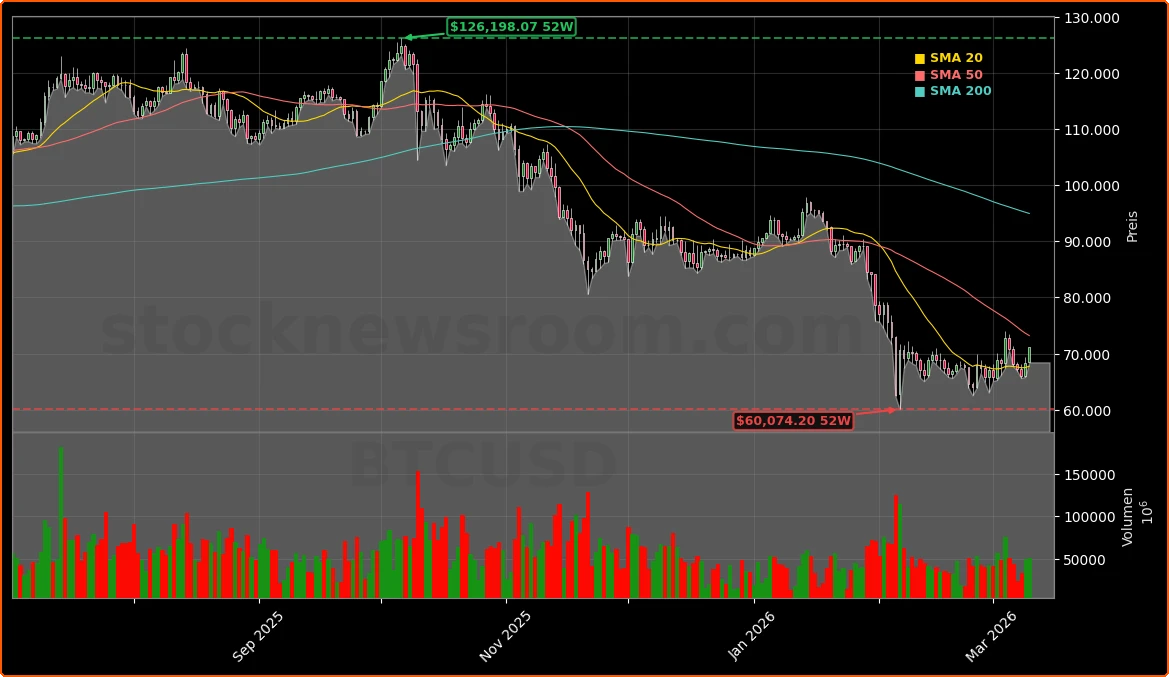
Bitcoin is changing hands near $71,085, compared with a previous close around $68,401, putting the token up about 3.9% on the session. After struggling below $70,000 in recent days, the move back above this psychological level is drawing renewed attention on Wall Street as traders debate whether the March backdrop can sustain a broader risk-on recovery. While volatility remains elevated relative to the S&P 500 and NASDAQ benchmarks, the latest bounce has been supported by a notable shift in ETF flows.
U.S. spot Bitcoin ETFs recorded roughly $167 million in net inflows on Monday after two sessions of sizeable redemptions totaling around $577 million. That reversal suggests that institutional and advisory accounts are again using the exchange-traded wrapper to gain exposure rather than selling into strength. For equity investors more familiar with mega caps like NVIDIA, Tesla or Apple, these ETFs have become the primary gateway into the crypto asset class, linking the fortunes of Bitcoin more tightly to traditional brokerage and retirement platforms.
What changes with new Bitcoin Regulation?
The most immediate shift for U.S. investors in 2026 comes from tax-focused Bitcoin Regulation. The IRS now treats digital assets in a manner broadly similar to equities, and the introduction of Form 1099-DA for digital assets formalizes that stance. Once trading or income thresholds are reached, platforms must report gains and losses both to the investor and directly to the IRS, reducing the scope for under-reporting and making documentation of every crypto transaction far more important.
This framework affects not only straightforward spot purchases of Bitcoin but also more complex activities such as staking rewards, airdrops, splits and forks, which can create taxable income even without a sale. Advisors are urging clients to run scenarios for major life or income changes—such as stock-based compensation, bonuses or heavy crypto trading—because estimated tax payments and withholding may need to be adjusted during the year. With the digital-asset market now estimated around $2 trillion, regulators have a strong incentive to enforce compliance, and Bitcoin Regulation is expected to tighten again with further rule updates slated for 2026.
Are ETFs beating platforms like Coinbase?
One theme emerging among U.S. strategists is a preference for direct Bitcoin exposure or spot ETFs over listed exchanges. Rather than treating exchange stocks as a proxy for crypto prices, some portfolio managers argue that simply owning the underlying asset via regulated vehicles is a “cleaner” trade, avoiding platform-competition risk. This view has become more prominent as ETF liquidity has grown and fee wars among issuers have pressured costs.
For diversified portfolios, the question is where Bitcoin fits relative to other macro hedges. Recent commentary has highlighted a barbell approach that spreads risk across energy equities, precious metals and the dollar, with crypto as a satellite allocation. Gold has been threatening fresh highs, while Bitcoin recently slid below $86,000 and failed to hold the $94,000 area earlier in the year, reminding investors that its drawdowns can be sharp even when the long-term thesis remains intact.
How scarce are 20 million mined Bitcoin?
On the supply side, the network has crossed a major psychological threshold: 20 million Bitcoin have now been mined since the Genesis block in 2009. That means only about 1 million BTC remain to be created over the next century until the hard cap of 21 million is reached, with the final coin expected around the year 2140. Roughly 6,267 days were needed to reach this 20 million milestone, and the issuance schedule continues to slow via four-year halving events.
At present, miners are producing around 450 new coins per day, down sharply after the 2024 halving cut block rewards again. Over time, miner revenue will rely increasingly on transaction fees rather than new issuance, reinforcing the narrative of programmatic scarcity that differentiates Bitcoin from fiat currencies. For governments and corporations examining reserve strategies—similar to how some firms have amassed hundreds of thousands of coins—the realization that only one million BTC remain to be mined could be a catalyst for renewed accumulation.
What does Bitcoin Regulation mean for global holders?
Bitcoin Regulation is not solely a U.S. story. Sovereign investors are also adapting to the evolving landscape. Bhutan, for example, has accumulated roughly 13,000 BTC since launching state-backed mining operations in 2019, powered largely by hydroelectric energy. The country has periodically sold tranches of $5–10 million, and current holdings of around 5,400 BTC would place it among the larger nation-state holders, far behind the United States, which controls more than 328,000 seized or held coins.
The 2024 halving, coupled with higher energy and hardware costs, has made mining less efficient, pushing some smaller operators out and encouraging states and institutions with cheap power to scale up. For U.S. investors, this underscores that Bitcoin is increasingly intertwined with energy policy, geopolitics and regulatory oversight. As more jurisdictions codify reporting standards and clarify how digital assets fit within securities or commodities law, Bitcoin Regulation will shape everything from ETF structures on NYSE and NASDAQ to corporate treasury decisions across the S&P 500.
Conclusion
For now, Bitcoin sits above $71,000 with ETF inflows back in positive territory, a tightening tax net and only one million coins left to be mined. The balance between regulation, institutional adoption and algorithmic scarcity will determine whether it evolves into a mainstream portfolio component or remains a volatile macro trading instrument.
Further Reading
- Bitcoin price, market cap and chart (CoinGecko)
- IRS digital assets frequently asked questions (IRS)
- Spot Bitcoin ETF flow dashboard (SoSoValue)
- Bitcoin bei Yahoo Finance (Yahoo Finance)