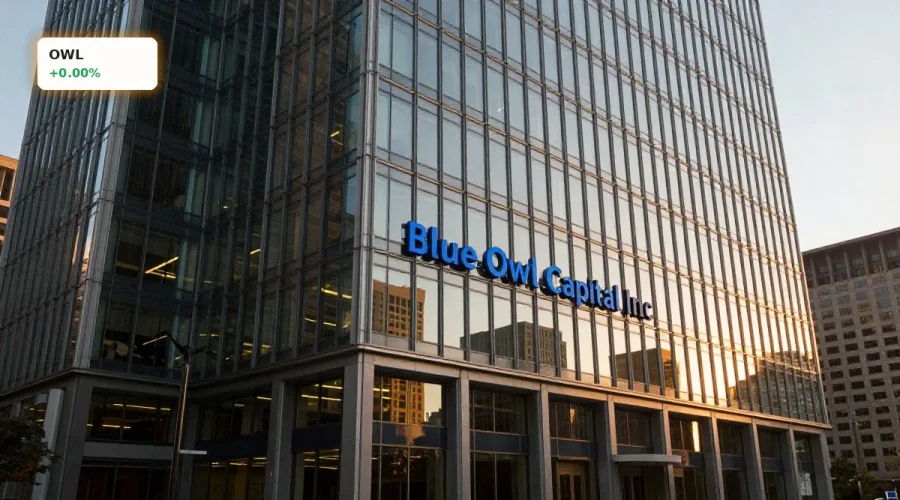
Is Blue Owl Private Credit becoming a harbinger for the booming private credit market – or will the damage be contained?
Blue Owl Capital Under Liquidity Stress
Blue Owl Capital Inc. has halted redemption requests for a smaller private credit fund and has permanently closed its doors. Investors can no longer withdraw their funds continuously while management sells assets to gradually return capital. The trigger was a wave of redemption requests for a product that is actually designed for long-term, illiquid credit commitments.
To create liquidity, Blue Owl has sold a loan portfolio of approximately $1.4B. Buyers included large North American pension funds as well as its own insurance arm. According to market reports, the sale price was about 99.7% of par value – an indication that the credit quality is fundamentally intact, with the problem primarily lying in the maturity transformation between long-term Blue Owl Private Credit assets and the short-term redemption rights of investors.
At the same time, Blue Owl’s stock has suffered significantly in recent months. From a high of over $25, the price temporarily fell to around $10.50. The market is pricing in not only the fund closure but also reputational damage and a potential weakening of the manager’s fundraising power.
Blue Owl Private Credit as a Warning Signal?
The turbulence at Blue Owl Private Credit is seen by many market participants as a “canary in the coal mine” for the entire private credit sector. The industry has grown rapidly over the past decade and has increasingly replaced traditional bank loans, especially for software and service companies. Blue Owl is heavily engaged in this segment; a significant portion of the recently sold loans pertains to software financing.
The current stress highlights the core risk: Private credit funds promise attractive returns and seemingly predictable distributions, but can hardly react to sudden liquidity needs without selling loans at a discount in the secondary market. If a downturn occurs in an industry – currently in the software and AI space, for example – it can amplify borrower losses, default fears, and redemption needs into a kind of doom loop.
At the same time, Blue Owl is facing headwinds in new transactions. Recently, it struggled to syndicate a planned $4B financing for an AI data center for CoreWeave, partly due to the weak creditworthiness of the borrower. This raises doubts about whether the growth story in direct lending to technology companies can continue seamlessly.
How Hard Will the Shock Hit Blue Owl Capital?
Despite the massive stock decline, the core businesses of Blue Owl Capital Inc. continue to report rising revenues. In the fourth quarter of 2025, both fee-related revenues and distributable earnings rose by more than 20% year-over-year, with assets under management reaching approximately $307B. Management emphasizes that defaults and losses in the loan portfolio have so far been low and that the portfolios are robustly structured, particularly in the software sector with moderate loan-to-value ratios and solid EBITDA growth.
At the same time, pressure from the capital markets is increasing. A class-action lawsuit criticizes allegedly insufficient transparency regarding liquidity risks and redemption restrictions. Additionally, the company has registered a stock sale program of over $615M in connection with an ESOP structure – another factor putting pressure on shareholder sentiment.
Moreover, liquidity adjustments are taking place at OBDC II, another credit vehicle for private investors that has permanently tightened its redemption rules. Critics see this as a gradual rewriting of Blue Owl Private Credit’s original liquidity promise; supporters argue that such restrictions are necessary to prevent future “run-like” situations.
What Does Blue Owl Private Credit Mean for Investors?
The valuation of Blue Owl Capital Inc. has fallen so sharply in a short time that even previously skeptical market observers are now calling it an overreaction. Some professional investors interpret the sell-off as an opportunity, as the recent loan sales near par value indicate structural rather than fundamental issues. Others warn that rising defaults in the broader private credit market may be just around the corner – particularly in heavily leveraged software and AI business models.
For retail investors, the lesson is clear: Products in the realm of Blue Owl Private Credit and similar direct lending vehicles are only semi-liquid. They do not offer daily access like a stock or ETF. Those investing here must explicitly account for maturity risks and potential redemption restrictions and diversify portfolios accordingly.
Bottom Line
The frozen funds and forced sales in the Blue Owl Private Credit segment dispel the image of a seemingly always available source of returns and expose the structural liquidity risks in the private credit market. For investors, this means understanding the high volatility of the Blue Owl stock as a reflection of this uncertainty and scrutinizing commitments in illiquid credit vehicles more rigorously based on maturity and risk budget. It will be crucial whether Blue Owl can regain trust in its private credit platform and structure future products so that return promises and liquidity profiles align better.
Related Sources
- Blue Owl Capital Inc. (OWL) on Yahoo Finance (Yahoo Finance)
- Alternative Managers’ Woes Deepen Amid Software Slump (Barrons)
- Blue Owl Capital: Retail Panics, Smart Money Buys (Seeking Alpha)
- Illiquid loans, investor demands: Blue Owl’s software lending triggers another quake in private credit (CNBC)