
Are BMW Earnings strong enough to justify the dividend boost while profit momentum keeps sliding into 2026?
How did BMW Earnings develop in 2025?
BMW Jahreszahlen 2025 und Ausblick 2026 reveal a mixed picture. Net income slipped for a third consecutive year, down about 3% to roughly EUR 7.45 billion. Operating profit (EBIT) fell more sharply, declining around 11.5% to EUR 10.19 billion, leaving earnings at their weakest level since the early phase of the COVID-19 pandemic. Revenue dropped 6.3% to about EUR 133.5 billion, reflecting softer pricing and volume pressure in key markets.
Despite these setbacks, BMW’s performance notably outpaced its German rivals. Both Mercedes-Benz and Volkswagen saw profits almost halve in 2025, while BMW’s decline was comparatively modest. That resilience stems partly from the group’s diversified powertrain strategy: instead of going all-in on pure battery-electric vehicles, BMW continues to sell a mix of internal combustion, hybrid, and EV models from flexible assembly lines. Management argues this technology-open approach reduces execution risk as the global shift to electric mobility evolves unevenly across regions.
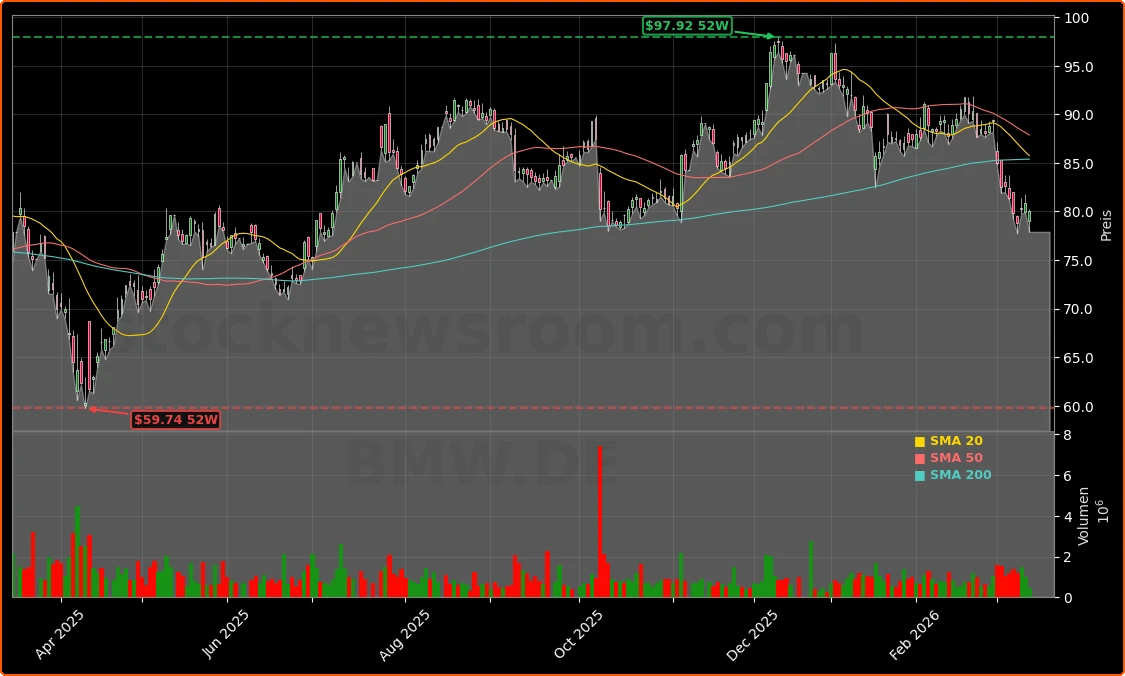
From a stock perspective, the current BMW.DE share price around EUR 80 is well below its 52‑week high near EUR 98, and the stock is down roughly 13% year-to-date on Xetra. The latest BMW Earnings therefore arrive at a time when sentiment toward European autos is fragile, but relative earnings strength could help limit further downside versus peers.
Why are margins under pressure at BMW?
The core automotive EBIT margin fell to 5.3% in 2025, the lowest since 2020 and notably below BMW’s own long-term goal of 8–10%. While the result landed within the guided 5–7% range, it underscores how external shocks are eating into profitability. The group highlights three main factors: intense price competition in China, higher import tariffs in key markets, and less favorable currency and raw-material trends.
China has shifted from growth engine to drag. Unit sales of BMW and Mini vehicles in the country tumbled by about 12.5% last year as more than 100 brands fight for share in the world’s largest auto market. Aggressive discounting by local EV makers – notably players such as Tesla and strong Chinese domestic brands – is forcing incumbents to sacrifice margin to protect volumes. Combined with a weaker mix, this dynamic significantly weighed on BMW Earnings in the second half of 2025.
Tariffs are another structural headwind. Elevated U.S. and EU import duties on vehicles, steel and aluminum are estimated to cut BMW’s automotive margin by roughly 1.5 percentage points for 2025 and around 1.25 points for 2026. The company partly offsets this via its large Spartanburg plant in South Carolina, which produced around 413,000 vehicles last year, more than half of which were sold in the U.S. market. Even so, the group still imports a substantial share of its U.S. lineup and is exposed to 10% EU tariffs on U.S.-built exports back into Europe.
What do BMW Earnings say about the 2026 outlook?
Guidance for 2026 is deliberately conservative. Management sees the automotive EBIT margin in a 4–6% range, below consensus expectations that had pointed to a mild recovery to around 5.7%. The company also anticipates that profit before tax will fall moderately despite broadly stable deliveries, citing ongoing tariff burdens, FX volatility and higher input costs.
For Wall Street investors, that suggests limited near-term earnings momentum and caps the scope for a major re-rating. At the same time, BMW’s commentary on global demand is not uniformly negative. The group expects relatively stable conditions in Europe and the U.S., with most of the downside risk concentrated in China. CEO Oliver Zipse, speaking to financial media, emphasized that recent geopolitical shocks – including the war in the Middle East – have so far not materially disrupted BMW’s supply chains after the company toughened its logistics during the pandemic and semiconductor shortage.
The strategic priority for the mid- to long term remains the “Neue Klasse” EV platform. The first model, the iX3, has just reached dealers and is off to a strong start, prompting BMW to add another production shift in January. The next key launch is a new i3 – an electric counterpart to the 3‑Series – aimed squarely at BMW’s core volume segment and at global competitors such as NVIDIA-powered software-defined vehicles from tech-heavy automakers and premium EVs from Apple’s broader ecosystem partners, should those ever reach scale.
How attractive is BMW for income-focused investors?
One of the most surprising elements of the latest BMW Earnings is the dividend move. Despite softer profits, the company plans to raise its payout by EUR 0.10 to EUR 4.40 per common share. At the current BMW.DE price around EUR 80, that implies a forward dividend yield north of 5%, a level that stands out versus many S&P 500 names and even some high-yield U.S. industrials.
The biggest beneficiaries are the Quandt family heirs, Stefan Quandt and Susanne Klatten, but international shareholders also gain from BMW’s confidence in its balance sheet and cash generation. Management has so far avoided broad-based layoffs, unlike other German automakers, preferring to lean on production flexibility and cost discipline rather than aggressive restructuring. For U.S. investors hunting for income and relative stability outside the mega‑cap tech space, the combination of a high yield and still-solid free cash flow is a key part of the investment case.
Analyst coverage from major Wall Street banks will now focus on whether the conservative margin guidance proves beatable if pricing in China stabilizes and tariffs ease. While no major rating changes have been announced in the immediate wake of the report, firms such as Goldman Sachs, Morgan Stanley and Citigroup are likely to recalibrate their models around the 4–6% automotive margin band and test how sensitive their price targets are to different China and tariff scenarios.
We have strategically positioned ourselves correctly in recent years. In a challenging environment, we don’t need to change course, but can consistently execute our strategy.
— Oliver Zipse, CEO of BMW
Conclusion
In summary, BMW Earnings confirm the group’s relative resilience in a difficult European auto landscape, but they also highlight persistent structural challenges from China and global trade policy. For long-term investors, BMW remains a high-yield, value-oriented exposure to premium autos rather than a pure EV growth story. The next set of results and updates on the Neue Klasse rollout will show whether the company can turn cautious guidance into upside surprises.
Further Reading
- BMW raises dividend despite lower 2025 profit and cautious 2026 outlook (Bloomberg)
- BMW full-year 2025 results: profit down, dividend up, guidance for 2026 (Reuters)
- BMW earnings press conference and 2025 annual report (BMW Group)
- BMW Jahreszahlen 2025 und Ausblick 2026 bei Yahoo Finance (Yahoo Finance)