
Are recurring Boeing 737 MAX issues turning a long-awaited recovery story into a renewed test of investor patience and confidence?
How are Boeing 737 MAX issues hitting the stock?
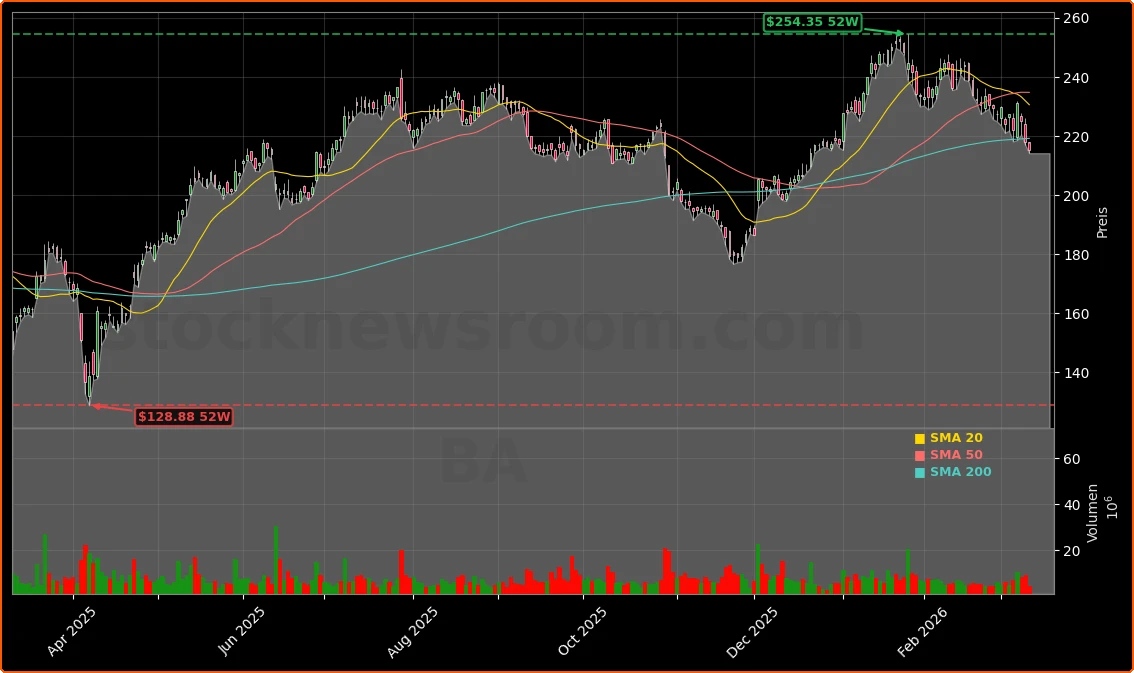
Shares of The Boeing Company (BA) slipped about 1.2% in Wednesday trading to around $215, extending a pullback after a sharper 3%+ drop earlier in the week. The move keeps the stock well below its 52‑week high near $254 and above its low around $129, underscoring how sensitive sentiment remains to any headlines around Boeing 737 MAX issues. The latest pressure came after management disclosed a wiring problem on some 737 MAX jets that will temporarily slow deliveries, though Boeing emphasized that the defect does not pose an immediate safety risk.
In Europe, broader equity indices were mostly in the red, with large industrials and banks underperforming, adding to the risk‑off backdrop. For U.S. investors, BA’s slide stands in contrast to mega‑cap growth names like NVIDIA and Apple, which continue to dominate S&P 500 returns and offer an alternative for capital seeking lower perceived operational risk. Boeing’s beta to market sentiment and event risk remains elevated, making position sizing and time horizon crucial for portfolio construction.
Are deliveries offsetting quality concerns at Boeing?
Despite the wiring setback, Boeing’s February commercial deliveries reportedly reached their best level since 2017, outpacing rival Airbus and marking a clear improvement versus the pandemic trough years. That acceleration is critical for cash‑flow generation, given Boeing’s heavy debt load and the lingering financial impact from the original 737 MAX groundings and COVID‑era demand shock. Management has so far not reduced its full‑year 2026 delivery outlook, signaling confidence that the wiring rework can be contained to the near term.
However, additional Boeing 737 MAX issues continue to cloud that narrative. Recent reports highlighted potential scratches or surface defects on 737 MAX wings that may require inspection and remediation, raising the risk of further bottlenecks in an already stretched supply chain. While these are not yet framed as safety‑critical, airlines and regulators are acutely sensitive after past MAX accidents. Any perception that Boeing has not fully stabilized its production system could lead to more conservative fleet plans at carriers and additional oversight from the Federal Aviation Administration.
At the same time, Boeing’s defense and space franchise provides some diversification. The company recently secured a roughly $289 million contract to supply Israel with up to 5,000 Small Diameter Bombs, reinforcing its role as a key U.S. defense contractor. Though modest versus its commercial backlog, such deals help steady revenues and may support sentiment among investors who also follow defense names like Tesla’s rival EV suppliers and traditional contractors in the S&P 500.
What do Boeing 737 MAX issues mean for demand?
Airline demand for new aircraft has recovered significantly since the pandemic, supported by robust travel demand in North America and rising tourism flows into Asia. Carriers such as Alaska Airlines are expanding their strategic footprint in Asia following recent acquisitions and leadership changes, signaling continued long‑term confidence in regional growth. For Boeing, that backdrop is supportive, but Boeing 737 MAX issues add a layer of uncertainty about how much of that demand it can reliably capture versus Airbus.
Some carriers may choose to delay deliveries or renegotiate schedules if they perceive elevated operational or certification risk. Management has acknowledged that the newly identified wiring flaw will push some deliveries from the first half into later in the year, though it still expects to meet year‑end targets. There is also a macro overlay: if energy prices remain volatile, airlines could get more cautious on capital spending, reducing the urgency to take near‑term deliveries of fuel‑efficient jets.
From an S&P 500 perspective, Boeing’s stop‑and‑go recovery contrasts with the cleaner growth trajectories of technology leaders like Apple and NVIDIA, which face very different execution risks. That divergence may limit BA’s weighting in some growth‑oriented portfolios, while value and cyclical investors may view the current drawdown as an opportunity if they believe production headwinds will eventually normalize.
How are analysts viewing Boeing now?
Analyst sentiment on Boeing remains mixed but generally constructive over a multiyear horizon. Major Wall Street firms such as Morgan Stanley, Goldman Sachs and Citigroup have in recent months emphasized that the path back to normalized free cash flow depends heavily on stabilizing 737 MAX production, improving quality controls and avoiding fresh regulatory shocks. Price targets across the Street still embed a recovery story, but several firms have highlighted that repeated Boeing 737 MAX issues are capping valuation multiples versus historical levels and versus industrial peers.
Investors Business Daily recently pointed out that Boeing is trading near potential technical buy zones, even as the stock reacts negatively to each new production headline. TradingKey flagged the recent 3.26% decline as a sign of how quickly the market punishes perceived quality lapses, even when management insists that safety is not compromised and full‑year guidance remains intact. For active traders, this setup can create short‑term opportunities around news‑driven swings, while long‑term investors need to focus on whether Boeing can deliver consistent earnings per share again after several loss‑making years.
Relative to high‑profile growth names such as NVIDIA, Boeing’s story is less about secular demand expansion and more about operational execution and balance sheet repair. That makes any new Boeing 737 MAX issues disproportionately important for the equity narrative, as they directly impact deliveries, cash collections and ultimately leverage metrics.
Conclusion
In conclusion, Boeing’s latest wiring and wing‑surface setbacks underline how fragile confidence remains in the 737 MAX platform, but they do not yet derail the broader recovery in deliveries and cash flow. For investors, the stock stays a high‑beta, execution‑heavy play where Boeing 737 MAX issues can drive outsized volatility relative to the S&P 500. The next few quarters of production data, regulatory interactions and airline order activity will be critical in determining whether BA can re‑rate higher as a repaired aerospace champion or remains a turnaround story that trails more predictable Wall Street favorites.
Further Reading
- The Boeing Company (BA) Quote on Yahoo Finance (Yahoo Finance)
- Boeing Deliveries Outpace Rival. Shares Dip On 737 MAX Wiring Issue. (Investors Business Daily)
- Boeing Logs Best February Deliveries Since 2017. There’s One Problem. (Barron’s)
- Boeing Co Stock (BA) Closed Down by 3.26% on Mar 10 (TradingKey)