Are Broadcom AI Chips quietly becoming the hyperscalers’ secret weapon in the race to dominate next‑gen data centers?

Is Broadcom Inc. becoming an AI cycle winner?
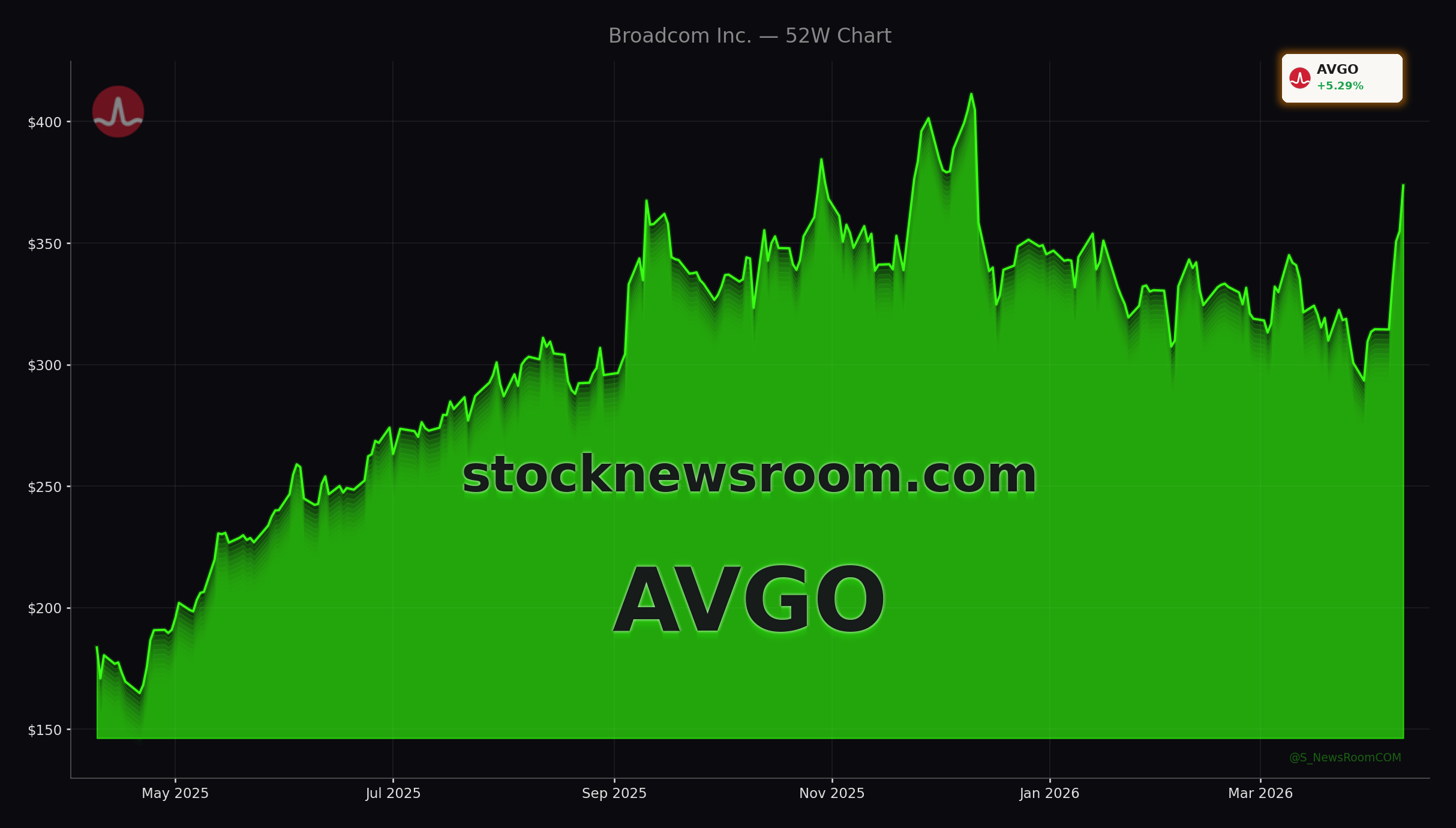
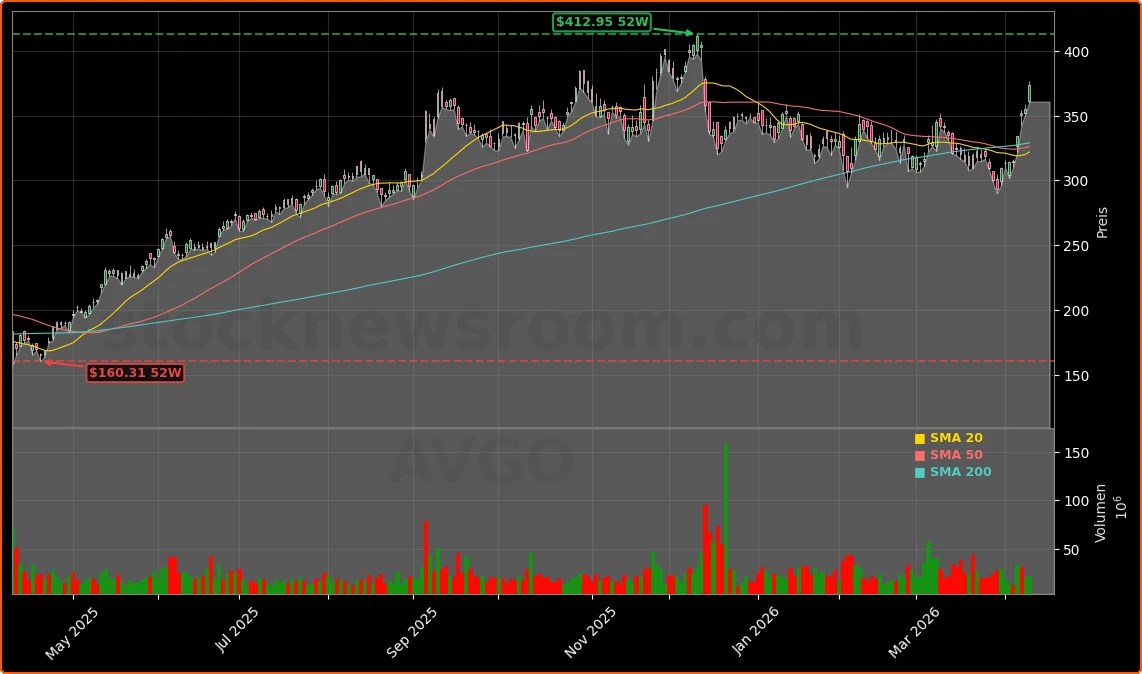
Chipmakers helped lift the broader market on Friday, with Broadcom Inc. up more than 5% alongside gains in ARM, AMD and other semiconductor names. AVGO closed at $373.86 versus a prior close of $355.79, extending a year-to-date performance that has outpaced many Computer and Technology sector peers. While the stock is not at a fresh 52-week high, the renewed momentum reflects rising confidence that Broadcom AI Chips tied to hyperscaler spending can drive multi‑year revenue expansion.
Unlike GPU specialists such as NVIDIA, Broadcom focuses on application‑specific integrated circuits (ASICs) and custom accelerators built hand‑in‑hand with the largest cloud and AI platforms. That specialization has turned AI data center demand into a material growth driver on top of Broadcom’s legacy businesses in networking, storage and infrastructure software, which continue to throw off substantial free cash flow regardless of AI cycles.
How do Broadcom AI Chips fit into hyperscaler strategies?
The core of the bullish thesis is that Broadcom AI Chips sit directly inside the capex budgets of the world’s biggest hyperscalers. Broadcom has been a key design and manufacturing partner for Google’s Tensor Processing Unit (TPU) program for years, supplying custom accelerators that power training and inference across Alphabet’s AI models and Google Cloud. Recent disclosures show Anthropic will tap 3.5 gigawatts of Google’s Broadcom-built TPUs, highlighting just how large the underlying infrastructure footprint could become.
At the same time, Broadcom is reportedly co‑developing dedicated accelerators for OpenAI, often cited as the “Titan 1” custom chip project, which could add billions in incremental revenue as it ramps toward 2027. Meta and other hyperscalers are also moving from pure GPU reliance toward diversified “XPU” strategies that mix GPUs with tailor‑made silicon optimized for specific AI workloads. In this architecture, Broadcom AI Chips can offer better total cost of ownership than general‑purpose GPUs in certain applications, especially at hyperscale training and high‑volume inference.
That demand is already visible in Broadcom’s numbers. In fiscal Q1 2026 (ended Feb. 1), management reported about $8.4 billion in revenue from its custom AI chip division, implying an annual run rate near $34 billion. Company guidance points to more than $100 billion in annual sales from custom AI chips alone by the end of 2027, a near‑tripling from today’s trajectory if execution stays on track.
Where does Broadcom stand versus Nvidia and AMD?
For US investors used to framing AI purely as a NVIDIA versus AMD story, Broadcom’s position can look underappreciated. Nvidia dominates general‑purpose GPUs, while AMD is rapidly scaling its own AI accelerators and just won a major data center GPU deal with Meta. Broadcom is “the new kid on the block” in AI compute units, but it competes in a different lane: it does not sell off‑the‑shelf chips to the mass market, it sells co‑designed systems to a handful of deep‑pocketed customers.
This model has trade‑offs. Broadcom AI Chips are less flexible than GPUs but can be tuned to specific models and data flows, yielding lower power per token, tighter latency guarantees and better economics at scale. Strategically, it also embeds Broadcom inside its customers’ long‑term roadmaps, making it harder to switch vendors once a full stack – from silicon to networking – has been architected.
Crucially, Broadcom layers this AI exposure onto a large base of switch silicon, optical interconnects and enterprise software. That diversification, combined with strong free cash flow, is one reason some investors view AVGO as a “platform compounder” rather than a pure speculative AI bet, similar in spirit to Apple in consumer hardware and services or to data‑center‑heavy cloud providers.
What are analysts saying about Broadcom AI Chips?
Wall Street remains broadly positive on AVGO even as some voices call for more caution after the recent rally. A recent note highlighted that the average analyst price target implies roughly 30% upside, with one survey pointing to a mean target near $467 per share and a consensus rating in the Buy range. Zacks assigns Broadcom a Rank #1 (Strong Buy), citing upward earnings revisions and outperformance versus the broader tech sector.
Not every firm is all‑in. Seaport Research downgraded Broadcom to Neutral from Buy, arguing that the company is now running into similar industry constraints as Nvidia, including supply bottlenecks and an increasing need to provide customer financing for massive AI deployments. In Seaport’s view, much of the good news from Google TPU contracts and Anthropic partnerships is already reflected in expectations, limiting near‑term upside.
Still, other research desks emphasize Broadcom’s cash‑generation profile. An analysis that grouped Broadcom with Verizon and Apple underscored that all three are “cash‑generating machines,” using robust free cash flow to fund dividends, buybacks and debt reduction. For income‑oriented investors inside and outside the S&P 500, that combination of AI growth and capital returns is a key part of the AVGO story.
How are institutions positioning around Broadcom Inc.?
Hedge fund interest has accelerated as the AI build‑out moves from hype to deployment. Millennium Management, run by billionaire Israel Englander, has rebuilt a multi‑million‑share stake in Broadcom Inc. after heavily trimming in prior years, reflecting renewed conviction in the AI pipeline. Multiple elite funds are closely tracking the Google TPU ramp, Meta’s custom accelerators, and OpenAI’s Titan chips, viewing Broadcom as a central enabler of the hyperscaler pivot away from single‑vendor GPU dependence.
Structured products are also emerging around AVGO. The Toronto‑Dominion Bank recently issued auto‑callable market‑linked securities tied to Broadcom stock, providing yield‑seeking investors with contingent coupons in exchange for downside risk to the underlying share price. For retail investors, this is a reminder that AVGO has become a mainstream underlying for both equity and derivatives strategies as its market cap has swelled.
Related Coverage
For a deeper dive into how Google and Anthropic are scaling their TPU deployments with Broadcom, read “Broadcom TPU partnership +3% Surge as Google, Anthropic Lock In”, which explores whether these alliances can cement Broadcom’s edge in the AI chip race. To understand how broader AI sentiment can swing, including downside risks for cloud and SaaS names, see “Cloudflare AI Competition: -12.8% Crash Tests AI Hype”, which looks at how competitive pressure and valuation resets are hitting other corners of the AI ecosystem.
Broadcom AI Chips now sit at the center of hyperscaler spending plans, giving Broadcom Inc. a structurally advantaged role in the next wave of data center build‑outs. For US investors, the mix of custom silicon growth, networking leadership and hefty free cash flow makes AVGO a rare way to play AI without going all‑in on GPUs. The next few quarters of execution on Google, Anthropic and OpenAI programs will show whether today’s 5% surge is just another rally or the start of a longer re‑rating for this AI infrastructure powerhouse.