Can the bold Broadcom AI Forecast of $100 billion in 2027 chip sales really materialize, or are investors chasing a mirage?

How big is the Broadcom AI Forecast for 2027?
The new Broadcom AI Forecast centers on one eye‑catching number: management says it has “line of sight” to generating over $100 billion in AI chip revenue in fiscal 2027 alone. That figure excludes traditional products and focuses strictly on custom accelerators (XPUs) and AI networking silicon deployed in hyperscale data centers.
For context, Broadcom’s most recent quarter delivered $19.3 billion in revenue, up 29% year over year, with AI-related revenue more than doubling. Management guides for fiscal Q2 revenue of $22 billion, a 47% jump, implying that AI infrastructure is becoming the company’s dominant growth engine. If the Broadcom AI Forecast is realized, AI chips would transform Broadcom from a diversified chip-and-software supplier into one of the primary arms dealers of the global AI build‑out.
This growth thesis is underpinned by unusually clear customer visibility. Broadcom co‑designs chips with cloud giants including Google parent Alphabet, Anthropic, Meta Platforms, OpenAI and two unnamed hyperscalers. Ramps of Google’s next‑gen Ironwood TPU and OpenAI’s first custom accelerator are explicitly baked into the 2027 outlook. The company has also secured leading‑edge wafers and high‑bandwidth memory capacity through 2028, a crucial hedge against supply bottlenecks that have constrained rivals.
Can Broadcom challenge NVIDIA in AI chips?
While NVIDIA still dominates off‑the‑shelf AI GPUs, Broadcom has quietly captured more than 70% of the custom AI silicon market, leaving Marvell with a distant second share. That niche could become far more important as hyperscalers seek to lower costs, reduce dependence on Nvidia’s ecosystem, and optimize chips tightly for large language models and recommendation systems.
Beyond accelerators, Broadcom’s Tomahawk and Jericho switch families have become the de facto standard for wiring together thousands of GPUs in AI clusters. Customers typically deploy networking hardware first, then bring accelerators online, creating a reinforcing cycle that is already boosting AI networking revenue. In a recent buy‑rated note, Seeking Alpha contributors argued that this integrated positioning gives Broadcom multi‑year growth visibility at what they see as a discounted valuation, pointing to a forward PEG ratio near 0.5x.
Wall Street’s stance is increasingly favorable. A series of bullish research notes highlight Broadcom as a preferred AI infrastructure play versus more expensive peers. One high‑profile Seaport Research analyst even recommended rotating out of Nvidia into Broadcom, arguing that the custom silicon wave and hyperscaler in‑house chips could gradually erode Nvidia’s margin and market share while benefiting Broadcom’s tailored solutions.
What risks could derail the Broadcom AI Forecast?
The Broadcom AI Forecast is not without real risk. Revenue concentration is high: just six cloud and AI leaders account for the vast majority of the company’s AI business. Any slowdown in data center expansion at Alphabet, Meta, or OpenAI, or a shift toward competing chip partners, could hit growth expectations hard.
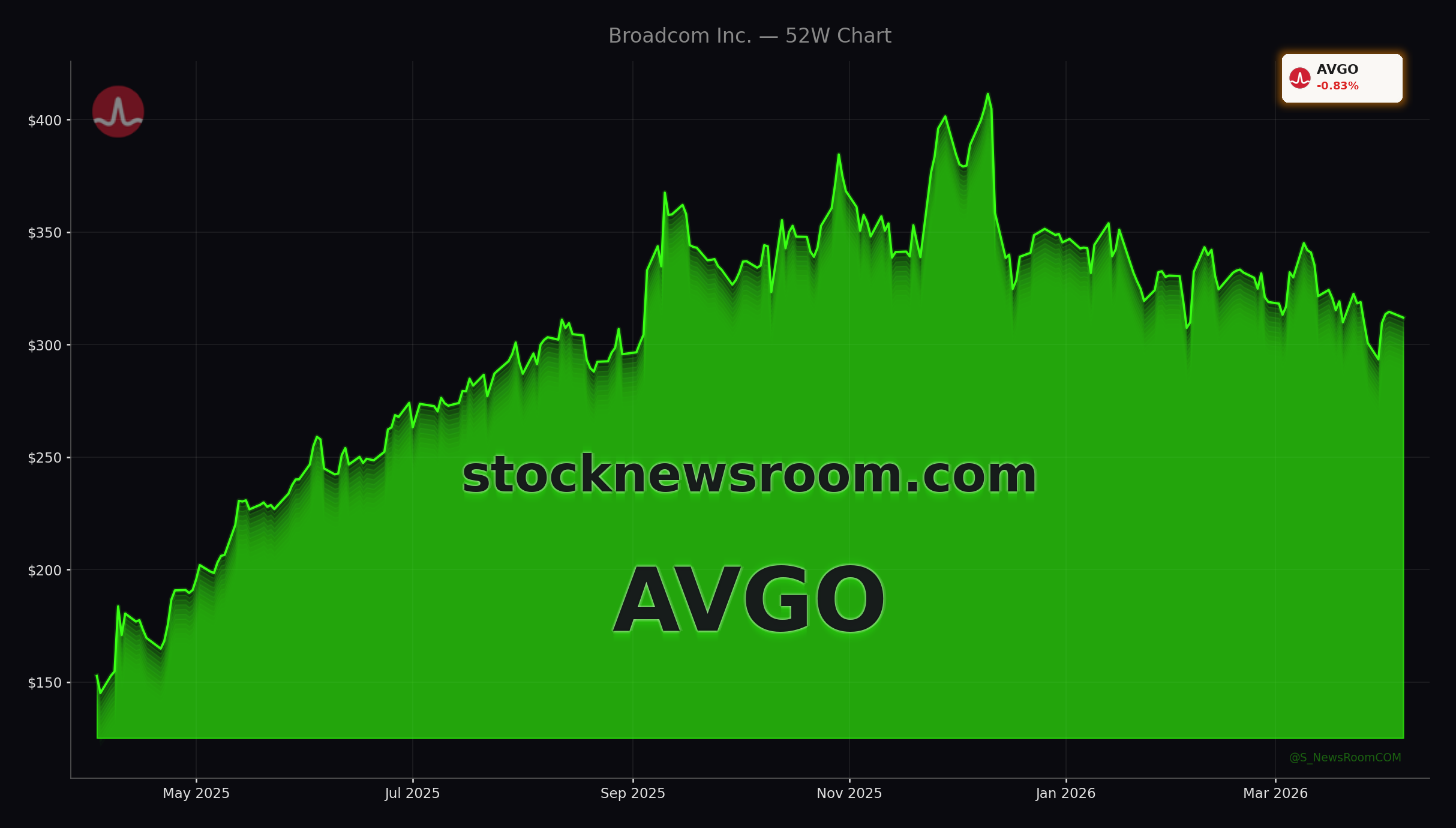
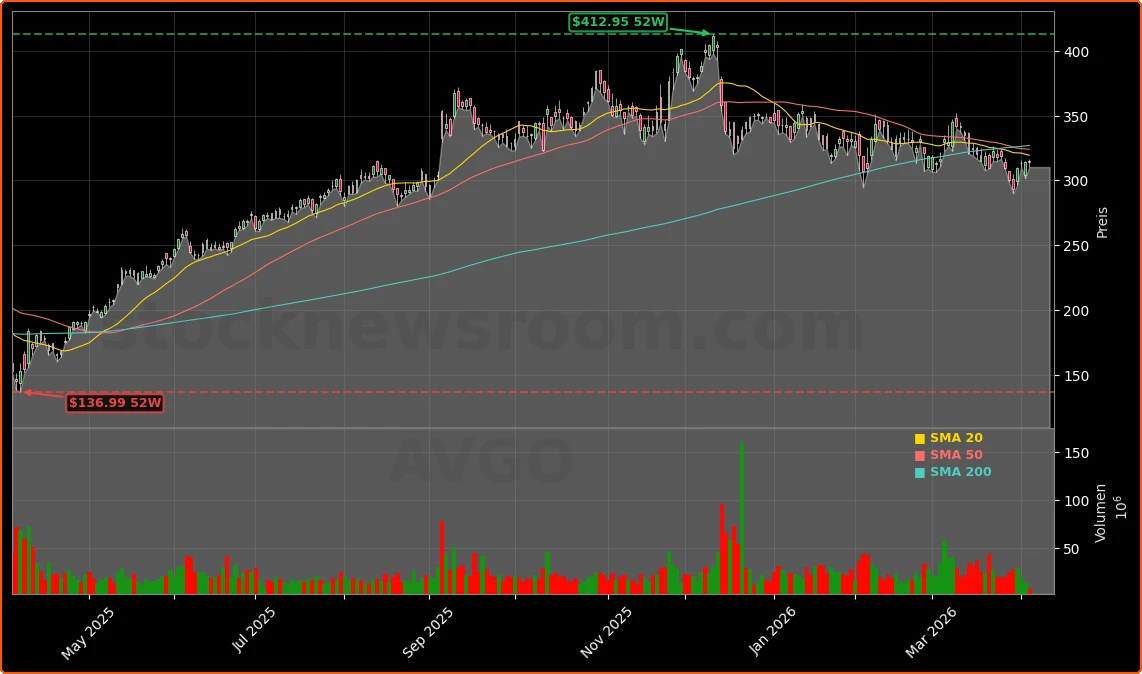
Macro and geopolitical factors add another layer. AVGO recently formed a “death cross” on the charts, with the 50‑day moving average falling below the 200‑day, and technicians note that $320 has become a critical resistance zone aligned with the 20‑day average. Multiple failed attempts to reclaim that level could trigger a correction toward the $275 area, especially if Middle East tensions or higher oil prices stoke broader risk‑off sentiment in the NASDAQ and S&P 500.
Fundamentally, however, AI spending remains robust. Analysts expect AI infrastructure budgets at mega‑caps to grow well into the 2030s. Broadcom’s aggressive push to shift VMware customers to subscription‑only software is another earnings lever, with expectations for double‑digit software growth over time. Combined with AI hardware, that could support consensus forecasts for roughly 40% annualized earnings growth, even as the stock’s forward P/E has compressed to the high‑20s.
How does new leadership shape Broadcom’s AI roadmap?
Governance and execution are also in focus after Broadcom appointed Amy Thurner as its new chief financial officer, effective June 12, succeeding Kirsten M. Spears. The move, highlighted in recent Benzinga coverage, brings in a leader with deep large‑cap tech experience just as CAPEX, supply commitments and AI‑driven M&A opportunities are set to scale.
For US investors, the CFO transition intersects directly with the Broadcom AI Forecast. Managing multi‑year supply deals for leading‑edge wafers and high‑bandwidth memory, absorbing VMware and pushing subscription conversions, and balancing shareholder returns with massive AI growth investments will require disciplined capital allocation. The appointment comes as prominent institutional investors, including Ken Griffin’s Citadel, have built multi‑billion‑dollar AVGO positions, signaling confidence in the long‑term AI narrative despite near‑term volatility.
In parallel, AI infrastructure demand is lifting the entire chip supply chain. Companies like Apple and Tesla are ramping their own AI‑heavy workloads, helping sustain demand for networking and custom silicon even outside the hyperscale cloud cohort. For diversified US portfolios, this makes Broadcom a central way to gain exposure to the data center build‑out rather than betting solely on front‑end AI application winners.
Related Coverage
Investors tracking management changes around the Broadcom AI Forecast may want to read how a former Alphabet executive could reshape financial strategy in “Broadcom CFO Transition Boom as Alphabet Veteran Joins”. That piece explores whether fresh leadership can accelerate AI ambitions or introduce timing risks just as spending ramps.
For a broader semiconductor view, memory specialist Micron is riding the same AI wave from a different angle. The analysis in “Micron Forecast +3.8% Rally: AI Memory Boom or Pause Ahead?” examines whether AI‑driven demand for DRAM and HBM signals a supercycle or the first signs of a classic chip downturn—context that matters for assessing how sustainable Broadcom’s AI‑driven outlook really is.
Ultimately, the Broadcom AI Forecast of $100 billion‑plus in 2027 AI chip revenue underscores how central the company has become to the global AI infrastructure build‑out. For long‑term investors, the combination of custom accelerators, dominant networking, and a refreshed finance team keeps AVGO firmly on the radar, with upcoming quarters likely to determine whether the stock’s consolidation turns into a breakout or a deeper buying opportunity.