Can Broadcom’s bold AI revenue roadmap overpower a fresh -4.1% share price slide and reprice the stock for a $3 trillion future?
Is Wall Street underestimating Broadcom’s AI pivot?
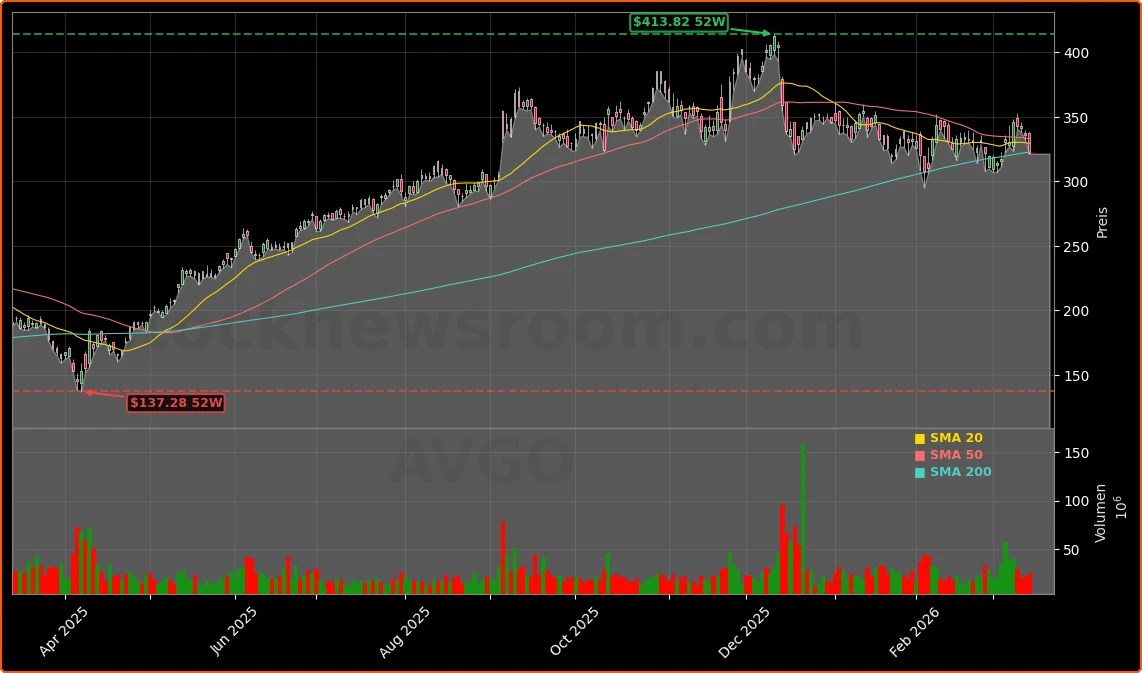
Broadcom Inc. (AVGO) has become one of the most hotly debated AI names on Wall Street. On the one hand, the stock has already delivered spectacular multi‑year gains and now sports a roughly $1.6 trillion market capitalization, putting it in the same conversation as megacap tech leaders like Apple and Microsoft. On the other, the shares have just pulled back, closing at $322.16 on Friday, down 4.13% on the day and slightly lower in after‑hours trading at $321.08. That move came even as management reaffirmed a bold trajectory for its AI chip business and raised near‑term guidance.
The tension is straightforward: valuations are rich across the AI hardware space, but Broadcom’s fundamentals are inflecting higher at a speed that even many AI bulls did not anticipate. The latest quarter showed AI revenue more than doubling year over year, far outpacing growth in the broader semiconductor sector and even outstripping the expansion rate at AI bellwether NVIDIA. The core question for US and global investors is whether the market has fully discounted the company’s next leg of AI‑driven growth.
Driving this debate is the new Broadcom AI Forecast for more than $100 billion in AI chip revenue by 2027 and management’s suggestion that this is only the beginning of a structurally larger opportunity. If these projections prove even directionally correct, AVGO could justify joining the exclusive $3 trillion market‑cap club alongside Apple, Alphabet, Microsoft, and potentially NVIDIA in the coming years.
How did Broadcom’s latest quarter reshape expectations?
The catalyst for the current discussion around AVGO was Broadcom’s fiscal first quarter of 2026 (for the three months ended Feb. 1). The company reported record revenue of $19.3 billion, up 29% year over year, as demand for its AI‑related products accelerated dramatically. Adjusted earnings per share climbed 28% to $2.05, reflecting not only strong top‑line growth but also solid operating leverage in its semiconductor and infrastructure segments.
Most striking was the surge in AI revenue. Broadcom disclosed that AI‑related chip sales reached $8.4 billion during the quarter, a jump of 106% compared with the same period a year earlier. That means AI chips alone now account for 43% of total revenue, up from 27% in the prior‑year quarter. The company is effectively transforming itself from a diversified semiconductor and infrastructure vendor into an AI‑centric hardware powerhouse.
Management did not stop there. For the current quarter, Broadcom guided for total revenue of roughly $22 billion, implying nearly 47% year‑over‑year growth, and projected adjusted EBITDA of around $15 billion, up 50%. Within that, AI chip revenue is expected to jump again to $10.7 billion in a single quarter. This acceleration suggests that Broadcom’s AI design wins with major hyperscale and AI‑native customers are now ramping into large‑scale deployments, especially in the data center.
While stocks across the AI complex have seen bouts of profit‑taking after big runs, these numbers underscore that Broadcom’s fundamentals continue to move in the opposite direction of the recent share‑price dip. For long‑term investors who focus more on earnings power than on week‑to‑week price action, the quarterly results and raised guidance materially strengthen the credibility of the company’s long‑term AI story.
What exactly is the Broadcom AI Forecast for 2027?
The centerpiece of the new narrative is the formal Broadcom AI Forecast that CEO Hock Tan laid out on the company’s latest earnings call. Tan stated that Broadcom now has “line of sight” to generate AI revenue from chips alone – “just chips,” as he emphasized – in excess of $100 billion in 2027. Importantly, management also said that it has already secured the necessary supply chain capacity to support that level of demand.
To put that figure in perspective, Broadcom’s entire company‑wide revenue over the last twelve months was about $68 billion. The forecast implies that AI chips alone could become significantly larger than the company’s current total business within less than two years. It also suggests a roughly fivefold increase in AI chip revenue between Broadcom’s fiscal 2025 (which ended in November 2025) and fiscal 2027.
This pace of expansion is extraordinarily rapid for a company that is already operating at scale. Based on the $100 billion annual AI revenue goal, Broadcom is effectively targeting an AI chip run‑rate of around $25 billion per quarter by 2027. That would place its AI operations in the same revenue ballpark as the entire businesses of many large S&P 500 technology constituents.
Management further hinted that this target might prove conservative if the industry migration toward custom AI accelerators gains momentum faster than currently modeled. The 2027 Broadcom AI Forecast therefore looks more like a waypoint than an endpoint, particularly when viewed against broader projections for AI data center spending and the likely long‑term mix shift from general‑purpose GPUs toward application‑specific silicon.
How do Broadcom’s custom AI ASICs compete with GPUs?
While Nvidia’s general‑purpose GPUs currently dominate much of the AI compute market, Broadcom is not trying to displace GPUs head‑on. Instead, it has carved out a leadership role in application‑specific integrated circuits (ASICs), custom‑designed chips tailored to the needs of individual customers and specific AI workloads. These chips are engineered in close collaboration with hyperscalers and AI platform companies, allowing Broadcom to optimize performance, power efficiency, and cost for each deployment.
ASICs differ from GPUs in a few critical ways. GPUs are incredibly versatile and well‑suited for a wide variety of AI training and inference tasks, which has made them the default choice for many customers. However, that flexibility comes with overhead: GPUs are more power‑hungry, typically larger, and more expensive per unit of useful computation when the workload is well understood and stable. In contrast, ASICs are “hard‑wired” for specific operations, enabling higher performance per watt and lower total cost of ownership when the software stack is tightly aligned with the hardware.
Industry research suggests that Broadcom is in a dominant position within this niche. Analysts expect Broadcom to command around 60% of the custom AI ASIC market as soon as next year, driven by strong demand from large cloud and internet platforms. Some estimates see its share in the 60% to 80% range over the longer term as more hyperscalers shift portions of their AI workloads to custom silicon to control cost and energy consumption.
The logic for customers is straightforward. As AI models become larger and more frequently used in production, the cost of inference – running those models at scale – begins to dominate. Custom ASICs offer a way to dramatically reduce that ongoing cost, even if initial development is more complex than buying off‑the‑shelf GPUs. Broadcom’s strength lies not only in chip design but also in its system‑level expertise and ability to integrate networking, switching, and interconnect technology into complete data center solutions.
Which customers are driving Broadcom’s AI surge?
The most important proof points for Broadcom’s AI thesis are the specific partnerships it has landed with top‑tier AI and cloud platforms. While many details remain confidential, Broadcom has publicly highlighted several marquee relationships that support its aggressive growth outlook and bolster the new Broadcom AI Forecast for 2027 and beyond.
One of the most prominent examples is its cooperation with Google. Broadcom designs and manufactures high‑performance cores at the heart of Google’s Tensor Processing Units (TPUs), custom accelerators that power the company’s internal and external AI services. TPUs help Google reduce dependence on third‑party GPU suppliers for critical AI compute, while giving Broadcom a long‑duration revenue stream tied to the expansion of Google Cloud and AI‑driven search and advertising products.
Broadcom is also working on a custom AI accelerator for Meta Platforms. Meta is investing heavily in AI for content recommendation, advertising, and the emerging metaverse ecosystem, and it is rapidly scaling its internal AI infrastructure. Broadcom has indicated that its next‑generation custom AI processors for Meta will “scale to multiple gigawatts in 2027 and beyond,” implying large‑scale data center deployments and significant chip volumes over time.
In the pure‑play AI arena, Broadcom has landed deals with high‑growth players like Anthropic and OpenAI. Anthropic is on track to deploy about 1 gigawatt (GW) of Broadcom’s custom processors in 2026, followed by more than 3 GW in 2027, underscoring the speed with which AI‑native companies are building out their own compute stacks. OpenAI, meanwhile, is expected to buy 1 GW of custom Broadcom chips next year, complementing its well‑publicized multi‑gigawatt GPU partnerships.
These agreements matter not only for near‑term revenue but also for strategic positioning. By embedding its ASICs into the compute backbone of leading AI platforms and hyperscalers, Broadcom creates a sticky ecosystem and long‑term switching costs. Once a customer’s software stack is optimized around a given ASIC architecture, moving away becomes technically complex and economically unattractive. That dynamic is central to why the company believes its AI revenue can compound from $8.4 billion last quarter to $100 billion annually and potentially far beyond by the end of the decade.
Can Broadcom catch up with Nvidia by 2030?
Comparisons with NVIDIA are inevitable when discussing any AI chip maker. Nvidia remains the undisputed leader in AI GPUs and recently reported $62.3 billion in data center revenue in its latest quarter, implying an annualized run‑rate approaching $250 billion. By that metric, Broadcom’s current AI chip revenue of $8.4 billion per quarter may seem modest. However, the relevant question is not today’s gap but the relative growth trajectories over the next five to ten years.
Broadcom’s AI revenue grew 106% year over year in the latest quarter, outpacing Nvidia’s 75% data center growth over a similar timeframe. More importantly, if Broadcom hits its $100 billion AI chip revenue target by 2027 and can sustain compound annual growth of roughly 35% from 2028 through 2030, its AI segment alone could reach around $246 billion annually by 2030. That would put Broadcom’s AI business alone in the same league as Nvidia’s current data center franchise.
External industry forecasts have historically expected custom ASICs to account for about 19% of a roughly $600 billion AI chip market by 2033. Yet Broadcom’s internal projections imply that the shift from GPUs toward custom AI processors may be unfolding faster than originally anticipated. The logic is intuitive: as AI workloads mature and become mission‑critical across search, social media, cloud computing, and enterprise software, optimizing for cost and performance via custom silicon becomes increasingly attractive.
If this scenario materializes, Broadcom could evolve from being perceived primarily as a diversified semiconductor and networking supplier into a co‑leader of the AI compute market alongside Nvidia. From an investor’s standpoint, that would justify a re‑rating of the stock closer to the premium multiples granted to the top tier of AI beneficiaries.
What does the AI boom mean for Broadcom’s valuation?
Despite its dizzying ascent in recent years, many valuation metrics suggest that AVGO may not be as stretched as some skeptics assume, particularly when factoring in its AI growth runway. Based on Wall Street estimates, Broadcom is expected to generate nearly $105 billion in total revenue in fiscal 2026. At a recent market cap near $1.6 trillion, that implies a forward price‑to‑sales (P/S) ratio of roughly 15x.
Analysts project that Broadcom’s total revenue could rise to about $196 billion by 2028, putting it within striking distance of the roughly $200 billion in annual sales that would likely be needed to support a $3 trillion valuation if its P/S multiple remains relatively stable. Crucially, Broadcom has a history of beating consensus expectations and raising guidance as demand proves stronger than initially modeled, particularly in its infrastructure and AI segments.
From an earnings perspective, the stock currently trades at around 30 times forward earnings. While that is a premium to the broader S&P 500, it appears less demanding when considering Broadcom’s growth rate. On a price/earnings‑to‑growth (PEG) basis, the stock’s multiple is near 0.44, well below the rule‑of‑thumb threshold of 1.0 that often delineates “reasonable” or even undervalued growth stocks. This suggests that, if Broadcom delivers on its AI roadmap, current valuations could end up looking conservative in hindsight.
That said, investors must recognize that much of the long‑term upside is contingent on continued AI outperformance. Any material slowdown in hyperscale spending, delays in major AI projects, or a sharper‑than‑expected cyclical downturn in the broader chip sector could compress multiples and test the resilience of the bull case.
How are institutional investors positioning in AVGO?
Recent fund‑flow data indicates that large institutional investors remain broadly constructive on AVGO, even as some managers trim positions to manage risk after a powerful rally. For example, Aristotle Atlantic Partners LLC recently disclosed that it had increased its stake in Broadcom Inc., making AVGO its fourth‑largest position. That move underscores ongoing institutional confidence in Broadcom’s AI strategy and long‑term earnings power.
At the same time, there are signs of cautious rebalancing elsewhere. Cadence Bank, for instance, reduced its Broadcom position by about 3.6% in the third quarter of 2026, selling 8,237 shares. Yet even after that sale, the bank still classifies AVGO as a core holding, with the stock representing around 4.4% of its investment portfolio. The partial trim appears driven more by portfolio concentration and risk management considerations than by a negative view of Broadcom’s fundamentals.
These contrasting moves highlight a common dynamic across institutional portfolios. After a multi‑year run in AVGO and other high‑growth AI names, some managers are locking in profits and reducing single‑stock exposure to keep diversification in check. Meanwhile, others are using pullbacks and volatility to build or enlarge positions at what they view as attractive long‑term entry points. The net effect has been continued strong ownership by long‑horizon investors who are willing to ride out interim volatility in exchange for exposure to one of the most compelling AI hardware stories in the market.
What are analysts on Wall Street saying about Broadcom?
Wall Street research desks remain broadly positive on AVGO, with most major firms highlighting Broadcom’s AI optionality as a key reason for their bullishness. Recent commentary has pointed to the company’s strong quarterly performance, rapid AI revenue mix shift, and the credibility of its medium‑term guidance.
Across covering analysts, the average price target currently sits around $435.30, well above the recent share price near $322, suggesting meaningful upside potential if the company executes on its AI roadmap. Research from bulge‑bracket firms such as Goldman Sachs, Citigroup, Morgan Stanley, and RBC Capital Markets has generally emphasized Broadcom’s strategic importance in AI data centers and the durability of its custom ASIC moat, even if specific rating changes and target adjustments vary over time.
For example, some analysts at Goldman Sachs have highlighted Broadcom as a top beneficiary of the multi‑year AI infrastructure build‑out, citing its unique positioning across both compute and networking. Citigroup has pointed to the $100+ billion AI revenue trajectory as a key driver behind its constructive stance, while Morgan Stanley analysts have focused on Broadcom’s strong free‑cash‑flow generation and disciplined capital allocation, including dividends and share repurchases, as supportive of long‑term shareholder returns.
RBC Capital Markets, for its part, has discussed Broadcom in the context of the broader AI supply chain, noting that the company’s mix of custom accelerators, Ethernet switching, and fiber‑channel connectivity gives it a differentiated role relative to both pure‑play GPU vendors and traditional networking firms. The consensus across these research houses is that AVGO remains a core AI holding for growth‑oriented portfolios, though many also caution that volatility will likely stay elevated as the market digests rapidly evolving AI spending trends.
How important is data center spending to Broadcom’s story?
Broadcom’s AI ambitions are inseparable from the global boom in data center investment. AI models require enormous compute and storage resources, and the infrastructure needed to train and deploy them at scale is far more capital‑intensive than traditional enterprise IT. Global management consultants estimate that data center capital expenditures could reach roughly $7 trillion by 2030, driven largely by AI, cloud computing, and high‑bandwidth applications.
Broadcom sits at the center of this build‑out. Beyond its AI accelerators, the company is a leading supplier of network switches, specialized controllers, and other semiconductors that connect and optimize servers inside modern data centers. As more AI workloads move from experimentation into production, customers are not just buying chips; they are architecting entire systems to maximize throughput and efficiency. Broadcom’s broad product portfolio and deep relationships with hyperscale customers position it as a key enabler of this shift.
This is one reason why many investors are increasingly viewing AVGO not simply as a cyclical semiconductor name, but as an infrastructure‑like growth asset that can benefit from secular trends in AI and cloud. The combination of custom AI chips and high‑speed networking creates opportunities for Broadcom to capture a larger share of each incremental dollar spent on data center capacity. As a result, the AI wave enhances not only the company’s addressable market but also the quality and visibility of its long‑term growth profile.
What risks could derail the Broadcom AI thesis?
No AI story is without risks, and investors in AVGO need to consider both company‑specific and macro‑level uncertainties. One of the most significant is customer concentration. Broadcom’s AI momentum is closely tied to a relatively small number of hyperscalers and AI specialists, including Google, Meta Platforms, Anthropic, and OpenAI. While these are formidable counterparties, a delay, cancellation, or redesign of a major AI program could temporarily slow Broadcom’s growth or create short‑term supply‑chain imbalances.
Competition is another key factor. Nvidia is not standing still; it continues to enhance its GPU roadmap and software ecosystem, while other chip designers and cloud operators are developing their own accelerators. Over time, some of Broadcom’s custom ASIC work could potentially be insourced by large customers, particularly those with deep internal chip design capabilities. Maintaining a clear performance, cost, and time‑to‑market advantage will be essential for Broadcom to defend its market share.
There are also broader industry risks. A cyclical downturn in semiconductors, a slowdown in cloud spending, or macroeconomic shocks that cause enterprises to delay AI adoption could dampen the pace at which AI data centers are built out. Regulatory uncertainties around AI, data privacy, and export controls could further complicate demand planning for both Broadcom and its customers.
Finally, valuation risk cannot be ignored. While metrics like the PEG ratio suggest AVGO remains reasonably valued relative to its growth, the absolute level of expectations is high. If Broadcom fails to deliver on its Broadcom AI Forecast, particularly the $100 billion AI revenue target by 2027, investors may reassess the appropriate multiple and trigger a more pronounced correction.
What does this mean for US and global investors now?
For American and international investors managing diversified portfolios, the implications of Broadcom’s AI push are multifaceted. First, AVGO increasingly looks like a core AI infrastructure holding rather than a peripheral semiconductor play. Its exposure to both compute (custom ASICs) and connectivity (networking and switching) gives it a unique, system‑level role in the AI stack that differs from both GPU‑centric vendors and traditional chipmakers.
Second, the stock offers a way to participate in the AI growth theme with a slightly different risk profile. While Nvidia has greater direct exposure to AI training and is more sensitive to GPU demand cycles, Broadcom’s mix includes recurring infrastructure and enterprise elements that can provide some buffer in periods of GPU digestion. At the same time, the speed of its AI growth means AVGO still has significant upside leverage if the AI investment cycle continues at its current pace.
Third, from an index perspective, Broadcom’s rising weight in the S&P 500 and NASDAQ means that its performance will increasingly influence US equity benchmarks. For passive investors, this underscores how central AI infrastructure plays have become to broad market returns. For active managers, it raises the question of whether AVGO should be treated as a benchmark‑plus overweight in AI‑themed mandates.
Finally, AVGO’s growing relevance in AI places it alongside names like Tesla and NVIDIA in discussions about the next generation of mega‑cap leaders. Whether Broadcom ultimately reaches a $3 trillion valuation will depend on its ability to execute on its ambitious AI roadmap, maintain technology leadership in custom accelerators, and navigate competitive and macro headwinds. But the direction of travel is clear: AI is no longer a side story for Broadcom – it is rapidly becoming the defining dimension of its future.
Today, in fact, we have line of sight to achieve AI revenue from chips, just chips, in excess of $100 billion in 2027. We have also secured the supply chain required to achieve this.
— Hock Tan, CEO of Broadcom Inc.
Conclusion
In conclusion, Broadcom’s latest results and the expansive Broadcom AI Forecast signal that the company is positioning itself as a central pillar of the global AI infrastructure build‑out, with a credible path toward $100 billion in AI chip revenue and potentially a $3 trillion valuation. For investors willing to embrace volatility and focus on multi‑year outcomes, AVGO remains one of the most compelling AI hardware opportunities on Wall Street. The next several quarters of execution and data‑center spending trends will show whether Broadcom can fully capitalize on this moment and solidify its role at the top tier of the AI revolution.
Further Reading
- Broadcom Inc. (AVGO) Stock Price, News, Quote & History (Yahoo Finance)
- Broadcom Inc. $AVGO is Aristotle Atlantic Partners LLC’s 4th Largest Position (MarketBeat)
- Strong Wall Street sentiment on Broadcom (AVGO) amid $100+ billion AI chip sales forecast (MSN)
- You’ll Never Believe What Broadcom’s CEO Just Said About AI Demand (The Motley Fool)