Can the Broadcom AI Forecast really support another decade of hypergrowth, or is today’s rally already pricing in perfection?

How much AI upside is priced into Broadcom?
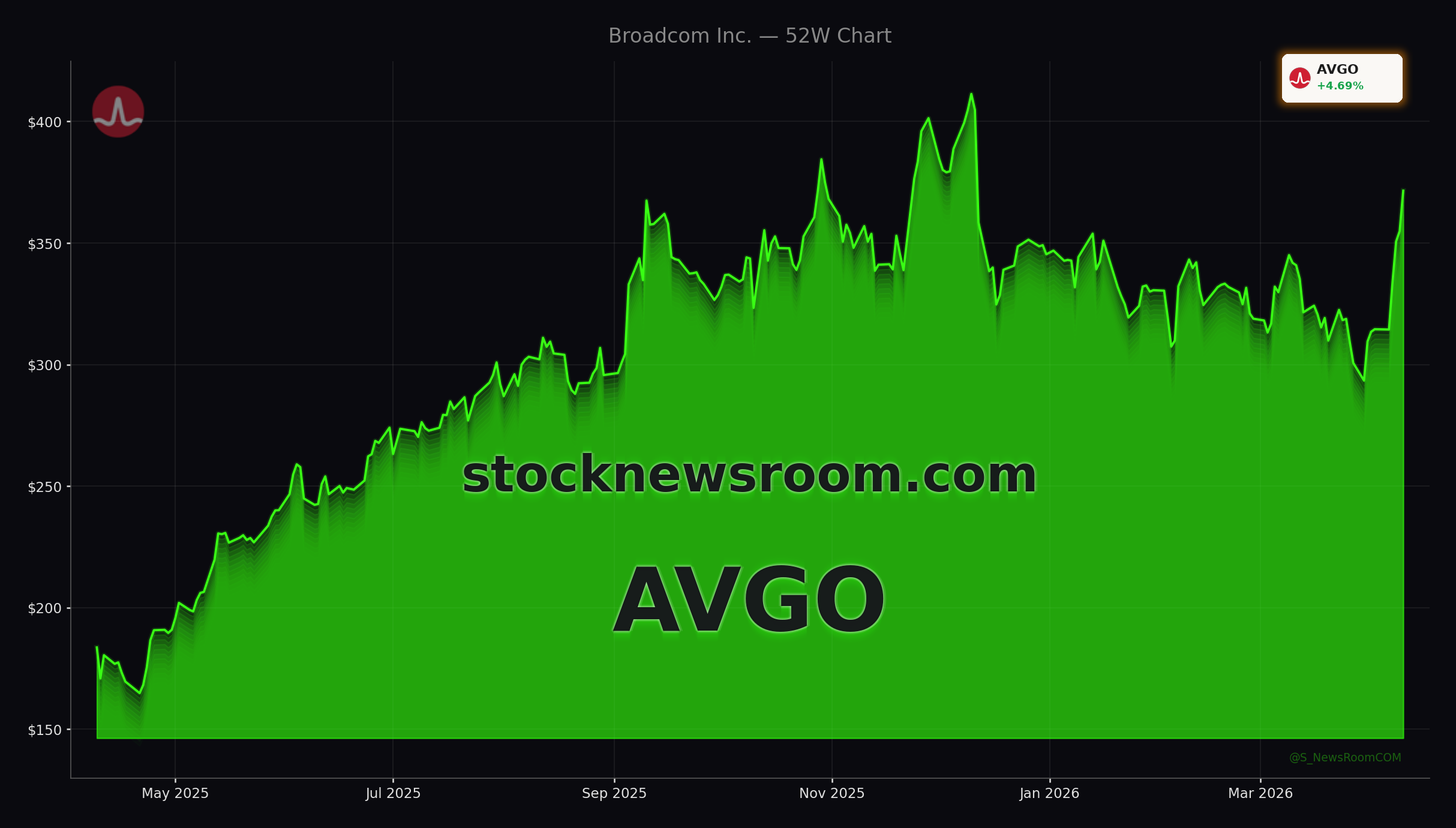
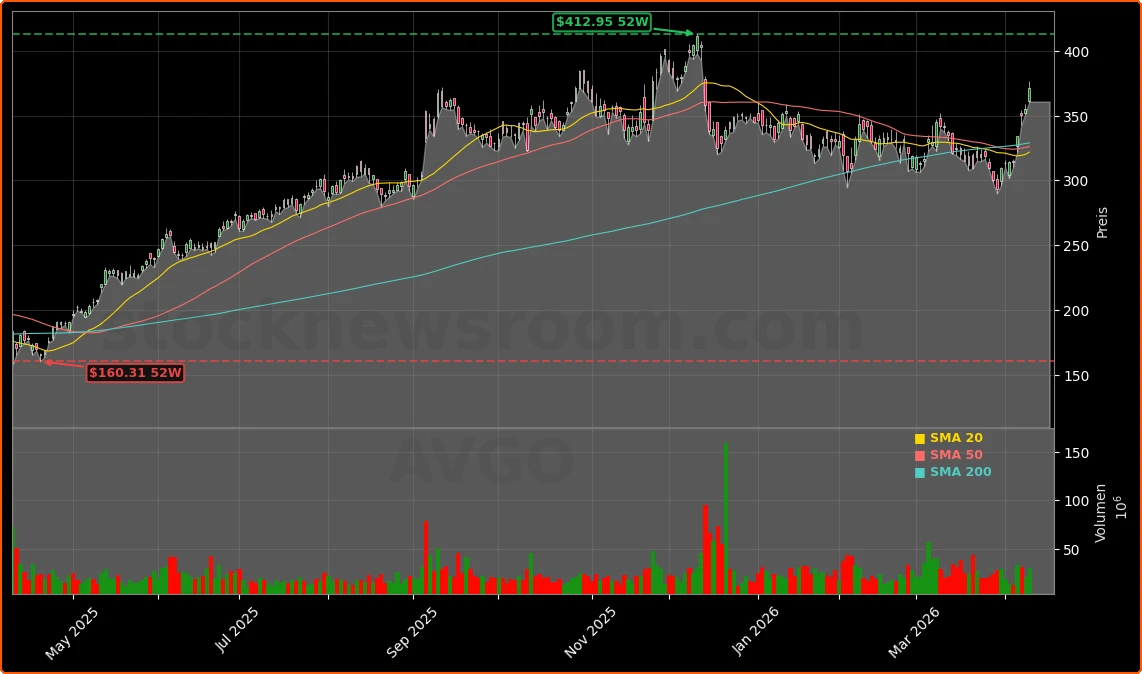
Broadcom (AVGO) has already been a life-changing winner. A $50,000 position ten years ago would be worth roughly $1.1 million today, excluding dividends, implying about a 35% annualized return. Replicating anything close to that from here, with a market cap around $1.6 trillion, demands that the Broadcom AI Forecast plays out almost perfectly. The shares now trade around 32 times this year’s expected earnings, a premium multiple that assumes years of double‑digit growth from AI data center infrastructure.
The core bet is that the current Broadcom KI-Wachstum phase is not a short‑lived spike but the start of a multi‑year build‑out of AI compute. Analysts on Wall Street model earnings growth north of 40% annualized over the next few years, driven by high‑margin custom accelerators (XPUs) and networking silicon that sit behind cloud giants’ most demanding AI workloads. If those estimates hold, the current valuation could still leave room for upside, but any disappointment in the Broadcom AI Forecast would hit the stock hard.
Why hyperscalers rely on Broadcom custom chips
Unlike NVIDIA, which sells largely standardized GPUs to the market, Broadcom partners directly with hyperscalers to co‑design application‑specific integrated circuits (ASICs) tuned to each customer’s workloads. These bespoke chips are less flexible than GPUs but can deliver better performance‑per‑watt and lower total cost of ownership when deployed at hyperscale. That structure has made Broadcom a go‑to design partner for Alphabet, Meta Platforms and other mega‑cap cloud players.
Recent news underscores that edge. Broadcom shares spiked after reports of a long‑term AI infrastructure partnership with Alphabet and Anthropic that secures gigawatts of future TPU capacity for training and inference. Broadcom is deeply involved in designing Google’s next‑generation Tensor Processing Units, which are central to both internal AI services and external customers running large models like Anthropic’s Claude. This kind of embedded role in hyperscaler silicon roadmaps is a key pillar of the bullish Broadcom AI Forecast.
How big can the data center AI cycle get?
AI infrastructure spending is proving far more resilient than the broader tech tape. Leading cloud platforms, including several of the “Magnificent Seven”, are expected to pour at least $600 billion into capex this year, up roughly 50% year over year. That capital is funding GPUs from NVIDIA, CPUs and accelerators from AMD, and increasingly, custom ASICs and high‑speed interconnects from Broadcom.
Crucially, these customers have the balance sheets to sustain the surge. Two of Broadcom’s largest partners, Alphabet and Meta Platforms, together generated about $280 billion in operating cash flow last year, enough to finance years of elevated AI build‑outs. Taiwan Semiconductor Manufacturing and ASML stand behind them in the supply chain, with TSMC projecting around 30% revenue growth in 2026 as it fabricates ever more AI‑optimized chips for clients like Broadcom. Those ecosystem dynamics support the more aggressive Broadcom AI Forecast scenarios, including management’s target of a roughly fivefold jump in AI chip revenue over just two fiscal years.
How does Broadcom stack up against other AI chip plays?
For U.S. investors, the choice is not just whether to own AI infrastructure, but which flavor. NVIDIA has dominated AI accelerators with CUDA‑optimized GPUs, while AMD is pushing hard into data center GPUs and CPUs. Broadcom’s approach is different: it monetizes the shift to AI both through custom accelerators and the networking backbone that connects thousands of accelerators in a single cluster.
Recent market action shows those models can win in parallel. AMD and Broadcom both rallied this week, but for distinct reasons: AMD on strong data center GPU momentum and a large Meta deal, Broadcom on expanding Google TPU supply agreements and accelerating bespoke AI revenue. Some research shops, including Zacks Investment Research, currently rank Broadcom as a top‑tier AI buy versus more fully valued names like Palantir, citing its diversified revenue mix and stronger margins. Several large Wall Street banks, including Goldman Sachs and Morgan Stanley, have reiterated bullish views on the stock this year, highlighting AI as the key driver of their Broadcom AI Forecast assumptions.
What risks could derail the Broadcom AI Forecast?
Despite the bullish setup, investors should be clear about the risks. Data center spending tends to be cyclical: even in a long‑term uptrend, hyperscalers can pause or re‑prioritize capex, which would likely compress the premium multiple on AVGO. Broadcom also depends heavily on a concentrated group of roughly six mega‑customers; any slowdown or insourcing decision by a single giant, including Apple on the hardware side, could ripple through results.
There are also competitive pressures. Custom chip partners like Marvell are chasing the same hyperscaler budgets, while internal design teams at Alphabet, Amazon and others are becoming more capable. And while the iShares Semiconductor ETF has been rallying on easing geopolitical tensions and strong numbers from Broadcom and peers, sector sentiment can swing quickly if macro or rate expectations shift. A more cautious Broadcom AI Forecast from Wall Street would almost certainly follow any sign that AI capex is normalizing sooner than expected.
Related Coverage
For a deeper dive into how custom accelerators are reshaping the hyperscaler landscape, see “Broadcom AI Chips +5.3% Surge as Custom Silicon Booms”, which examines whether Broadcom’s ASICs are becoming the secret weapon inside next‑gen data centers. Investors tracking the demand side of the equation should also read “Alphabet Forecast Boom: Can AI Capex Really Pay Off?”, which analyzes whether Alphabet’s massive AI spending can translate into long‑term profit growth and how that could feed back into the broader AI supply chain.
In the end, the Broadcom AI Forecast comes down to whether hyperscaler AI capex remains on a steep upward curve and Broadcom continues to win a meaningful share with its custom silicon and networking stack. If the current Broadcom KI-Wachstum momentum persists and management delivers on its innovation roadmap, AVGO could still compound meaningfully from here despite its size. For long‑term investors building AI exposure across chips and cloud platforms, Broadcom looks well positioned as a core holding in a diversified portfolio.