Is Broadcom AI Growth signaling a durable shift in AI infrastructure leadership or just a spectacular mid‑cycle surge?
Is Broadcom AI Growth reshaping AI infrastructure?
Broadcom Inc. has quietly built an AI infrastructure empire, with the company estimating that more than 99% of global internet traffic touches its technology. Unlike NVIDIA, whose GPUs are general‑purpose accelerators, Broadcom focuses on custom application‑specific integrated circuits (ASICs) and high‑performance networking silicon tailored for hyperscale data centers. That specialization is paying off: in fiscal Q1 2026, AI semiconductor revenue surged 106% year over year to about $8.4 billion, driven by demand from major cloud and AI customers.
Management expects AI semiconductor revenue to jump again in the current quarter to roughly $10.7 billion, implying growth of around 140% year over year. Broadcom AI Growth is being fueled by deep, multi‑year design wins with six large customers, including Anthropic, OpenAI, Alphabet and Meta Platforms. Anthropic alone has reportedly placed AI chip orders totaling over $21 billion, underscoring how tightly Broadcom is tied into the next wave of AI compute build‑outs.
How do Broadcom and NVIDIA compete and coexist?
For US investors used to viewing NVIDIA as the default AI trade, the key distinction is that Broadcom’s success does not require displacing the GPU leader. Nvidia’s GPUs excel at flexible training and inference workloads, while Broadcom’s XPUs and ASICs are optimized for specific, scaled‑out tasks where customers prioritize efficiency and total cost of ownership over flexibility. Alphabet’s long‑running collaboration with Broadcom on the Tensor Processing Unit (TPU) shows how custom silicon can dramatically improve cost performance on mature AI inference workloads.
That dynamic allows Broadcom AI Growth to run alongside Nvidia’s expansion rather than against it. As AI applications move from experimentation into production at hyperscale, the economics increasingly favor specialized chips and ultra‑fast networking, areas where Broadcom is already entrenched. Recent analyst commentary on the S&P 500’s AI leaders has started to place Broadcom and Nvidia side by side as complementary infrastructure pillars rather than direct rivals.
What role do networking and Ultra Ethernet play?
Beyond compute, Broadcom is cementing a leadership position in AI networking. Roughly one‑third of its AI revenue currently comes from high‑end switches such as the Tomahawk 6 family, and management expects that share to climb to about 40% in the near term. The upcoming next‑generation Tomahawk switch is designed to double performance, aligning with the rising bandwidth and latency demands of advanced AI clusters.
In a notable technology milestone, Keysight Technologies and Broadcom recently completed the first public interoperability test of Ultra Ethernet Consortium specifications at an 800G line rate using Broadcom’s Tomahawk Ultra Ethernet switch. That successful demo helps validate Broadcom’s roadmap for deterministic, loss‑tolerant networking in massive AI data centers. The launch of the Taurus BCM83640 3nm 400G/lane optical PAM‑4 DSP adds another crucial piece, enabling cost‑effective, low‑power 1.6T optical modules aimed directly at AI data‑center interconnects.
Do Wall Street targets reflect Broadcom AI Growth?
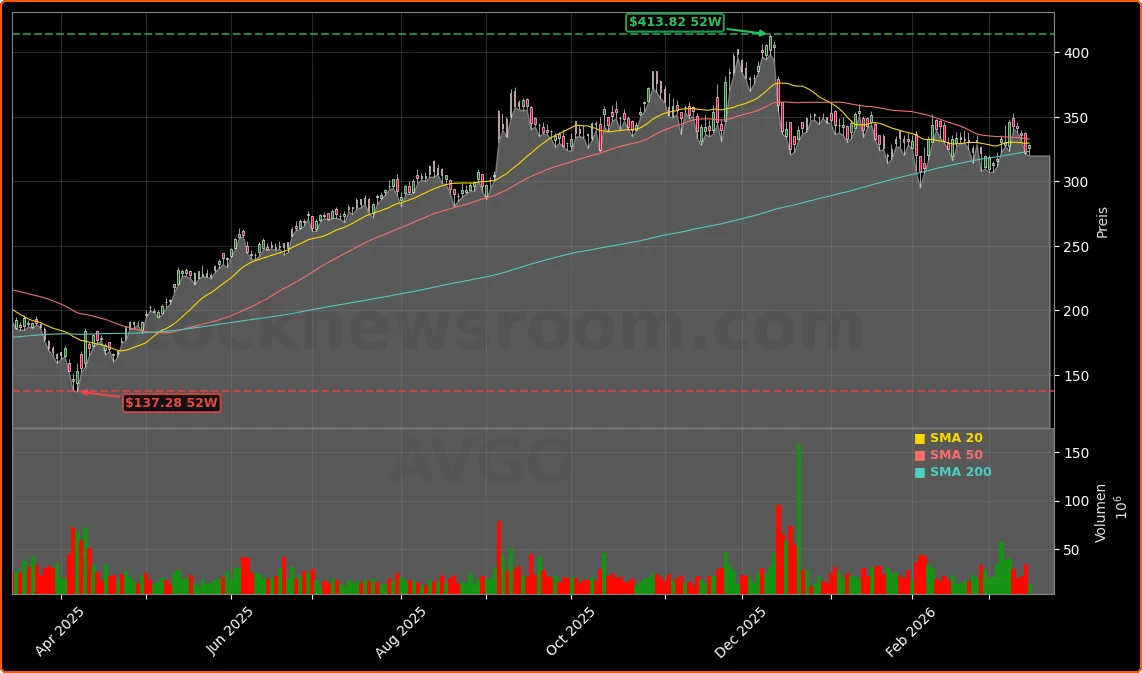
Analysts have taken notice of Broadcom’s acceleration. A recent survey of 33 brokerages shows a “Moderate Buy” consensus rating with an average 12‑month price target near $435.30, implying solid upside from the current $328 area. Firms such as Mizuho and Benchmark have issued above‑consensus targets, pointing to Broadcom’s custom AI chips, VMware‑enhanced software stack and networking portfolio as reasons the stock can continue to outperform the broader NASDAQ and S&P 500.
Valuation remains a key debate. Broadcom currently trades at about 29x forward earnings estimates, down from more than 50x only a few months ago. Some Wall Street models, extrapolating Broadcom AI Growth toward management’s forecast of more than $100 billion in annual AI chip revenue by 2027 and consensus revenue around $154 billion, see room for the stock to nearly double by the end of 2027 if earnings per share reach the high‑teens and the multiple stabilizes in the mid‑30s.
For US investors comparing AI exposure across mega‑caps like Apple and Tesla, Broadcom’s pitch is clear: a defensive, cash‑generative technology name that is increasingly indispensable to AI compute and networking, with Broadcom AI Growth now the primary catalyst for both earnings and multiple expansion.
Broadcom has moved from being a high‑quality semiconductor name to a foundational builder of the AI infrastructure supercycle.
— Hock Tan, CEO of Broadcom Inc.
Conclusion
In summary, Broadcom AI Growth is transforming the company from a cyclical chip supplier into a structural AI infrastructure leader. The combination of multi‑billion‑dollar custom chip orders, cutting‑edge networking products and supportive analyst targets keeps the stock firmly on Wall Street’s radar. The next few quarters of AI demand and execution will show whether Broadcom can fully deliver on its 2027 ambitions, but for long‑term investors, the AI‑driven trajectory looks increasingly compelling.
Further Reading
- Broadcom Inc. (AVGO) Quote & Profile (Yahoo Finance)
- Broadcom’s AI Chip Revenue Surges in Fiscal Q1 2026 (IndexBox)
- Broadcom (AVGO): The Architect of the AI Infrastructure Supercycle (FinancialContent)
- Analysts Set Broadcom Inc. (NASDAQ:AVGO) Target Price at $435.30 (National Today)