Are the latest Broadcom Earnings proof that the AI infrastructure boom still has years to run, or a peak in disguise?
Broadcom Inc.: How Did Wall Street React to the Latest Broadcom Earnings?
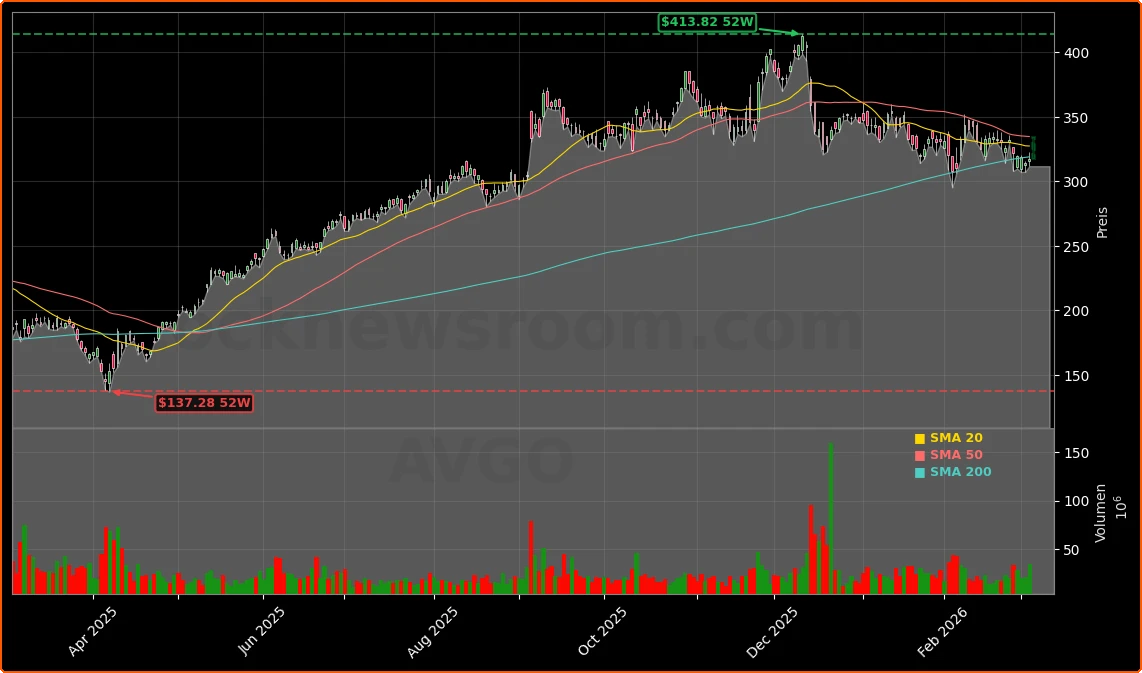
Broadcom Inc. entered its fiscal Q1 2026 report under pressure. The stock had lagged the S&P 500 so far this year, and investor sentiment around AI hardware was cooling. Into the report, Broadcom traded around $313–318, and in the immediate after‑hours session the shares pushed to roughly $334, a gain of more than 5%, as traders digested the results and guidance.
The headline numbers were strong. Broadcom posted record quarterly revenue of $19.31 billion, up 29% year over year and slightly above consensus expectations near $19.18–19.26 billion. Adjusted earnings per share came in at $2.05, beating the $2.03–2.04 range that analysts had penciled in. Operating performance was equally notable: adjusted EBITDA reached about $13.1 billion, or 68% of revenue, with an operating margin above 66%, reinforcing the company’s reputation as one of the most profitable large‑cap chipmakers in the S&P 500.
Wall Street’s initial response, however, was more nuanced than the after‑hours price pop alone would suggest. Some investors had hoped for an even stronger near‑term outlook and continue to debate whether 2026 could mark a temporary peak in AI capital spending. Others focused on the fact that Broadcom also announced a fresh $10 billion share repurchase program through 2026 and maintained a healthy dividend, underscoring management’s confidence in free‑cash‑flow durability.
For U.S. portfolios already exposed to high‑beta AI names such as NVIDIA, the latest Broadcom Earnings add an important data point: AI spending is not rolling over. If anything, Broadcom’s numbers and guidance argue that we are still early in the infrastructure build‑out, with custom accelerators and advanced networking driving another leg of growth.
Broadcom Earnings: What Do the Q1 Numbers Really Tell Investors?
Behind the headline beat, the composition of Broadcom’s Q1 2026 results matters for equity valuation. Total revenue of $19.31 billion was powered by a 52% jump in Semiconductor Solutions sales to $12.5 billion, while Infrastructure Software revenue rose a modest 1% to $6.8 billion. That mix highlights how central AI has become to Broadcom’s growth engine.
AI semiconductor revenue surged 106% year over year to $8.4 billion, marking the 12th consecutive quarter of AI‑driven expansion. AI now represents the majority of Broadcom’s semiconductor revenue and a substantial share of overall company sales. Within that AI bucket, two subsegments stood out: custom AI accelerators (XPUs/ASICs) and AI networking. Management noted that the customer accelerator business grew roughly 140% year over year, while AI networking revenue climbed about 60% and now accounts for roughly one‑third of AI revenue, with expectations to reach 40% next quarter.
Cash generation kept pace with the income statement. Operating cash flow reached about $8.26 billion, fueling roughly $8 billion in free cash flow—an impressive 41% of revenue. Broadcom returned $10.9 billion to shareholders during the quarter via $3.1 billion in dividends and $7.8 billion in share repurchases, even before the new $10 billion authorization. This capital‑return profile is more reminiscent of a mature cash‑cow rather than a hyper‑growth chip startup, yet the company is still posting growth rates in line with younger AI names.
On margins, investors had been concerned that rising shipments of custom AI chips—which often include more third‑party components such as memory—could pressure gross margins. Q1 gross margin of about 77% was slightly below some expectations, but CFO Kirsten Spears emphasized that the mix impact is far less negative than feared and should remain manageable. Operating margin actually expanded year over year, suggesting Broadcom can absorb AI mix shifts while still driving earnings growth.
From a balance sheet and operations standpoint, inventory days on hand rose to 68 from 58, reflecting deliberate planning for higher AI volumes rather than any sign of channel saturation. Management also stated that component capacity needed to support AI chip demand is fully secured through 2028, an important de‑risking point for long‑term investors.
Google, OpenAI and the Hyperscalers: How Strong Is Broadcom’s AI Franchise?
One of the most important takeaways from the latest Broadcom Earnings call is the strengthened visibility into AI demand from hyperscale customers. Broadcom now works closely with six strategic clients on multi‑year, multi‑generation custom accelerator roadmaps. These engagements are not one‑off chip design wins; they are long‑dated partnerships embedded in customers’ broader infrastructure plans.
Google is the flagship example. Broadcom co‑develops Tensor Processing Units (TPUs) for Google’s AI workloads and highlighted strong demand for the 7th‑generation “Ironwood” TPU in 2026. Management expects even higher volumes from subsequent generations in 2027 and beyond. At the same time, Broadcom cited ongoing momentum with other cloud leaders, including Microsoft, Meta and Amazon, where it is supplying both custom AI accelerators and high‑speed networking silicon.
The newest marquee customer is OpenAI, which Broadcom confirmed as its sixth custom silicon partner. Management expects OpenAI to deploy its first‑generation XPU in volume in 2027, exceeding 1 GW of compute capacity, with a total contract framework of more than 10 GW through 2029. That deployment schedule implies a steep ramp in AI capacity starting in 2028, creating another layer of demand visibility.
Concerns had been brewing on Wall Street that big tech clients might increasingly shift to customer‑owned tooling (COT), designing their chips fully in‑house and reducing reliance on Broadcom’s intellectual property. CEO Hock Tan pushed back firmly, arguing that in the current land‑grab phase of AI computing, the bottleneck is not design creativity but the ability to bring complex chips into high‑volume, high‑yield production at foundries like TSMC. Broadcom’s decades of experience bridging design and manufacturing remain a key moat, and Tan said he does not expect meaningful COT competition “for many years to come.”
For investors comparing AI infrastructure options, Broadcom occupies a distinct niche relative to NVIDIA. While NVIDIA focuses on standardized GPUs and a rich software ecosystem, Broadcom is dominating the application‑specific integrated circuit (ASIC) and custom XPU market, where it holds an estimated 75% share. That gives customers more control over cost, performance and energy efficiency—an attractive value proposition as AI workloads scale into the tens of gigawatts.
Is Broadcom’s Software and VMware Business at Risk in the AI Era?
The AI narrative around Broadcom often overshadows its sizable infrastructure software franchise, bolstered by the 2023 acquisition of VMware. This segment generated $6.8 billion in Q1 revenue, up 1% year over year, with VMware sales up 13% and annual recurring revenue growing 19%. Total contract value bookings for VMware reached about $9.2 billion, reinforcing the stickiness of the customer base.
On the earnings call, Hock Tan addressed a sensitive question for software investors: whether generative AI could disrupt Broadcom’s infrastructure software business. His answer was unambiguous—management does not see AI as a disruptor here. Instead, VMware and related tools are positioned as enablers of private‑cloud and hybrid AI deployments, where enterprises want to run AI workloads alongside existing virtualized infrastructure.
Importantly, software carries gross margins in the low‑ to mid‑90% range, far above the roughly upper‑60% margin in semiconductors. As AI chips become a larger slice of revenue, maintaining a robust software profit base helps stabilize overall margin structure. That dynamic should matter to investors worried about a long‑term erosion in Broadcom’s profitability as hardware mix rises.
Market reaction has started to recognize this resilience. Coverage from MarketWatch highlighted that Broadcom’s reassurance on software helped push the stock higher in after‑hours trading, countering fears of AI‑led cannibalization. For U.S. investors used to software‑only stories, Broadcom’s combined model of high‑margin recurring software plus capital‑intensive but fast‑growing AI hardware is unusual—and potentially powerful—if execution continues.
Valuation, Analyst Views and What the Broadcom Earnings Mean for AVGO
With the latest Broadcom Earnings in hand, the debate now shifts squarely to valuation and risk. Before the report, AVGO traded at a trailing P/E near the high‑60s but a far more modest 12‑month forward P/E around 22 and a five‑year PEG ratio near 0.9, suggesting that, adjusted for growth, the stock was not excessively priced. The after‑hours move into the mid‑$330s still leaves the multiple below many high‑profile AI peers.
Street sentiment remains broadly positive. Around 96% of the 55 analysts covering Broadcom rate the stock a buy. Morningstar recently raised its fair value estimate from $480 to $500, citing stronger‑than‑expected 2027 guidance and the view that AI chips are earnings‑accretive rather than margin‑dilutive. Analyst notes from Evercore ISI reiterated an outperform stance, arguing that fears of a 2026 AI capex peak are overstated. On the more cautious side, Bloomberg reported that some investors were underwhelmed by the Q2 revenue forecast, which, while above consensus at $22 billion, did not match the most bullish whisper numbers on the Street.
Looking at the guidance, Broadcom expects Q2 revenue of approximately $22 billion, implying 47% year‑over‑year growth—an acceleration from Q1’s 29%. AI semiconductor revenue is projected to jump 140% to $10.7 billion, driving total semiconductor sales to about $14.8 billion. Infrastructure software should grow to roughly $7.2 billion, up 9%. The company also guided to a sustained 68% adjusted EBITDA margin, suggesting that operating leverage will remain intact even as AI volumes ramp.
The most eye‑catching data point is longer‑term: Broadcom now has line of sight to more than $100 billion in AI chip revenue in fiscal 2027 alone, and CEO Hock Tan told analysts he expects AI chip revenue to be “significantly” above that threshold. Morningstar and CNBC both highlighted this outlook as a key reason why long‑term investors may want to reassess AVGO’s upside ceiling.
Against this backdrop, the stock’s recent underperformance versus the S&P 500 and NASDAQ looks more tied to sector rotation and generalized “AI fatigue” than to Broadcom‑specific fundamentals. For diversified U.S. investors, AVGO offers a way to gain exposure to AI data‑center build‑out, high‑margin infrastructure software and a substantial capital‑return program in a single name—something few other large‑cap techs can match. That said, position sizing remains crucial, given the cyclical and customer‑concentrated nature of the business.
How Does Broadcom Stack Up Against Other AI Leaders Like NVIDIA, Tesla and Apple?
For many American investors, the natural reaction to any AI‑heavy Broadcom Earnings report is to compare it with existing holdings in NVIDIA, Tesla or Apple. All four companies are riding elements of the AI wave, but their risk‑reward profiles differ materially.
Compared to NVIDIA, Broadcom is less exposed to the ebbs and flows of standardized GPU cycles and more tethered to bespoke accelerator and networking designs locked into multi‑year contracts. That can reduce volatility but also means a higher degree of customer concentration—some estimates suggest Google alone accounts for a large slice of Broadcom’s AI chip revenue. NVIDIA enjoys a broader base of customers but faces rising competition from those same hyperscalers’ internal chips, many of which are co‑designed with Broadcom.
Relative to Tesla and Apple, Broadcom is far more of a pure infrastructure play. Tesla’s AI story centers on autonomous driving and internal training clusters, while Apple’s angle is edge AI in consumer hardware and services. Broadcom, by contrast, sits deeper in the stack, supplying the plumbing—custom accelerators, switches, routers and high‑speed networking—to the cloud providers that power everything from large language models to enterprise AI services. That makes its revenue more directly tied to aggregate AI compute demand rather than to specific consumer product cycles.
For portfolio construction, this distinction matters. Investors overweight front‑end AI application names might use AVGO to balance that exposure with a back‑end infrastructure component, especially if they believe the main bottleneck in AI over the next three to five years will be data‑center capacity rather than app‑level innovation.
We now have line of sight to achieve AI revenue from chips, just chips, in excess of $100 billion in 2027, and we have secured the supply chain required to achieve this.
— Hock Tan, CEO of Broadcom Inc.
Conclusion
Still, the risks are real. A sharper‑than‑expected slowdown in hyperscaler capex, execution missteps in next‑generation accelerator programs, margin compression from more complex chip packages, or regulatory pressure around large tech partnerships could all derail the bullish case. In addition, if bond yields move higher again, high‑multiple AI hardware names, including Broadcom, could see multiple compression even if earnings keep climbing.
Further Reading
- Broadcom Inc. (AVGO) on Yahoo Finance (Yahoo Finance)
- Broadcom Earnings: Raising Fair Value Estimate on Strong 2027 Guidance (Morningstar)
- Broadcom CEO Hock Tan sees AI chip revenue ‘significantly’ above $100 billion next year (CNBC)
- Broadcom’s AI chip business jumps 106% as it cruises to another solid earnings and revenue beat (SiliconANGLE)
- Broadcom Inc. (AVGO) Tops Q1 Earnings and Revenue Estimates (Zacks Investment Research)