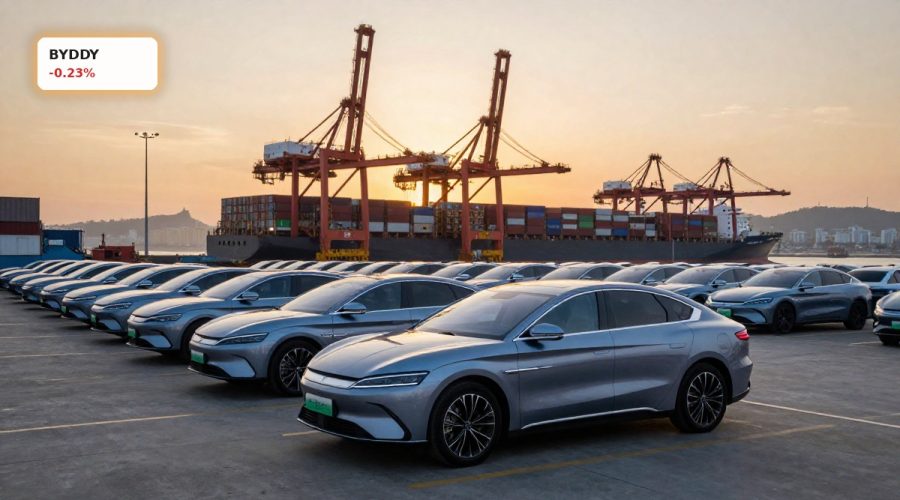
Can BYD Expansion into luxury EVs and Brazil-based exports really offset weak China margins and revive investor confidence?

How does BYD Expansion fit the current market setup?
BYDDY trades around $13.12, fractionally below the previous close of $13.15 and well off its 52-week highs, after a bruising China EV price war and a 2025 earnings slump. While U.S.-listed EV names like Tesla have dominated NASDAQ headlines, the world’s largest EV and plug‑in hybrid seller by volume is increasingly trying to write its next chapter abroad. The stock sits in what technicians describe as a support zone, with recent trading suggesting a potential base-building phase rather than outright capitulation.
Chart analysts highlight a broad consolidation after last year’s declines, with Fibonacci retracement levels signaling upside potential toward a resistance band near the equivalent of 108 in the Hong Kong listing. For U.S. investors, that setup frames BYDDY as a contrarian play: sentiment is fragile after a roughly two‑year de‑rating, yet the fundamental narrative around BYD Expansion—more exports, more factories, more brand layers—is strengthening.
How crucial is the luxury Denza brand for BYD Expansion?
A key pillar of the BYD Expansion strategy is the rollout of its upmarket Denza brand in Europe, showcased recently in Paris. Denza targets the premium EV segment that German automakers dominate, positioning itself against brands like Mercedes, BMW, and Audi rather than BYD’s own mass-market lineup. By structurally separating Denza from its core brand, BYD Company Limited aims to preserve its value-focused image in emerging markets while courting higher-margin buyers in the EU.
The European premium push also places BYD in more direct competition with Tesla and, to a lesser extent, luxury‑leaning technology ecosystems from groups like Apple and NVIDIA, which are shaping in-car software and autonomous driving stacks. For investors, Denza is crucial because premium models can improve blended margins at a time when Chinese mass-market EV prices are under intense pressure. If Denza gains traction in Europe, it could prove that BYD can climb the value chain rather than remain a pure volume story.
Why is Brazil central to BYD Expansion into Europe?
Another cornerstone of BYD Expansion is its manufacturing and logistics pivot into Brazil. The company is building out factories near coastal regions to serve both the local Latin American market and, importantly, the European Union via sea routes. A recent labor dispute clouded the narrative, as Brazilian authorities had placed BYD on a list of companies accused of forced-labor-related issues. After investigation, BYD received a favorable ruling and was removed from that list, removing a critical overhang.
This timing is important because the Mercosur–EU free trade agreement is set to take provisional effect on May 1. By shifting a meaningful portion of EU-destined production to Brazil, BYD Company Limited could reduce tariff friction and logistics costs, improving export margins at a moment when earnings have been under pressure. For U.S. shareholders, Brazil is not just about volume growth—it is about margin repair and risk diversification beyond China.
Can global exports offset weak China sales?
Chinese exports of electric and hybrid vehicles more than doubled in March, reaching a new record as high global energy costs and fuel-price volatility push fleets and consumers toward EVs. BYD has been a major beneficiary of that export boom, even as its domestic sales have slipped amid intense competition and ongoing price cuts at home. That mix shift is central to BYD Expansion: China may be stalling, but demand in Europe, Latin America and other emerging markets is accelerating.
Still, earnings have not been immune. Net profit fell about 19% recently, raising concerns that thinner Chinese margins and heavy capex for new plants could weigh on returns. Some analysts on Wall Street and in Asia remain cautious. While no major U.S. bank has issued a fresh rating in the past few days, previous commentary from firms like Morgan Stanley and Citigroup has stressed that long‑term upside depends on whether export-led growth can stabilize margins by 2026–2027. If the export boom sustains while domestic pricing stabilizes, current valuations could start to look more attractive relative to global auto peers.
How does BYD Expansion compare to global EV rivals?
Unlike Tesla, which remains asset-light in some regions and leans heavily on software and brand power, BYD is pursuing a vertically integrated, factory‑heavy strategy. The company is building or planning plants not just in Brazil but also in Hungary, Turkey and Canada, reinforcing its image as a full-scale global automaker rather than a niche tech brand. This factory network is designed to reduce geopolitical risk, shorten supply chains and localize content to navigate tariffs and regulations.
From a U.S. investor’s perspective, BYD functions as a diversified EV and battery play with a broad mix of hybrids, pure EVs and components. While it lacks the S&P 500 index presence of U.S. auto majors, it offers exposure to EV adoption in regions often underrepresented in NYSE and NASDAQ portfolios. The flip side is clear: capital intensity is high, earnings are more cyclical, and political risk—especially around trade barriers—remains significant.
Related coverage: What do earnings say about BYD Expansion?
Investors who want to understand how growth and profit dynamics intersect with BYD Expansion should also look at recent earnings coverage. Our in‑depth analysis in BYD Earnings Plunge 19%: Is This EV Knockout Stage? examines whether shrinking margins stem mainly from temporary pricing pressure in China or signal a more structural squeeze on returns. Together with the export and factory narrative outlined here, that piece offers a fuller picture of BYD’s risk‑reward profile for global investors.
Overall, BYD Expansion into luxury segments, Brazil-based EU production and booming exports positions the company for a more balanced global footprint. For investors on Wall Street, BYDDY is evolving from a purely China‑centric EV bet into a diversified international auto story with improving optionality but ongoing margin questions. The next few quarters will show whether this expansion strategy can translate into sustained earnings growth and a durable recovery in the share price.