Is Carvana’s 5-for-1 stock split a fresh leg in the rally or just a cosmetic move after a massive comeback?
How does Carvana’s 5-for-1 split work?
The Carvana Stock Split approved by the board is a straightforward 5‑for‑1 forward split of both Class A and Class B common stock. If shareholders sign off on a required charter amendment at the annual meeting on May 5, 2026, investors of record on May 6 will receive four additional shares for every one they currently own. Trading on a split‑adjusted basis is expected to begin May 7 under the existing CVNA ticker on the NYSE.
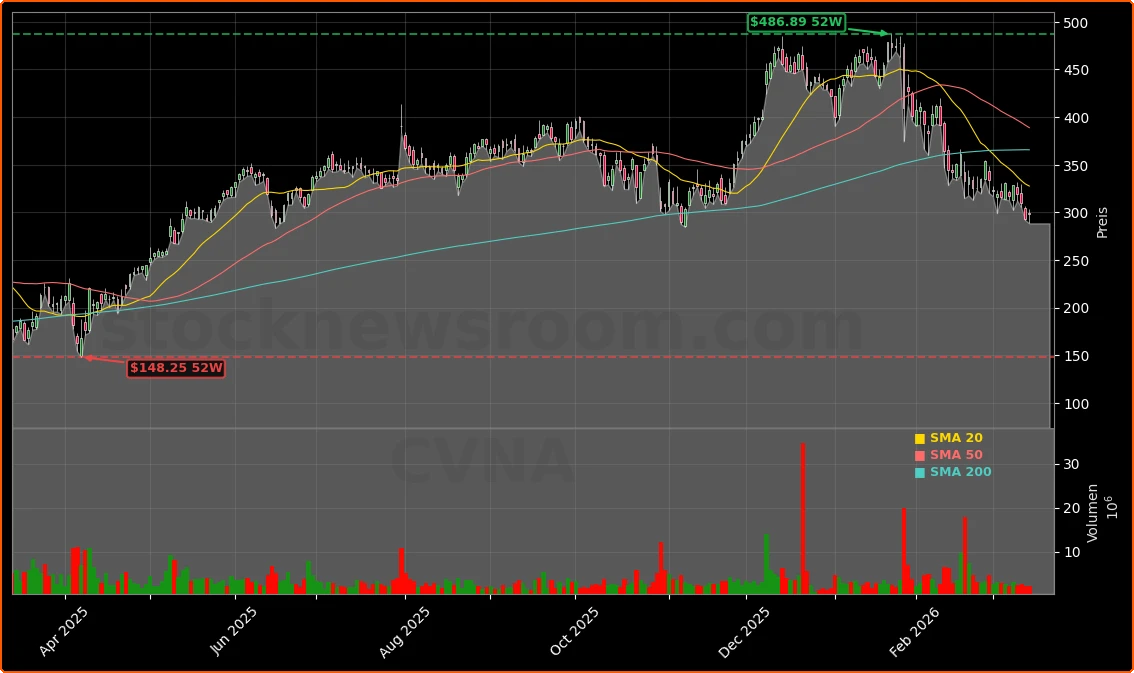
At today’s price of about $298.00, up roughly 1.8% from the prior close, a 5‑for‑1 split implies a post‑split price around $60 per share, without altering the company’s overall market capitalization. An investor holding 100 shares at $298 would end up with 500 shares at approximately $59.60; the total economic value of the position stays the same.
Management is framing the Carvana Stock Split primarily as an accessibility move. Chief financial officer Mark Jenkins emphasized that the split is intended to keep whole shares affordable for team members participating in equity programs and the company’s discounted Employee Stock Purchase Plan, as well as for outside retail shareholders who may be put off by a near‑$300 sticker price.
Why is Carvana making this move now?
The timing of the split follows one of the most dramatic turnarounds on Wall Street in recent years. From pandemic‑era lows, Carvana Co. has rallied thousands of percent, transforming from a distressed, near‑penny stock in early 2023 into a member of the S&P 500 with a share price that briefly approached $487 over the past 52 weeks. Even after a roughly 30% pullback year‑to‑date and a drawdown of nearly 40% from January highs, the stock remains up massively from its 2022 trough.
The company has also posted record levels for units sold and profitability in 2025, with trailing 12‑month revenue around $20.3 billion and earnings per share of about $8.45. Several research desks continue to see a robust growth runway. William Blair, for example, views Carvana as one of the most profitable operators in its segment and models long‑term unit growth of 20% to 40% annually over a four‑ to ten‑year span.
On the other hand, near‑term sentiment has turned choppy. Rising reconditioning and depreciation costs on used vehicles pressured fourth‑quarter 2025 results and triggered a reset in expectations. UBS cut its CVNA price target from $545 to $485 but maintained a Buy rating, calling the cost pressures temporary. DA Davidson was more cautious, reducing its target from $470 to $320 on valuation concerns, though it highlighted strong volume growth and execution.
Carvana Stock Split: Does cheaper mean better value?
From a corporate finance perspective, the Carvana Stock Split is purely cosmetic. A stock split multiplies the share count while proportionally cutting the price per share, leaving earnings per share, market cap, and balance‑sheet metrics unchanged. No new cash is raised and no debt is retired. It is essentially slicing the same pizza into more pieces.
Yet markets often interpret splits as a confidence signal. Boards typically authorize them after substantial price appreciation and when management believes the business can sustain or build on those gains. In Carvana’s case, the split follows record profitability and a long rally, even if momentum has cooled since January. For U.S. investors, the lower nominal price could also increase trading liquidity, facilitate option strategies with smaller contract notional values, and make it easier for employees and smaller accounts to build positions without relying on fractional shares.
Still, valuation remains a central question. CVNA trades at roughly 13 times estimated 2026 gross profit, at the low end of its historical band but rich relative to traditional used‑car players. Zacks Investment Research recently flagged the stock’s premium multiple versus CarMax (KMX), arguing that CarMax currently looks more attractive on value metrics while Carvana is the higher‑beta growth story.
How does Carvana compare with other growth names?
For many U.S. retail traders, Carvana sits in the same high‑volatility bucket as disruptive, story‑driven equities like Tesla or fast‑growing tech names such as NVIDIA and Apple. Like these companies, Carvana has experienced sharp drawdowns following meteoric gains, and its share price can swing dramatically around macro headlines, credit‑market shifts, and quarterly updates.
Sector‑wise, the company also intersects with the fast‑evolving electric‑vehicle ecosystem. As falling prices steer more buyers toward used EVs, platforms such as Carvana could become a key entry point for consumers priced out of new models from automakers including Tesla. That trend may support unit growth even in a slower macro environment, though it also introduces additional inventory and residual‑value risk.
Analyst opinions reflect this mix of opportunity and risk. Citizens has reiterated a positive stance on the stock with a $460 price target, citing progress toward an EBITDA margin goal of roughly 13.5%. At the same time, questions about accounting transparency raised in a January short‑seller report and concerns over related‑party transactions have tempered some institutional enthusiasm, contributing to the recent consolidation below the 52‑week high.
This is the first split in Carvana’s history, and we believe it achieves the important goal of keeping our stock accessible to all of our team members.
— Mark Jenkins, CFO of Carvana Co.
Conclusion
For diversified U.S. portfolios, the Carvana Stock Split itself doesn’t transform the investment thesis, but it may increase volatility around the split date as options markets reset and short‑term traders attempt to front‑run retail inflows.
Further Reading
- Carvana Co. (CVNA) on Yahoo Finance (Yahoo Finance)
- Carvana announces 5-for-1 stock split (Proactive Investors)
- Carvana Board of Directors Approves 5 for 1 Forward Stock Split (Business Wire)
- Does Carvana’s 5-to-1 Stock Split Make It a Buy? (24/7 Wall Street)