
Is Caterpillar quietly becoming an AI infrastructure powerhouse while investors still value it like a traditional cyclical industrial?

Is Wall Street mispricing Caterpillar’s AI role?
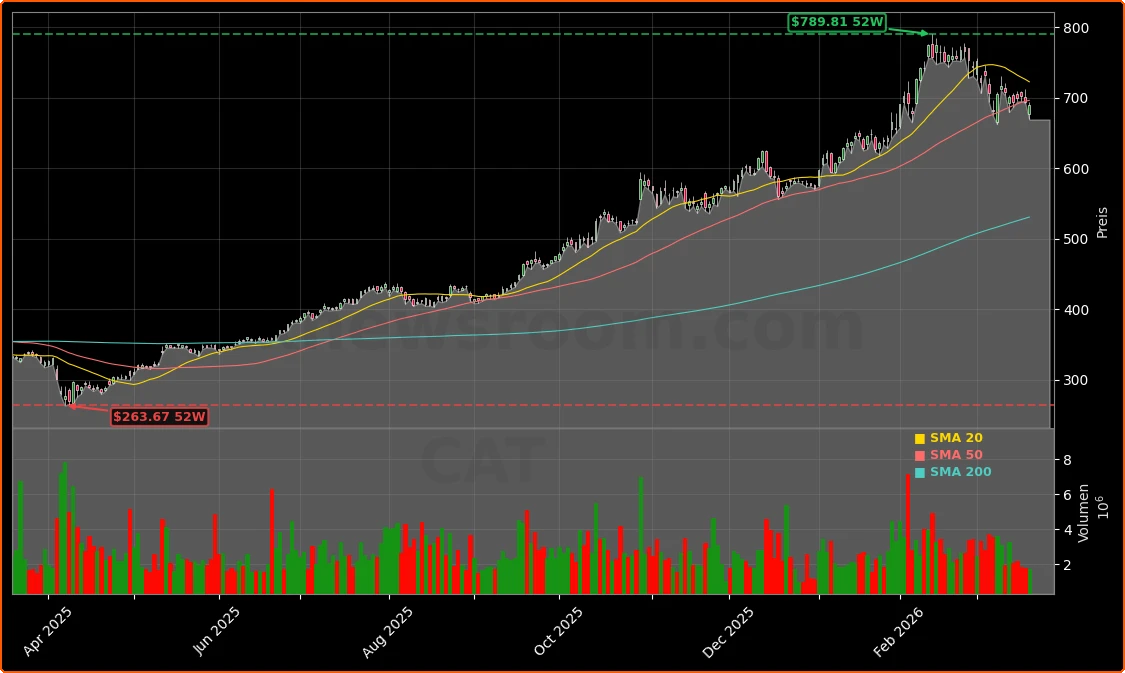
Caterpillar shares have cooled slightly, trading just under their 50‑day moving average after a stellar run in 2025, when the stock more than doubled. On Thursday, the Dow Jones Industrial Average fell sharply as rising oil and geopolitical tensions weighed on sentiment, and Caterpillar Inc. gave back around 1% intraday. Yet under the surface, the story is less about short‑term index swings and more about how Caterpillar AI Infrastructure exposure is changing the company’s risk and growth profile.
The energy and transportation segment, historically overshadowed by construction and mining, has become a strategic growth engine. Large‑scale reciprocating engines and backup generator systems are now being deployed as mission‑critical power for hyperscale AI data centers built by cloud giants such as Amazon and Microsoft. These megawatt‑scale facilities require highly reliable backup power to meet uptime guarantees, and only a handful of industrial players worldwide can deliver at Caterpillar’s scale, giving the company a tangible pricing and bargaining edge.
That focus is visible in the numbers: Caterpillar’s total backlog climbed 71% year over year to a record $51.2 billion, with a significant share tied to new‑build data center and AI power projects. Revenue in 2025 rose 4% to $67.6 billion, even as EPS dipped 17.2% to $18.81 on margin normalization and mix effects following a very strong prior year.
How central is Caterpillar AI Infrastructure to future growth?
For investors comparing Caterpillar to pure‑play AI winners like NVIDIA, the Caterpillar AI Infrastructure angle looks more like a “pick‑and‑shovel” play than a direct bet on semiconductors. As cloud providers race to deploy ever larger GPU clusters, they also need massive incremental power capacity, redundancy and on‑site emergency generation. Recent contracts to supply power solutions for large AI campuses, such as the Monarch AI campus power‑supply role, highlight that Caterpillar is becoming embedded earlier in the data center design cycle.
That position resonates with institutional buyers. Several asset managers, including CIBC Bancorp USA and Captrust Financial Advisors, have recently disclosed sizable or increased holdings in Caterpillar Inc., viewing the stock as a way to participate in AI infrastructure build‑out without paying the premium multiples attached to cloud or chip leaders. At the same time, some firms such as Mirabella Financial Services and Groupama Asset Management have trimmed positions, taking profits after the stock’s sharp rally, illustrating a healthy two‑way market rather than a one‑sided speculative surge.
Sell‑side analysts broadly remain constructive. Consensus on Wall Street currently sits at a “Moderate Buy,” with an average price target around $730, implying upside from current levels. While individual price‑target moves from houses like Morgan Stanley or Goldman Sachs have varied with the broader market, the underlying thesis is consistent: Caterpillar AI Infrastructure demand adds a secular layer on top of traditional construction and mining cycles.
What role does electrification and mining play for Caterpillar?
Beyond data centers, the global electrification trend is driving fresh demand for Caterpillar’s mining and construction equipment. As economies push toward electric vehicles and greener grids, consumption of copper, lithium and rare‑earth elements continues to rise. Mining companies are responding by investing heavily in larger, more efficient fleets, including autonomous haul trucks and advanced drilling systems supplied by Caterpillar Inc..
Management expects revenue growth of roughly 5% to 7% in 2026, supported by this electrification‑linked mining capex as well as elevated infrastructure spending worldwide. Unlike previous cycles, Caterpillar is also capturing more value through long‑duration service agreements, often lasting 20 to 30 years. These contracts generate higher‑margin, recurring revenue from parts, maintenance and digital monitoring solutions layered onto physical equipment.
For US investors, that means Caterpillar is evolving from a pure cyclical tied to housing and commodities into a hybrid model with more stable cash flows. In that sense, its profile is inching closer to diversified industrial peers like Honeywell and even tech‑adjacent infrastructure names. As governments in the US and abroad continue to roll out infrastructure and energy transition programs, Caterpillar is positioned to benefit both from physical project work and from the equipment needed to support EV and grid upgrades, somewhat analogous to how Tesla monetizes the EV ecosystem and how Apple and other platform companies build services around installed hardware.
Is the dividend still attractive after the rally?
Despite the run‑up in the stock price, income investors have not been left behind. Caterpillar Inc. has raised its dividend for 31 consecutive years, entering Dividend Aristocrat territory. The company lifted its quarterly payout by 7% in 2025 to $1.51 per share. Because the share price has climbed over 100% in the last year, the forward yield now sits around 0.8% to 0.9%, well below historical averages.
However, the payout ratio is only about 31.5%, leaving ample room for future increases. For long‑term holders, that combination of dividend growth, Caterpillar AI Infrastructure tailwinds and service‑led margin expansion offers a blend of growth and resilience rarely found in the industrials sleeve of an S&P 500 portfolio.
Volatility remains a risk, as recent sessions showed when Caterpillar and other Dow components dragged the index lower on macro headlines. But for investors comfortable with cyclical swings, the company’s deep moat in large‑scale engines, mining fleets and digitally enabled services provides a compelling case that today’s AI and electrification build‑out could support multi‑year growth beyond the current cycle.
Related coverage: how does this fit the industrial sector?
Caterpillar’s record backlog and AI-driven infrastructure push sit within a broader industrial renaissance on Wall Street. For context on how defense spending is reshaping the sector, our coverage of Boeing’s 737 MAX delivery challenges highlighted how legacy manufacturers are navigating regulatory headwinds while trying to capitalize on surging government budgets. Meanwhile, in European defense, Rheinmetall’s record earnings and bold 2030 targets illustrate how the global infrastructure and defense boom extends well beyond US borders, creating a multi-year tailwind for the entire industrial complex.
Ultimately, Caterpillar AI Infrastructure, mining exposure and rising services together suggest that the stock is more than a short‑term trade on construction activity and may merit a core allocation in diversified US and global equity portfolios.