Can a veteran insider stepping into Caterpillar’s CFO seat keep the stock’s powerful rally and AI-infrastructure momentum on track?

How does Caterpillar CFO Change hit the stock?
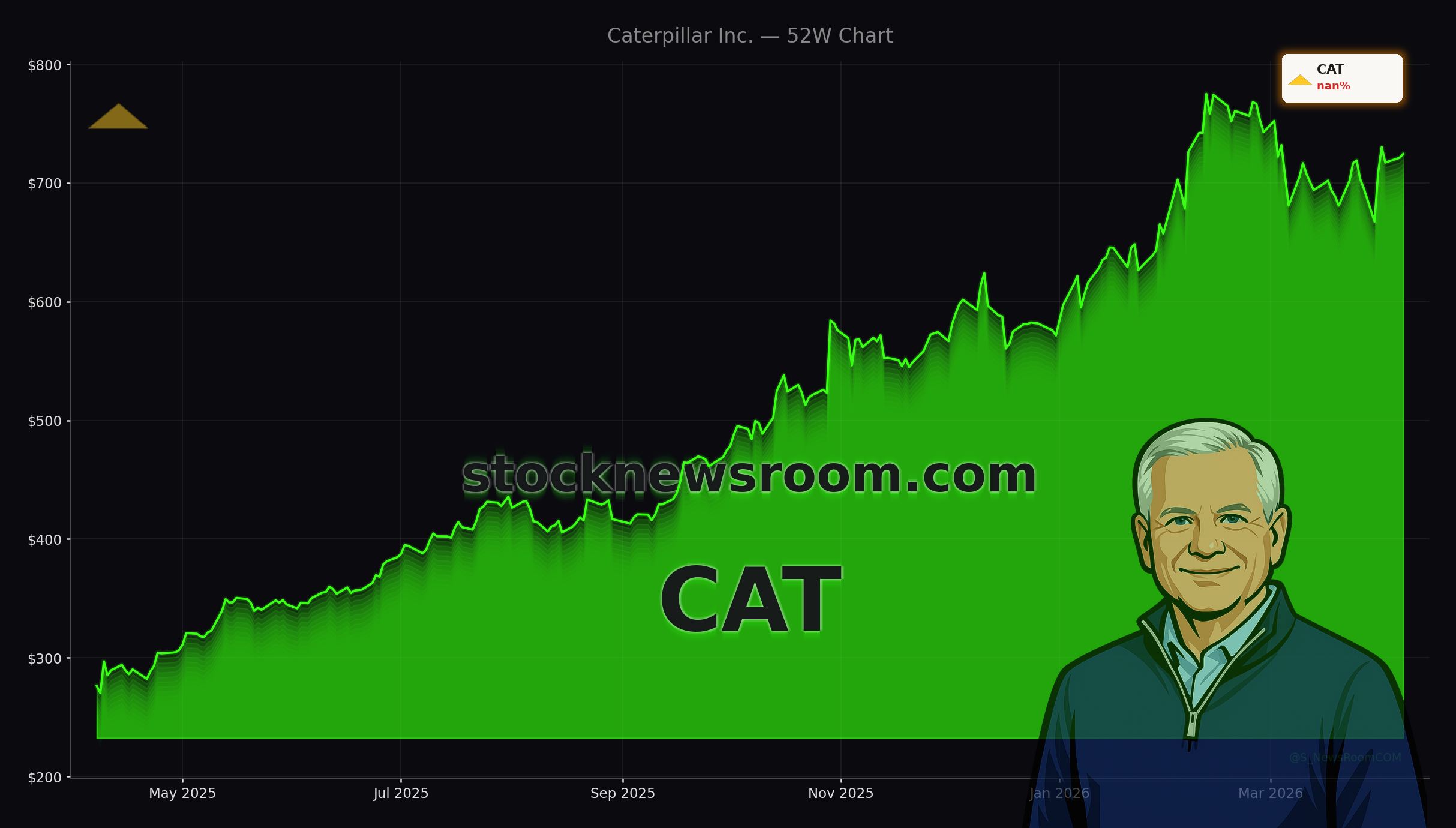
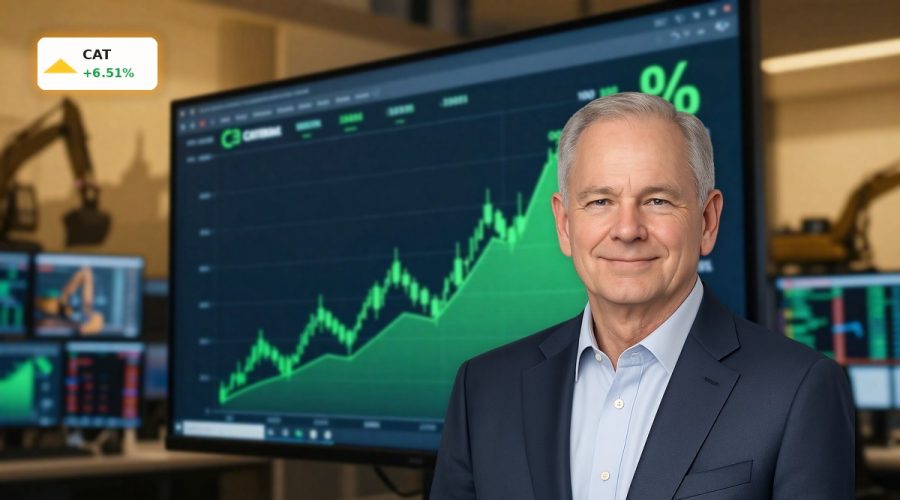
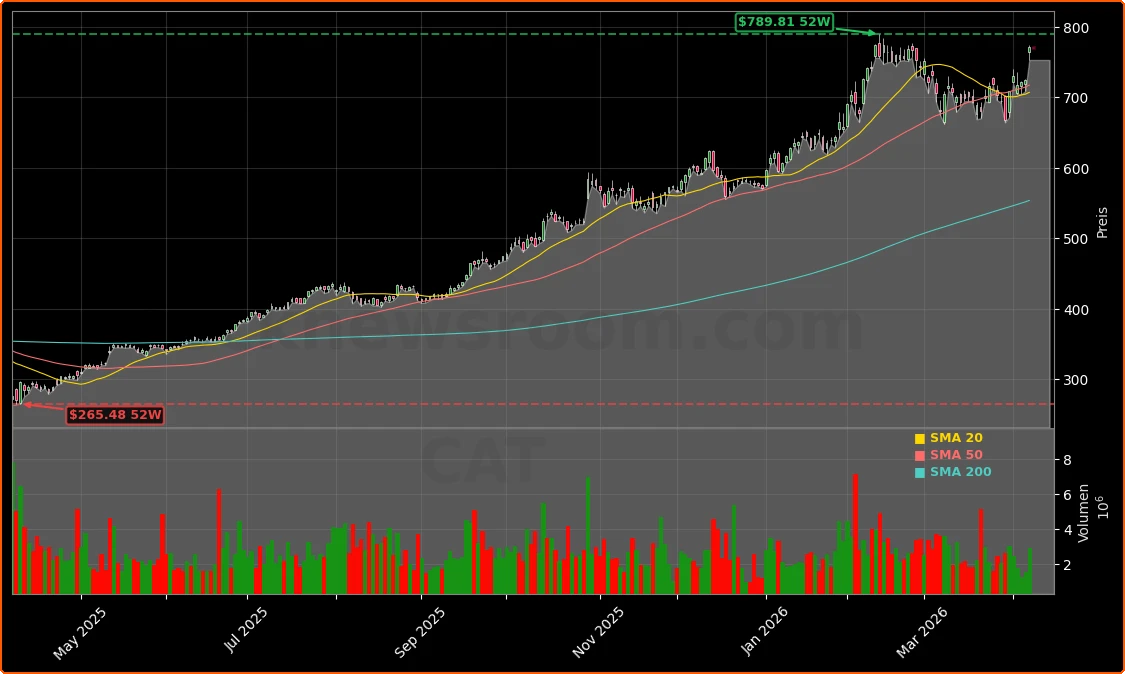
Caterpillar Inc. (CAT) was among the top performers in the Dow Jones Industrial Average on Wednesday, jumping 6.51% to close at $771.58 before easing slightly in after‑hours trading to about $769.26. The rally coincided with softer Treasury yields, which tend to support capital‑intensive construction and infrastructure names by lowering financing costs for large projects. Against this supportive macro backdrop, the Caterpillar CFO Change announcement reinforced a narrative of continuity rather than disruption at the industrial heavyweight.
Wall Street’s bullishness on the name has increasingly been tied to multi‑year infrastructure spending, mining demand and the fast‑growing need for backup and primary power solutions in AI and cloud data centers. Caterpillar’s generators and gas‑fired power systems are being deployed to support new data‑center capacity, a theme that has also benefited hyperscale technology leaders like NVIDIA and Apple further up the stack. For many portfolio managers, the combination of cyclical tailwinds and structural AI‑infrastructure growth makes leadership stability in the finance seat particularly important.
Who is new finance chief Kyle Epley?
The Caterpillar CFO Change elevates Kyle Epley, a nearly 30‑year company veteran, to one of the most influential posts in the U.S. industrial complex. Epley currently serves as senior vice president of Global Finance Services, overseeing enterprise‑wide finance operations, strategy, planning, treasury, pricing, real estate and facilities. Over his career he has held multiple senior finance roles, including division CFO and corporate controller, giving him deep visibility into margins, capital allocation and risk across Caterpillar’s three major segments: Construction Industries, Resource Industries, and Power & Energy.
Chairman and CEO Joe Creed positioned the promotion as a deliberate, succession‑planned handoff, emphasizing Epley’s institutional knowledge and track record of “working with the business to drive results.” Outgoing CFO Andrew Bonfield also endorsed his successor, describing Epley as the right leader to guide the next phase of profitable growth and shareholder value creation. For investors, internal promotions typically signal strategic continuity, particularly around disciplined capital returns and cautious balance‑sheet management.
What has Andrew Bonfield delivered?
Bonfield, who became CFO in 2018, exits after an unusually strong run for a traditionally cyclical industrial. Under his financial stewardship, Caterpillar’s sales climbed roughly mid‑20% and profit grew by more than 40%, culminating in record 2025 sales and revenues of $67.6 billion and a single‑quarter record of $19.1 billion in Q4 2025. He also helped steer the company through U.S.–China tariff pressures, pandemic disruptions and the early stages of the AI‑infrastructure build‑out that is now driving a surge in large‑engine and power‑systems demand.
Bonfield was recognized as 2025 CFO of the Year by the CFO Leadership Council and Chief Executive Group, reflecting both operational discipline and shareholder‑friendly capital allocation. Caterpillar has maintained a robust dividend policy, recently keeping its quarterly payout at $1.51 per share, preserving its status as an S&P 500 Dividend Aristocrat with more than 30 consecutive annual dividend increases. The advisory period through October 1, 2026, should give Epley time to absorb the role while ensuring no abrupt shift in financial strategy.
What does Caterpillar CFO Change mean for strategy?
The Caterpillar CFO Change is unlikely to herald a dramatic strategic pivot. Management has repeatedly stressed continuity in its operating model: disciplined pricing, lean manufacturing, tight cost control and a sharpened focus on high‑margin services and aftermarket revenue. Epley’s background in treasury and pricing suggests he will continue prioritizing return on invested capital, especially as the company weighs capacity additions to serve AI data centers and large infrastructure projects globally.
Investors will be watching closely how the new CFO balances growth investments with shareholder returns. Caterpillar ended 2025 with a record backlog—recent commentary pointed to around $51 billion—driven by demand in its Power & Energy segment tied to AI data centers, as well as traditional construction and mining cycles. Maintaining margin discipline while managing supply‑chain risk and potential tariff or regulatory shifts will be central to Epley’s mandate. His early moves on debt issuance, buybacks and potential bolt‑on acquisitions will set the tone for how aggressive or conservative his tenure will be.
How does Caterpillar compare to U.S. peers?
From a U.S. portfolio perspective, Caterpillar sits at the intersection of industrials, infrastructure and AI‑driven power demand, a position few peers can fully replicate. General Electric and other diversified industrials are also participating in the power and grid upgrade cycle, but Caterpillar’s deep exposure to construction, mining and on‑site generation makes it a unique play on global capital spending. The company’s performance has helped propel it to the upper tier of the S&P 500 industrials cohort, drawing comparisons with high‑beta growth names such as Tesla in terms of recent stock momentum, albeit with a more established dividend profile.
Analyst sentiment has generally leaned positive following Caterpillar’s strong Q4 2025 beat on both earnings per share and revenue, with several Wall Street banks lifting price targets earlier this year. While some firms have issued more cautious ratings—UBS, for example, recently slapped a “Sell” on the stock on valuation and cyclical risk grounds—others, including Goldman Sachs and Morgan Stanley, have highlighted Caterpillar as a multi‑year beneficiary of infrastructure and AI‑power demand. For now, the CFO transition appears to support, not undercut, that bullish long‑term thesis.
Related Coverage
Investors who want to dig deeper into the AI narrative behind Caterpillar’s recent run‑up can read how its power systems and engines are feeding data‑center demand in “Caterpillar AI Infrastructure Boom: Record Backlog and Growth Shock”. That piece explores whether the market is still valuing the company like a traditional cyclical industrial despite its growing AI exposure.
For a broader look at industrial‑sector risk, especially around aerospace and defense supply chains, see “Boeing Supply Chain Risk +3.8%: Middle East Conflict Warning”. Understanding how supply‑chain fragility can ripple across large manufacturers offers useful context when assessing Caterpillar’s own production and sourcing resilience.
Kyle is an outstanding leader with deep institutional knowledge and a proven track record of working with the business to drive results.— Joe Creed, Caterpillar chairman and CEO
In summary, the Caterpillar CFO Change marks a managed handoff from a highly regarded finance chief to an experienced insider at a moment of record sales, rising dividends and strong share‑price momentum. For U.S. and global investors, the transition underscores leadership continuity just as the company leans into multi‑year infrastructure and AI‑power tailwinds. The next few quarters will show how effectively Kyle Epley can convert Caterpillar’s vast backlog into sustained earnings growth while preserving the disciplined capital allocation that has defined the Bonfield era.