Is Chevron quietly turning geopolitical chaos into a strategic advantage while most investors focus only on the oil price spike?
How is Chevron Geopolitics moving Wall Street?
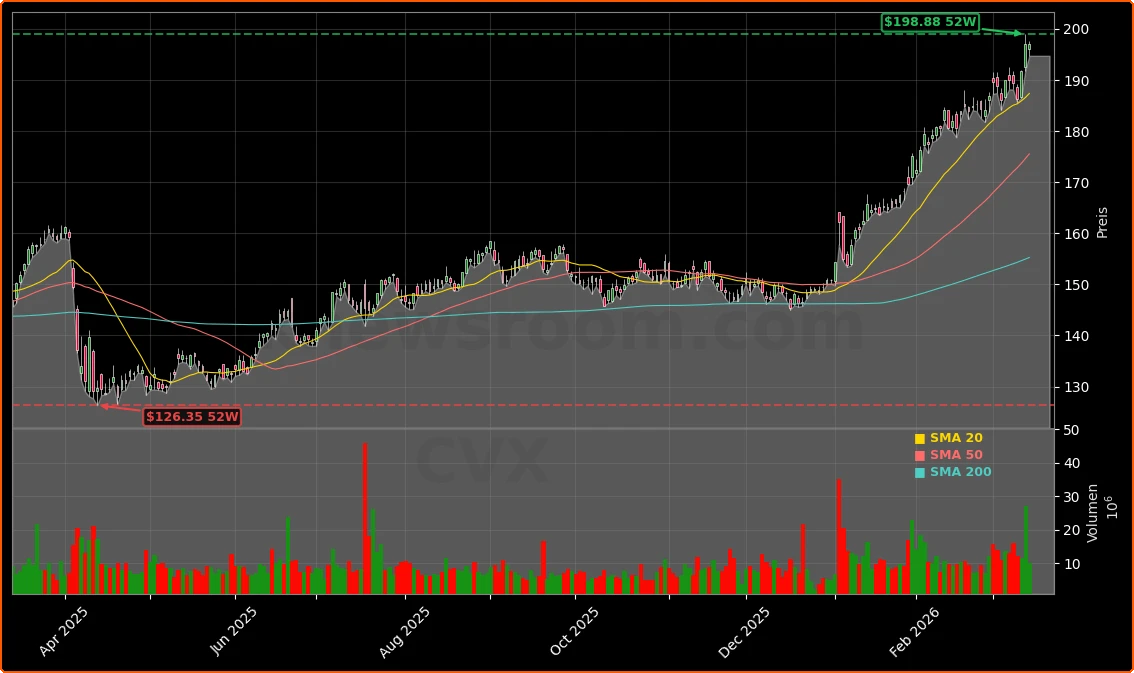
Energy is one of the only S&P 500 sectors in the green this week, helped by the surge in crude prices after Iran shut the Strait of Hormuz to international tankers. Brent is trading north of $100 per barrel and WTI near $95, feeding fears of stagflation but boosting cash flows for integrated oil majors. Chevron (CVX) closed around $196.99 on Friday, marginally below Thursday’s print but still near its recent record zone after touching an all-time high just above $197 earlier in the week.
While energy stocks make up less than 4% of the S&P 500, their sharp gains have stood out against broad index declines. CVX has climbed nearly 30% in 2026, outpacing peers like Exxon Mobil and Occidental as geopolitics reprices global supply risk. Market strategists on Wall Street now describe the large integrated oils as “defensive hard assets” in a nervous tape, with some hedge funds rotating capital out of high-multiple tech names such as NVIDIA and Apple into energy exposure.
Why Chevron and not Exxon Mobil?
In the current phase of Chevron Geopolitics, investors are rewarding the company’s specific asset mix. Chevron has emerged as a key beneficiary of efforts to offset Middle East disruptions via production growth in the Americas. It has expanded its operations in Venezuela, where it enjoys a unique incumbent position and long-standing political connections in Washington, allowing it to ramp volumes as sanctions regimes shift. That makes Chevron a more direct play on the re-routing of crude flows away from the Persian Gulf.
By contrast, Exxon Mobil and ConocoPhillips have rallied, but not to the same extent. Energy ETFs that overweight Chevron, Exxon and Occidental are seeing inflows as traders look for diversified exposure to elevated crack spreads and upstream profits. Bank of America Securities and JPMorgan have both highlighted the integrated oil majors as among the best-positioned groups for a prolonged stagflation or conflict scenario, with some short sellers using energy longs against broader S&P shorts.
What does the restructuring mean for Chevron?
Behind the headline gains, Chevron is undertaking one of the most radical overhauls in its 150-year history. The company had 39,742 employees at the end of 2024, plus more than 5,500 staff in its retail network. In February 2025, management announced plans to cut 15% to 20% of the global workforce by the end of 2026, implying up to 9,000 job losses. The goal is to simplify the organizational structure, boost efficiency and strip out roughly $3 billion in costs.
This restructuring has geographic as well as financial dimensions, underlining the role of Chevron Geopolitics in shaping its footprint. After decades as a California icon, Chevron closed its San Ramon headquarters in 2024 and shifted its corporate center to Houston, citing a friendlier regulatory climate and lower costs. The move underscores the company’s pivot toward US Gulf Coast and global export hubs, and away from states with tighter environmental rules.
Portfolio shifts: Angola sale and Eastern Med risks
Chevron is also reshaping its asset base. The company plans to sell its stakes in Angola’s offshore Blocks 14 and 14K to Energean for $260 million, allowing it to exit a mature West African position while focusing capital on higher-return projects. At the same time, Chevron and partners Shell and NewMed are advancing the Aphrodite gas field off Cyprus, with an updated development plan and front-end engineering design work underway.
Security risks remain visible. Israel temporarily shut gas fields such as Leviathan amid regional tensions, highlighting how quickly assets in the Eastern Mediterranean can be affected by conflict. Nonetheless, Chevron’s share price held up through those disruptions, reflecting investor confidence in its ability to navigate complex political environments and secure exemptions, permits and logistics solutions when other operators are sidelined.
Is the stock overextended after the oil spike?
Technical investors see CVX breaking out of a years-long sideways consolidation that resembled a large bullish flag, opening multi-year upside potential toward roughly $280 if high prices persist. Piper Sandler recently lifted its price target on Chevron from $179 to $242 and reiterated an Overweight rating, citing stronger cash generation and improved capital discipline. Other Wall Street houses, including Zacks Investment Research, still classify the stock as an outperformer within the integrated oil group.
Yet valuation has become a point of debate. With Chevron trading near $200 and at a premium to rivals like Exxon Mobil and Shell on some multiples, several analysts warn that chasing the trade after a 30% year-to-date run can be risky. GuruFocus estimates a fair value well below the current quote, and the average 12-month target from a broader analyst set sits under the market price, suggesting limited upside from here. Veteran portfolio managers argue that the best entry points in cyclical oil stocks typically come when spot prices are depressed, not when panic over supply is peaking.
The oil market itself also looks stretched. Brent’s intraday swings have reached as much as $50 in a single session, a sign of extreme risk premia driven by the Strait of Hormuz shutdown. Historically, such spikes have tended to fade as the system adapts—via Saudi pipelines to the Red Sea, rising US exports, or additional flows from Russia and Venezuela. If the Iran conflict stabilizes and the strait reopens, a pullback in crude could compress earnings expectations for Chevron just as the stock discounts a best-case scenario.
Conclusion
For investors, Chevron Geopolitics is therefore a double-edged sword: it currently supports record cash flows and a defensive narrative, but it also magnifies downside if tensions ease. Chevron remains a core global energy player with strong US ties, a powerful balance sheet and a deep dividend record, yet new buyers may prefer to wait for volatility or a correction rather than chase the latest spike, while long-term holders can use the elevated backdrop to reassess exposure alongside other large positions in names like Tesla and NVIDIA.
Further Reading
- Chevron Corporation (CVX) on Yahoo Finance (Yahoo Finance)
- Chevron Near $200 While Oil Tops $100: Does CVX Merit a Buy? (Zacks Investment Research)
- Chevron Hits New Highs Due to Oil’s Rally, But Is It Sustainable? (MarketBeat)
- Piper Sandler Raises Chevron (CVX) Price Target to $242 (GuruFocus)