Is the Chevron Middle East Crisis a fleeting oil shock or the start of a new energy supercycle for investors?
How is Chevron reacting to the Middle East shock?
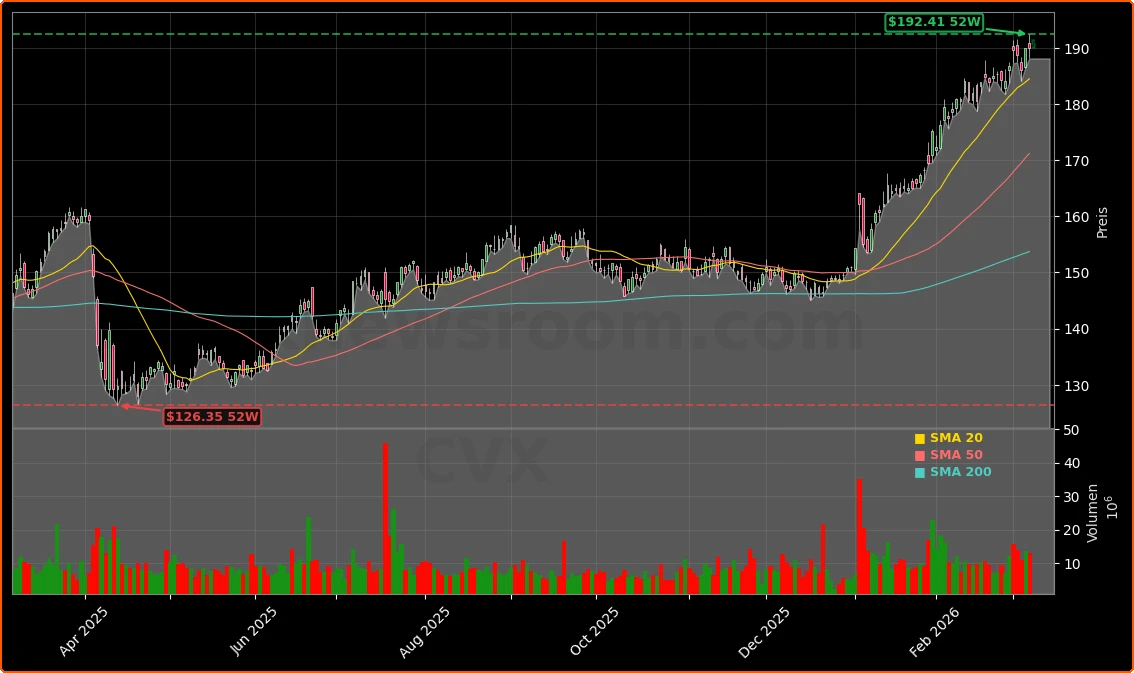
Energy stocks are once again separating from the broader market as crude spikes on supply fears linked to the Chevron Middle East Crisis. With the Strait of Hormuz effectively shut and several Gulf producers, including Bahrain, Kuwait and the UAE, suspending or rerouting exports, WTI has surged into the low $120s and Brent has traded close to $120–$125 per barrel. On Monday morning, Chevron Corporation (CVX) was quoted at about $189.94, fractionally above Friday’s close and indicated higher in pre-market trading around $191.41, as futures markets priced in elevated crude for at least the near term.
That modest move in the stock contrasts with the violent swing in the commodity itself. Chevron, along with peers Exxon Mobil and ConocoPhillips, had already rallied more than 20% in the weeks leading up to open conflict with Iran as traders front-ran the risk of disruption. Since the shooting started and the Chevron Middle East Crisis intensified, share price gains have been more muted, suggesting investors are discounting the likelihood that today’s extreme oil prices will persist for years.
What does the Strait of Hormuz shutdown change for Chevron?
The closure of the Strait of Hormuz is the core driver of the current Chevron Middle East Crisis narrative. Roughly a fifth of globally traded crude normally passes through this chokepoint, and any interruption immediately tightens physical supply and spikes shipping and insurance costs. The U.S. has announced a multibillion-dollar reinsurance backstop and stepped-up naval escorts to coax tankers back into the Gulf, but for now flows remain constrained, keeping a risk premium embedded in prices.
Chevron is structurally positioned to benefit from higher benchmark prices even without dramatically increasing output. The company has spent the past several years cutting costs, focusing on high-margin barrels in the Permian Basin and other shale plays, and maintaining discipline in capital spending. Management has repeatedly guided that it can grow free cash flow through 2030 assuming an average oil price of around $70 per barrel. Anything above that level, even if temporary, fattens margins, supports aggressive shareholder returns, and gives Chevron more flexibility to fund energy transition projects.
The flip side is that if diplomacy or military pressure quickly reopens the Strait and crude retreats back toward $80–$90 a barrel, some of the near-term upside investors are penciling in could evaporate just as fast. The pre-war rally in oil majors leaves room for a pullback if the crisis premium unwinds.
How are Wall Street and big investors positioned on Chevron?
Institutional money remains deeply involved in Chevron despite the volatility around the Chevron Middle East Crisis. Korea Investment CORP recently increased its stake by nearly 25% in the third quarter, taking its holdings to more than 1.4 million shares valued north of $200 million. Munich Reinsurance also initiated a sizable new position, adding Chevron as a top-20 holding. Vanguard and other large asset managers continue to be among the biggest owners, reflecting Chevron’s role as a core energy and dividend play in global portfolios.
Not all professional investors are adding exposure. Orleans Capital Management and Grantham Mayo Van Otterloo have trimmed positions, and insider selling by senior executives, including CEO Michael Wirth, has picked up after the latest share price strength. Analyst opinions are mixed but generally constructive: several Wall Street firms, including MarketBeat-tracked brokerages, show an average price target near $178–$180 per share, slightly below spot, which implies that many models were built on lower oil assumptions before the current shock.
Dividend-focused research from firms such as The Motley Fool continues to highlight Chevron alongside mega-cap names like Apple and NVIDIA as part of the market’s elite nominal-dollar dividend payers. The company recently increased its quarterly payout again, reinforcing its status as a defensive income anchor for investors looking to hedge inflation and geopolitical risk.
Is Chevron now a tactical trade or a long-term hold?
For options traders, the spike in implied volatility around Chevron offers additional ways to play the Chevron Middle East Crisis. Some strategies now circulating on Wall Street involve shorting out-of-the-money puts and covered calls on CVX, effectively betting that oil prices are near a peak and that the stock will remain range-bound rather than continuing a vertical climb. Elevated option premiums can generate attractive yields if crude stabilizes or drifts lower without a severe collapse.
Long-only investors are weighing a different question: whether Chevron should be treated mainly as a short-term crisis hedge or as a compounding dividend growth story. With crude already above $110–$120 and some forecasts envisioning a test of prior all-time records near $148 per barrel, Chevron has clear leverage to any prolonged disruption. At the same time, its ability to grow cash flows at $70 oil, combined with a strong balance sheet and disciplined capital allocation, underpins a long-term case that does not depend on permanent conflict in the Gulf.
Conclusion
For diversified U.S. portfolios that already hold sizable positions in growth leaders like Tesla and Apple, Chevron offers sector diversification and exposure to a very different macro driver. The next few weeks of headlines out of the Gulf will determine whether the Chevron Middle East Crisis proves to be a brief spike or the start of a longer regime of structurally higher energy prices.
Further Reading
- Chevron Corporation (CVX) on Yahoo Finance (Yahoo Finance)
- Double, Double, Oil and Trouble: Crude Hits $116 and Here’s What It Means (24/7 Wall Street)
- Wall Street Is Quietly Pricing In $100 Oil, And These Two Energy Giants Are the Biggest Winners (24/7 Wall Street)
- Korea Investment CORP Has $219.35 Million Stock Holdings in Chevron Corporation (MarketBeat)