
Is the Citigroup Strategic Shift finally unlocking hidden value or just the latest turn in a long restructuring saga?

How is Citigroup redefining its global footprint?
The most visible element of the Citigroup Strategic Shift is the separation of Banco Nacional de México, better known as Banamex, from the group’s core operations. Citigroup Inc. plans an initial public offering of the Mexican retail banking arm on the Mexican Stock Exchange (BMV) sometime in 2026, following a deal to sell a 49% stake to a consortium led by Mexican investor Fernando Chico Pardo ahead of the listing. For U.S. and international shareholders, the move is designed to crystallize value in a mature, domestically focused franchise while refocusing capital and management bandwidth on institutional and wealth clients.
Parallel to the Banamex deal, Citibank, N.A., the group’s consumer banking division, is closing all but one of its branches in the United Arab Emirates. Management has linked that decision to heightened geopolitical risk tied to Iran. Together, the Banamex carve-out and the UAE retrenchment underscore that the Citigroup Strategic Shift is not merely cosmetic; it is a systematic pruning of non-core or higher-risk consumer operations in favor of a leaner global network. That approach differentiates the bank from more domestically centered U.S. peers but aligns it with other globally exposed lenders that are sharpening their focus on returns and regulatory efficiency.
What does the leadership change mean for Citigroup Inc.?
Another pillar of the Citigroup Strategic Shift is internal: a C-suite rotation at a critical juncture. Long-time executive Mark Mason, who served as chief financial officer from 2019 and helped steer the bank through post-crisis restructuring and regulatory remediation, has stepped aside from the CFO role and plans to leave the company by year-end as he pursues a CEO post elsewhere. Mason, now executive vice chair and senior executive adviser, has been explicit that his next move should be a chief executive position, which likely means a smaller institution than Citigroup Inc. given typical board preferences against a direct CFO-to-CEO “double switch.”
Mason’s tenure was defined by unwinding Citi’s legacy “bad bank,” Citi Holdings, eliminating tens of thousands of jobs and disposing of roughly $830 billion in non-core assets, as well as navigating costly operational mishaps, including mistaken payments and heightened regulatory scrutiny. New CFO Gonzalo Luchetti has signaled a pivot from remediation to innovation, reinforcing CEO Jane Fraser’s narrative that the “heavy lift” on controls and infrastructure is largely done. For investors comparing Citi with peers like JPMorgan Chase, Bank of America and Wells Fargo, the question now is whether this leadership transition will finally convert years of clean-up spending into sustainable earnings growth and capital returns.
How does crypto fit into the Citigroup Strategic Shift?
The Citigroup Strategic Shift also extends to digital assets, where the bank is taking a more cautious stance. After previously projecting aggressive upside for major cryptocurrencies, Citigroup has cut its 12‑month price targets for Bitcoin and Ethereum, lowering its Bitcoin forecast from $143,000 to $112,000 and its Ether forecast from $4,304 to $3,175. The revision is linked to slower-than-expected progress on the U.S. CLARITY Act, which aims to define regulatory ground rules for digital assets.
In parallel, Citigroup’s equity research team has trimmed price targets across several crypto-related stocks and downgraded crypto exchange Gemini to Sell from Neutral, slashing its price target from $13 to $5.50 after a prolonged share-price slide and ongoing losses. This more defensive posture on digital assets contrasts with the enthusiasm that helped fuel earlier bull cycles and highlights that the Citigroup Strategic Shift includes tighter risk filters for high-volatility business models. For investors holding crypto-exposed equities alongside megacap tech names like NVIDIA and Tesla, Citi’s stance is a reminder that institutional capital can turn more selective even as blockchain adoption continues.
What are markets and institutional investors signaling?
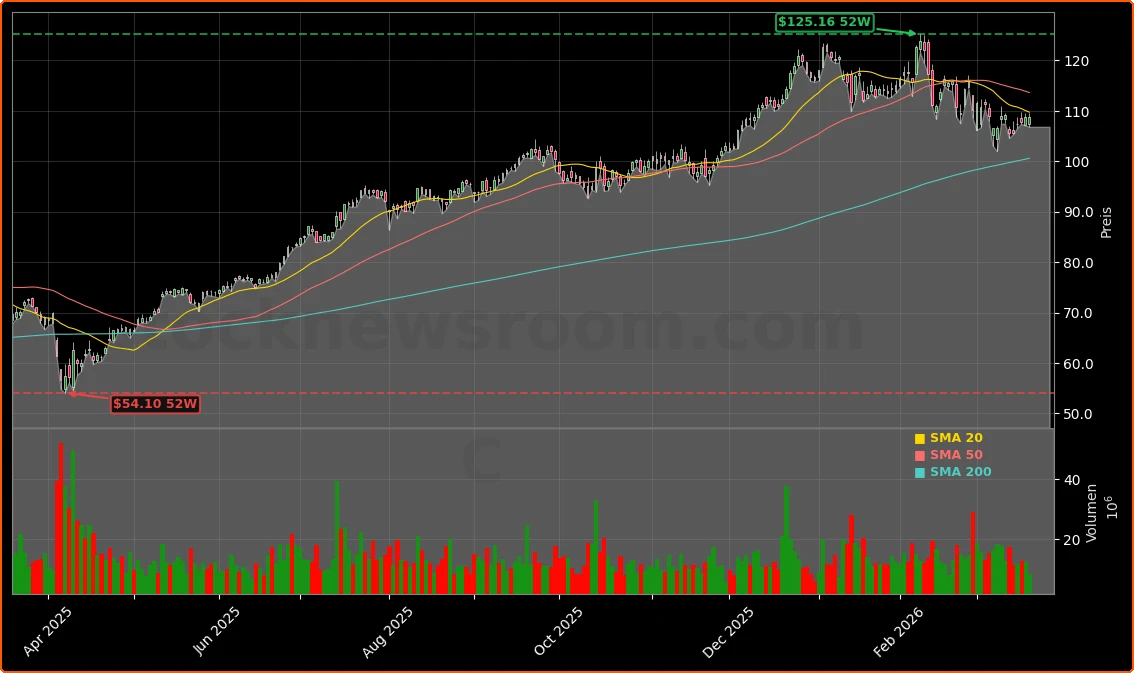
Citigroup shares edged up around 0.06% to $108.74, slightly above the previous $108.22 close, keeping the stock solidly in the upper portion of its 52‑week trading range but below any new-record territory. On CNBC’s “Halftime Report,” Jim Lebenthal of Cerity Partners highlighted Citigroup Inc. as a preferred bank exposure, citing the Banamex IPO plans and ongoing restructuring as catalysts for potential rerating. The bank remains part of the S&P 500 financials complex, so any multiple expansion could filter through widely held index and ETF allocations.
Institutional flows add another layer to the story. Swiss Life Asset Management Ltd recently increased its stake in Citigroup by 5.3% in the third quarter of 2025, lifting its position to 261,594 shares valued at about $26.55 million. At the same time, insider Ernesto Torres Cantu sold a sizable portion of his holdings, trimming his exposure by nearly half. Analyst consensus compiled by MarketBeat sits at “Moderate Buy,” with the bank offering a dividend yield around 2.2%, positioning it as a blend of income and restructuring-driven upside for diversified portfolios that might also hold mega-cap platforms like Apple.
How do regulation and macro conditions shape the outlook?
Macro and regulatory currents will heavily influence whether the Citigroup Strategic Shift delivers. The Federal Reserve has kept benchmark rates steady at 3.50%–3.75% while warning that inflation pressures remain sticky, a backdrop that compresses net interest margins and challenges near-term earnings across money-center banks such as JPMorgan, Bank of America, Citigroup, Wells Fargo and KeyCorp. At the same time, proposed easing of capital rules for major Wall Street lenders could eventually free up billions of dollars for additional lending, share buybacks and dividends, potentially benefiting Citi given its still-discounted valuation relative to some peers.
Beyond banking, Citi’s own research arm remains active across sectors. For example, Citigroup analyst Yigal Nochomovitz has reiterated a Buy rating on biotech firm Arvinas and raised its price target from $18 to $21, illustrating how Citi continues to shape sentiment in high-growth corners of the market. For investors balancing exposure across financials, technology and healthcare – from Apple-driven consumer tech to AI beneficiaries and select biotechs – Citi’s evolving risk posture and capital allocation priorities will be key reference points when assessing broader Wall Street trends.