
Is the Cloudflare AI Competition with Anthropic’s Claude Code Security just a panic reset or the start of a deeper SaaS repricing?

Why did Cloudflare get hit so hard today?
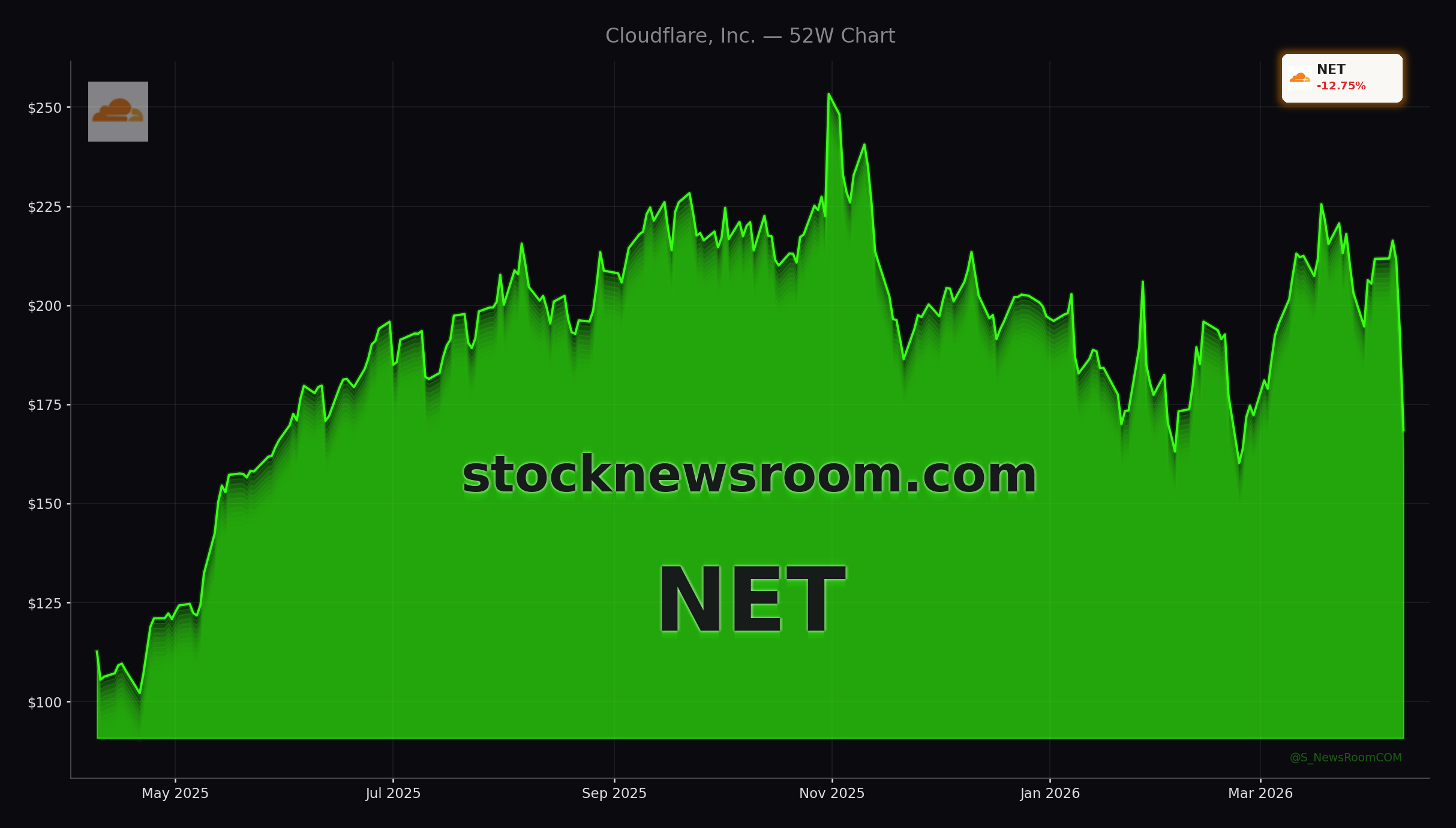
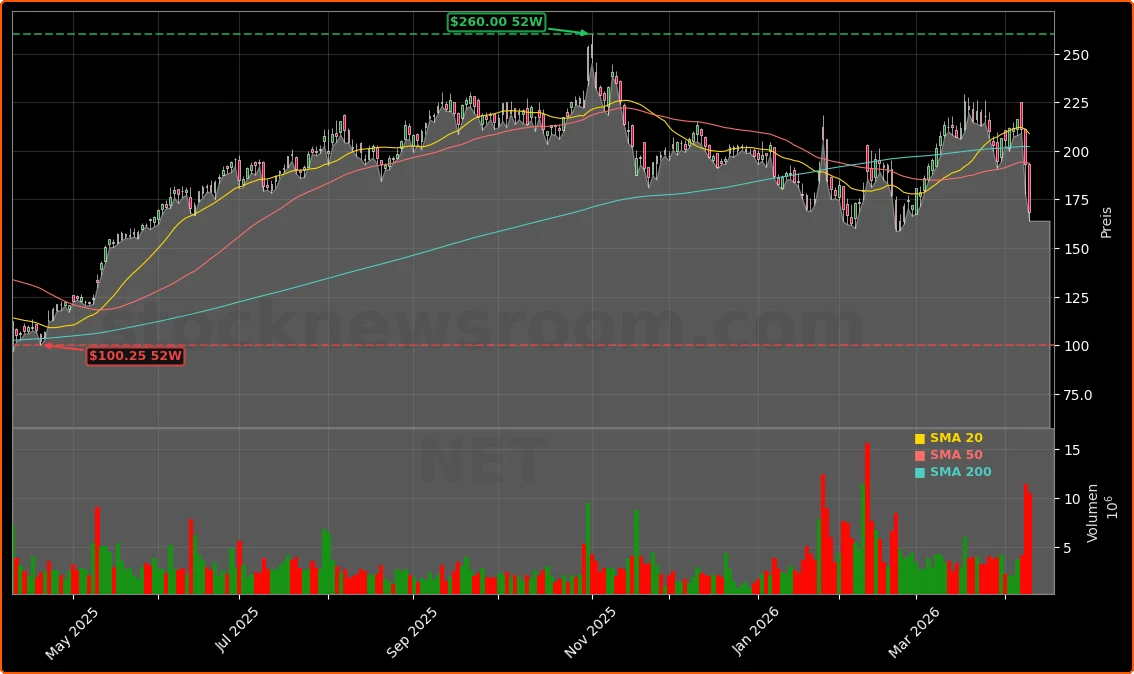
Cloudflare und SaaS-pocalypse durch Claude Code Security became the dominant narrative on Wall Street as the stock slid 12.82% on Friday to $168.31, from a prior close of $193.04. That follows a double-digit decline the previous session, taking NET from the low $210s on Wednesday to the mid‑$160s on Friday in one of the sharpest two-day drawdowns among large-cap software names this year. The move came even as the broader Nasdaq 100 was only modestly weaker, highlighting how concentrated the pressure was in high-multiple SaaS and security stocks.
Anxiety centers on whether Anthropic’s new Claude Code Security product could begin to compress the pricing power and strategic relevance of security and observability tools offered by Cloudflare, ServiceNow, and CrowdStrike. Investors are effectively stress-testing the entire SaaS model against a world in which AI agents automate more of the work today handled by subscription software platforms. For Cloudflare specifically, the fear is that incremental AI-native offerings could sit closer to the developer and application layer, sidelining parts of Cloudflare’s value proposition or forcing it to compete more directly on AI capabilities rather than just network scale and performance.
Is Cloudflare’s AI platform thesis breaking?
Cloudflare’s management has spent the past year arguing the opposite of what Friday’s trading implied—that AI will enhance rather than threaten its role in the stack. CEO Matthew Prince has repeatedly framed Cloudflare as the place “AI agents run on and through,” positioning its global edge network as the execution layer for agentic computing. The bull case is that as AI agents proliferate, they will need secure, low-latency, globally distributed infrastructure for inference, data access, and policy enforcement—precisely where Cloudflare specializes.
The violent reaction to Anthropic’s announcement shows how fragile that narrative can look when the Cloudflare AI Competition story tightens. If model providers like Anthropic start launching higher-level, turnkey security and automation products, they could abstract away portions of Cloudflare’s differentiation. That does not mean Cloudflare’s network is obsolete, but it could mean the economics shift: more value captured at the model and application layer, less at the infrastructure edge. For a stock that has traded at a premium revenue multiple versus many peers, even incremental uncertainty can translate into outsized price moves.
How does Claude Code Security change the landscape?
Claude Code Security is designed to use AI agents to scan, interpret, and remediate code and configuration vulnerabilities, integrating directly into developer workflows. That overlaps conceptually with parts of the broader cybersecurity and DevSecOps ecosystem, where Cloudflare, CrowdStrike, Palo Alto Networks, Fortinet, and Zscaler all play different roles. On Friday, those peers also traded lower—Palo Alto Networks was down more than 6%, CrowdStrike more than 5%, and Fortinet and Zscaler more than 4%—but Cloudflare bore the brunt of the Cloudflare AI Competition narrative because it has been one of the most aggressively AI-branded infrastructure stories on the market.
Anthropic’s move also arrives just as Cloudflare has been emphasizing new AI-related partnerships and use cases, including collaborations with security vendors and blockchain players. Earlier in March, NET rallied on optimism around AI-centric partnerships and strong Q4 2025 revenue trends, with bullish commentary from firms such as ChartMill highlighting consistent revenue and EPS beats. That backdrop helps explain why valuation concerns are now front and center: when a stock is priced for near-flawless execution in a fast-changing AI environment, any sign that a powerful model provider might sidestep it is enough to trigger a deep reset.
What about insider selling and valuation risk?
Recent insider activity is adding another layer to the debate. CEO Matthew Prince has been systematically selling shares via a Rule 10b5‑1 plan, including multiple blocks in March and smaller sales in early April at prices above $220. CFO Thomas Seifert also monetized shares under pre-arranged plans while NET traded near its recent highs. While these programs were disclosed well in advance and executives retain substantial positions, the timing relative to the latest Cloudflare AI Competition shock is not lost on institutional investors, many of whom were already uneasy about lofty revenue multiples.
Valuation concerns had been flagged by several Wall Street firms even before Friday’s move. Some analysts have praised Cloudflare’s growth and AI positioning but warned that its forward sales multiple left little margin for error if competitive intensity increased or if enterprise IT budgets tightened. Against that backdrop, the “SaaS-pocalypse” label captures more than just fear of AI—it’s also a repricing of long-duration software cash flows in light of potentially faster product disruption cycles.
How are US investors repositioning around AI risk?
For US equity portfolios, the Cloudflare AI Competition story is increasingly about portfolio construction across the AI stack. Mega-cap enablers like NVIDIA and platform ecosystems around Apple and Tesla have dominated AI headlines, but Friday’s action underscores that mid- to large-cap software names can be just as volatile as pure-play model developers when the competitive goalposts move. Investors with heavy exposure to high-multiple SaaS are reassessing whether to rotate some capital into more diversified AI beneficiaries or into firms with clearer hardware or data moats.
At the same time, optimists argue that the recent crash could create an entry point if Cloudflare can prove that Anthropic’s expansion is more complementary than competitive. Cloudflare still controls a vast global network and a rapidly expanding developer platform, and many AI agents will likely need secure, performant edge infrastructure no matter which model they run on. The coming quarters—especially management’s commentary on AI product attach rates, security growth, and potential new partnerships—will be critical in determining whether this week’s selloff marks a structural derating or a sharp but temporary reset.
Related Coverage
For a deeper dive into how Anthropic’s broader agent platform has already shaken confidence in NET, readers can review Cloudflare AI Strategy: -8.6% Crash as Anthropic Ups Pressure, which analyzes the first leg of the recent pullback and the strategic questions it raised. To place today’s move in the wider AI hardware and memory cycle context, Micron Technology Forecast: AI Boom or Deep Value Warning examines whether the AI super-cycle in semiconductors is still in its early innings or already priced in, a key backdrop for assessing risk across the entire AI trade.
In summary, the market’s violent reaction to Anthropic’s Claude Code Security launch shows how sensitive richly valued SaaS names like Cloudflare are to shifting Cloudflare AI Competition dynamics. For investors, the key question is whether Cloudflare can convert its global edge network and security stack into indispensable infrastructure for AI agents rather than a layer that model providers can bypass. The next few quarters of execution and guidance will determine whether this “SaaS-pocalypse” scare cements a lower valuation range or ultimately validates Cloudflare as a durable long-term AI infrastructure winner.