
Is the Cloudflare AI Strategy facing its first real stress test as Anthropic’s new agent platform rattles one of tech’s hottest stocks?

Why did Cloudflare sell off so hard today?
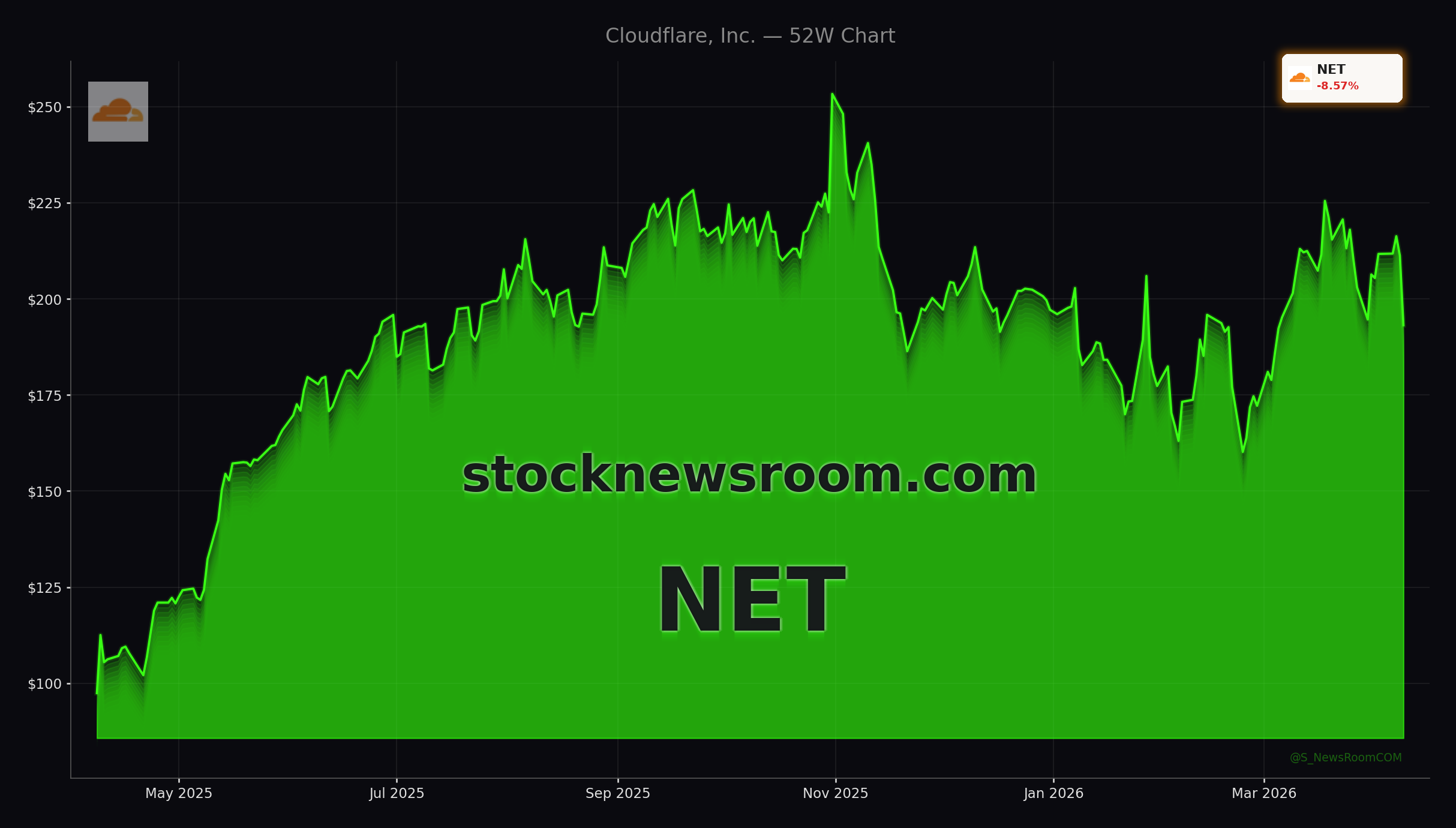
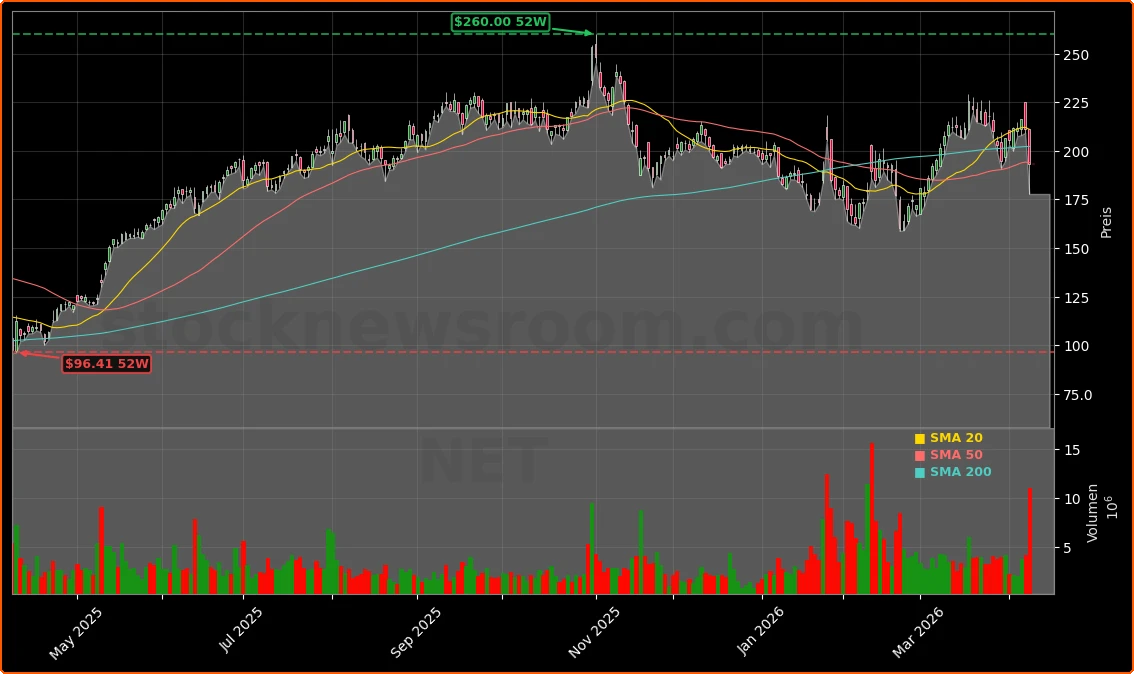
On a volatile day for enterprise software and cybersecurity, Cloudflare, Inc. led the downside. NET closed at $193.15, down 8.57% from Wednesday’s $211.25 close, at one point marking one of the steepest single-day pullbacks among high-multiple software names in the NASDAQ universe. The weakness came as peers like Okta, CrowdStrike, Zscaler, Palo Alto Networks and SentinelOne also traded lower, reflecting a broader risk-off move in security and infrastructure software.
What sets Cloudflare apart is how sharply sentiment flipped. NET had been a momentum favorite, up triple digits over the past year, supported by accelerating adoption of its Workers serverless platform, Zero Trust portfolio and emerging AI capabilities at the network edge. There was no earnings miss, no guidance cut and no negative company-specific operational update. Instead, the immediate catalyst was fear that Anthropic’s Claude Managed Agents could compress one of Cloudflare’s most exciting growth narratives.
The selloff fits a pattern seen across richly valued tech names: when the story shifts from “clear secular winner” to “credible new competition,” multiples can reset quickly, regardless of near-term fundamentals. For U.S. growth investors, Thursday’s price action looked more like a sentiment shock to the Cloudflare AI Strategy than a verdict on its current business performance.
How does Anthropic challenge the Cloudflare AI Strategy?
The core of the current anxiety is where Claude Managed Agents sits in the stack. Anthropic’s new offering provides composable APIs for building and deploying production-grade AI agents, including secure sandboxing, long-running sessions, multi-agent coordination, scoped permissions and execution tracing – functions that overlap with some of the orchestration and runtime capabilities Cloudflare has been touting for its Workers AI platform.
Over the last two years, CEO Matthew Prince has repeatedly framed Cloudflare as “the network AI agents run on and through,” positioning its massive global edge network as an ideal environment for low-latency, cost-efficient AI workloads. Under that vision, the Cloudflare AI Strategy turns its presence in front of more than 20% of all websites into a distribution and execution layer for AI agents from multiple providers, including Anthropic, OpenAI and others.
Claude Managed Agents tweaks that equation. Anthropic is no longer just a model provider; it is stepping into the infrastructure lane by hosting agents, handling state and permissions, and providing its own runtime environment. That raises the risk that some AI-native developers might simply build directly on Anthropic’s platform instead of shipping agents to the edge via Cloudflare’s network. Early adopters like Notion, Asana and Atlassian show that large SaaS players are at least willing to test this vertically integrated approach.
Still, the threat is nuanced rather than existential. Cloudflare is model-agnostic and does not depend on any single AI partner. Its security stack, Zero Trust offerings and network services continue to protect and accelerate traffic regardless of which model or agent framework sits underneath, offering a diversification that pure-play model platforms lack.
Is Cloudflare’s business actually weakening?
For now, the numbers say no. In the most recent reported quarter, Cloudflare delivered revenue of $614.51 million, up 33.6% year over year, while free cash flow roughly doubled to $99.44 million. Management guided full-year 2026 revenue to a range of $2.785 billion to $2.795 billion, signaling confidence that large-customer momentum and product cross-sell remain intact.
Insider selling, widely cited on social media as a culprit for today’s slide, looks far less dramatic on closer inspection. CEO Matthew Prince’s trusts executed pre-scheduled Rule 10b5-1 plans, selling roughly 157,000 Class A shares over several days in early April, a tiny fraction of his more than 26 million shares of total beneficial ownership, or about 7.7% of the company. Other executives, including co-founder and President Michelle Zatlyn, have also sold shares under similar plans while the stock more than doubled over the last year.
That pattern is typical for high-growth tech companies and does not, on its own, imply deteriorating fundamentals. Wall Street’s abrupt repricing instead reflects the market trying to discount how much value in the Cloudflare AI Strategy might be competed away if managed AI platforms from Anthropic or OpenAI become the default runtime environments for enterprise AI agents.
How should investors view Cloudflare versus other AI plays?
Against a backdrop where mega-cap leaders like NVIDIA, Apple and Tesla dominate AI headlines, Cloudflare sits in a different part of the ecosystem: the network and security layer that makes AI services reachable, secure and performant. Unlike chipmakers or model providers, Cloudflare earns revenue from traffic, security and developer workloads moving across its globally distributed edge.
That model has advantages. It allows Cloudflare to benefit from AI adoption regardless of which foundation model wins, as more applications translate into more traffic and more need for Zero Trust, DDoS mitigation and application security. But it also means the company’s valuation is highly sensitive to perceptions about its ability to capture incremental AI economics on top of its existing network tolls.
So far, major U.S. brokerages such as Goldman Sachs, Morgan Stanley and Citigroup have largely framed Cloudflare as a structural beneficiary of cloud and security trends, even as they warn clients about rich multiples across high-growth software. After today’s drop, NET remains a high-momentum, high-expectation name whose performance will likely hinge on how convincingly management can update investors on the Cloudflare AI Strategy at the next earnings call.
Related Coverage: What else is moving in tech?
Investors tracking Cloudflare’s AI pivot may also want to revisit how the company is reshaping internet traffic economics. A recent deep dive, “Cloudflare GoDaddy Partnership +2.1% Surge Shakes Up AI Traffic”, explores how its collaboration with GoDaddy could turn AI-driven web traffic from a largely free utility into a more identity-verified, monetizable channel for small businesses. That piece provides useful context on how Cloudflare is trying to embed itself deeper into the AI value chain beyond simple bandwidth.
At the sector level, advertising-tech and data players are also wrestling with AI-induced resets. In “The Trade Desk Analysis: Growth Boom or Serious Warning?”, we examine whether The Trade Desk’s Kokai rollout represents a temporary friction point or a more structural challenge to its growth algorithm. Together with today’s Cloudflare move, these stories show how generative AI is forcing a broader repricing of software and internet business models across the NASDAQ and S&P 500.
In summary, the Cloudflare AI Strategy is under market pressure, but the underlying business remains solidly profitable on a cash-flow basis and continues to grow at more than 30% year over year. For U.S. investors, the key question is whether the company can prove that its neutral, network-centric role in the AI stack offsets new competition from vertically integrated players like Anthropic. The next few quarters of customer commentary and product updates will be crucial in determining whether Thursday’s selloff is a buying opportunity or the start of a more durable rerating of Cloudflare, Inc.