
Can the Coca-Cola Dividend’s 64th straight increase still anchor conservative portfolios while growth stocks dominate the headlines?
Is Coca-Cola still a defensive anchor for Wall Street?
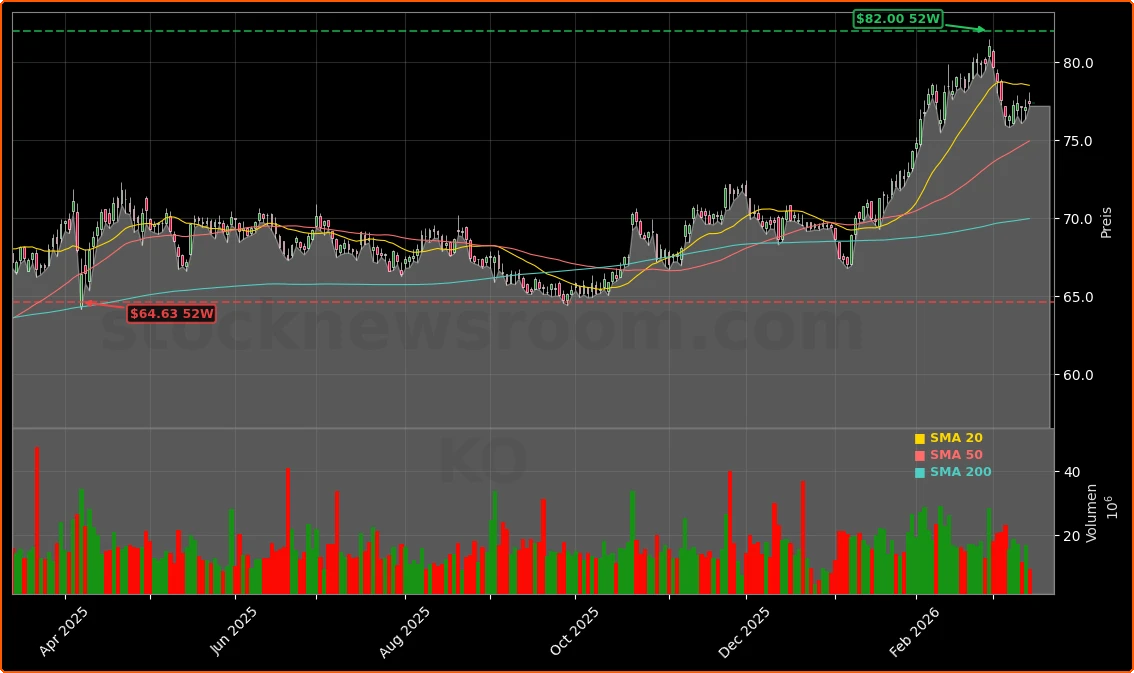
The Coca-Cola Company (NYSE: KO) is trading around $77.34 in regular Friday trading, up 0.34% with a slight after-hours gain to $77.38 as of late Friday in New York (ET). While the stock is not at a fresh 52-week high and has moved broadly in line with the defensive consumer staples complex, its latest dividend move has pushed it further into blue-chip income territory. In a market where the S&P 500’s dividend yield hovers near 1.2%, Coca-Cola’s roughly 2.8% yield stands out as a premium cash return, especially for investors worried about volatility in high-growth sectors like semiconductors and EVs.
Over the past five years, Coca-Cola has delivered a total return of about 78% through March 10, comfortably outpacing many bond-like income alternatives and reinforcing its reputation as a long-term compounder. The company’s products span more than 200 brands and reach over 200 countries and territories, making its cash flows both diversified and resilient. At a time when investors are increasingly trying to balance exposure to high-beta growth names such as NVIDIA and Tesla with more predictable cash generators, Coca-Cola sits firmly in the latter camp.
Importantly, the current macro environment is anything but easy. Slowing consumer demand in parts of the U.S. and Europe, pressure from higher energy and commodity costs, and heightened geopolitical risks in the Middle East are all weighing on sentiment toward consumer staples. Yet Coca-Cola is still posting organic revenue growth and expanding its dividend stream, which is exactly the combination many U.S. retirees, dividend funds, and conservative multi-asset portfolios are looking for.
What exactly changed with the Coca-Cola Dividend?
The latest increase in the Coca-Cola Dividend is modest in percentage terms but powerful in signaling. In February, the board approved a 4% bump in the quarterly payout from $0.51 to $0.53 per share. On an annualized basis, that brings the dividend to $2.12 per share. At the current share price in the high-$70s, that equates to a dividend yield around 2.8%, more than double the cash yield offered by the broader S&P 500.
This marks the 64th consecutive year of dividend increases, cementing Coca-Cola’s status as a Dividend King – an elite group of U.S. stocks that have raised their dividends for at least 50 straight years. Few companies have the brand strength, pricing power, and balance sheet discipline to sustain such a track record through wars, recessions, inflation cycles, and shifting consumer preferences. For investors who prioritize income durability over absolute growth, the Coca-Cola Dividend history is a core part of the investment thesis.
Management continues to pair this dividend policy with active share repurchases, although the buyback pace can vary depending on valuation and capital allocation priorities. The combination of a consistent dividend and occasional buybacks has allowed Coca-Cola to return a substantial portion of its free cash flow to shareholders over time, even as it continues to invest in marketing, new product categories, and emerging-market distribution.
From a cash coverage perspective, the payout appears well supported. Coca-Cola generates strong operating cash flow thanks to its asset-light franchised bottling model and high-margin concentrate business. With a trailing five-year average operating margin around 28%, the company enjoys significantly higher profitability than many other consumer staples names. That profitability underpins the Coca-Cola Dividend and gives the board room to continue raising the payout in line with earnings growth.
How resilient is Coca-Cola’s underlying business?
Despite selling its first soda in 1886, Coca-Cola remains far from a sunset business. The company has evolved beyond classic colas into a broad beverage platform that includes sports drinks, water, tea, lemonade, juices, and coffee. In the U.S., it maintains the leading market share in carbonated soft drinks, but its growth strategy increasingly relies on premiumization, packaging innovation, and expansion in non-sparkling categories where per-capita consumption still has runway in many markets.
On a currency-neutral, organic basis (excluding acquisitions), Coca-Cola’s 2025 top line grew about 5%. That growth was driven mainly by price/mix, which contributed 4 percentage points, with volume adding 1 percentage point. In other words, the company was able to raise prices and shift consumers toward higher-value products without sacrificing overall unit demand, a strong sign of pricing power in the face of inflation and squeezed household budgets.
The trend was similar in the fourth quarter of 2025, where favorable pricing of roughly 4% supported revenue growth. These are small, frequent purchases, often made on autopilot by repeat customers. That habitual nature of demand allows Coca-Cola to adjust pricing gradually without triggering sharp demand destruction. It is this steady, inflation-resistant cash flow profile that helps sustain the Coca-Cola Dividend even when the macro environment is challenging.
Geographically, Coca-Cola benefits from its enormous distribution reach. Revenue streams are diversified across developed markets like North America and Western Europe, as well as faster-growing emerging economies in Latin America, Africa, and Asia. While economic slowdowns or currency volatility in any one region can be a headwind, the global footprint helps smooth out localized shocks. The company’s ability to gain market share, even in a period marked by weaker discretionary spending and geopolitical tension, suggests that its brand strength is still intact.
How is Coca-Cola positioned within consumer staples?
In 2026, defensive positioning has returned to favor in many asset allocations. After an extended run for mega-cap tech and AI beneficiaries, portfolio managers are increasingly rebalancing toward sectors like consumer staples, healthcare, and defense that can hold up better if volatility picks up. This is visible in the outperformance of U.S. consumer staples ETFs relative to the S&P 500 in early 2026, as investors seek steady earnings and dividends rather than purely chasing multiple expansion in high-growth names.
Coca-Cola is a core holding in many of these staples-focused ETFs. In one large U.S. staples ETF, for example, Coca-Cola represents just under 4% of the portfolio, alongside other household names like Procter & Gamble, PepsiCo, Philip Morris, and Altria. These companies share a common characteristic: Their products are embedded in everyday routines and tend to see relatively stable demand regardless of war headlines, recession fears, or the latest technological disruption.
From a portfolio-construction standpoint, Coca-Cola often acts as a ballast against more cyclical or growth-oriented exposures. For instance, a U.S. investor heavily allocated to high-volatility tech names such as NVIDIA or consumer electronics leaders like Apple might pair those holdings with Coca-Cola to reduce overall portfolio beta and secure a reliable income stream. The Coca-Cola Dividend thus plays a role not only as a standalone income source but also as a stabilizing component in diversified portfolios.
This defensive quality is particularly important as energy prices have been destabilized by shipping disruptions and conflict in the Middle East, squeezing profit margins for companies that cannot pass on higher input costs. While some Wall Street analysts warn that consumer staples could lose some pricing flexibility if energy costs stay elevated, companies with premium brands and strong category positions are expected to be more resilient. Coca-Cola, with its long history of measured pricing actions and strong brand equity, is often cited as one of the better-positioned names within staples to navigate such pressures.
What are analysts saying about valuation and returns?
Despite Coca-Cola’s admirable fundamentals and dividend consistency, Wall Street is not uniformly bullish on the stock at current levels. At roughly 25–26 times trailing earnings, Coca-Cola commands a clear premium to the broader S&P 500 and to many slower-growing consumer staples peers. That valuation reflects both the perceived safety of the business and the reliability of the Coca-Cola Dividend, but it also limits upside from multiple expansion.
Some analysts now frame the stock primarily as a high-quality hold rather than an aggressive buy. One recent equity research note characterized Coca-Cola as a “wonderful business” with constrained return potential at current prices, projecting shareholder returns in the high single digits annually (around 8–10%), largely driven by the dividend and mid-single-digit earnings growth. That view aligns with a more conservative stance among income investors who see Coca-Cola less as a source of major capital gains and more as a reliable, bond-like equity income vehicle.
On the other hand, bullish commentary from several buy-side and retail-focused research outlets emphasizes Coca-Cola’s role as a “no-brainer” Warren Buffett stock for patient investors. Berkshire Hathaway’s long-term stake in Coca-Cola remains one of the best-known endorsements on Wall Street. Warren Buffett has frequently highlighted his preference for businesses that can be held “forever,” and Coca-Cola fits that profile thanks to its durable competitive advantages and predictable cash flows.
While major Wall Street banks like Citigroup, Goldman Sachs, or Morgan Stanley have not recently made headline-grabbing upgrades or downgrades specific to Coca-Cola’s rating in the latest batch of public commentary, the broad sell-side consensus still tends to cluster around neutral to moderately positive views. The key debate is not about the safety of the Coca-Cola Dividend or the durability of the business, but about whether investors are being compensated adequately for the valuation risk at a time when risk-free yields remain elevated and other value opportunities exist across the market.
Are there warning signs, such as insider or institutional selling?
One area drawing increased scrutiny from more cautious investors is insider activity. Recent disclosures have revealed notable insider selling by Coca-Cola executives, including a sizable sale by the CEO. Some bears interpret this as a potential red flag, suggesting that management may see limited near-term upside from current levels or that they are using a rich valuation to diversify their personal holdings.
It is important, however, to contextualize insider selling. Executives often sell shares for a range of reasons unrelated to their view on corporate prospects, such as tax planning, personal diversification, or estate considerations. Moreover, Coca-Cola’s long track record of consistent operations and regular compensation in the form of stock and options means that occasional large sales are not unusual. Still, for momentum-driven traders and valuation-sensitive investors, this activity can add to caution around initiating new positions after a period of price strength.
Institutional flows also show some mixed signals. Capital Wealth Planning LLC, a sizable U.S. investment firm, recently reduced its Coca-Cola holding by over 1 million shares, a cut of about 33.6% in its position. The firm now holds roughly 2.3 million shares, valued at around $155 million, accounting for about 1.1% of its overall portfolio. Moves like this may reflect portfolio rebalancing – shifting out of fully valued blue-chip staples into higher-growth or more opportunistic areas – rather than a fundamental downgrade of confidence in Coca-Cola.
These developments underscore a key point: Even for a high-quality dividend name like Coca-Cola, investor sentiment can ebb and flow with valuations, macro expectations, and relative opportunities in other sectors. The Coca-Cola Dividend itself remains solid, but the entry point matters. Long-term income investors may accept the current valuation as the price of safety, while more total-return-oriented investors might prefer to wait for pullbacks triggered by rotation or risk-on sentiment elsewhere.
How does Coca-Cola compare to other income plays?
For dividend investors on Wall Street, Coca-Cola often competes not only with other consumer staples giants but also with high-yield sectors like energy, telecom, and tobacco, as well as specialized dividend funds and ETFs. In one widely watched dividend-focused ETF that concentrates on large-cap payers, Coca-Cola makes up close to 4% of assets alongside heavyweight income names like Lockheed Martin, Chevron, ConocoPhillips, Verizon, Altria, Bristol Myers Squibb, Merck, PepsiCo, and Amgen.
Within that group, Coca-Cola’s yield of roughly 2.7–2.8% is middle-of-the-pack. It offers less headline yield than telecom or tobacco names like Verizon or Altria but with a much cleaner balance sheet and lower regulatory risk. At the same time, it pays significantly more than many growth-leaning mega-caps in the S&P 500, which often yield under 1%. The trade-off is straightforward: Coca-Cola offers lower downside volatility and higher predictability than more cyclical dividend payers such as integrated oil majors, but less income than the highest-yielding corners of the market.
Among consumer staples peers, Coca-Cola is frequently mentioned alongside PepsiCo and Procter & Gamble as a top-tier “buy and hold for decades” name. All three are Dividend Kings with global reach and robust brands. PepsiCo brings a diversified snacks-and-beverages model, while Procter & Gamble dominates household and personal care categories. For a U.S. investor building a core income portfolio, a blend of these staples can provide defensive diversification across categories and geographies, with Coca-Cola delivering particular strength in beverages.
Dividend-focused analysts also often compare Coca-Cola to real estate investment trusts (REITs) and covered-call ETFs, which can offer much higher current yields in exchange for more sensitivity to interest rates and, in some cases, higher payout volatility. Relative to those instruments, the Coca-Cola Dividend is less about maximizing income today and more about offering inflation-resilient, slowly growing income over time, supported by a business that has already navigated more than a century of economic cycles.
What is the long-term growth outlook for Coca-Cola?
The central long-term question for investors is not whether Coca-Cola will survive, but how fast it can grow from an already massive base. Most projections call for structural growth in the mid-single digits, supported by modest volume expansion, price/mix improvements, and ongoing cost discipline. Historically, earnings per share and dividends have grown around 5–6% annually, and many current forecasts see a continuation of this pattern rather than a major acceleration.
Strategically, management is focused on a few key levers to sustain this growth. First is continued brand investment to keep core products relevant, particularly among younger consumers who are more health-conscious and may favor low- or no-sugar options, bottled water, ready-to-drink teas, and functional beverages. Coca-Cola has been actively expanding and refreshing its portfolio in these segments, including through partnerships, minority stakes, and selective acquisitions.
Second, the company is leveraging its massive distribution network to deepen penetration in emerging markets where per-capita consumption is still far below developed-world levels. As incomes rise and urbanization continues in regions such as Africa, Southeast Asia, and parts of Latin America, beverage consumption typically increases, providing a long runway for volume growth. This is complemented by localized marketing and product adaptation to cater to regional tastes and price points.
Third, Coca-Cola is embracing operational efficiencies and digital tools in areas like demand forecasting, route optimization, and in-store execution. While artificial intelligence will not change how people quench their thirst in a fundamental sense, it can help Coca-Cola fine-tune pricing, promotions, and inventory management, thereby protecting margins and freeing up cash to support both investment and shareholder returns.
Will Coca-Cola outperform the S&P 500 from here?
Whether Coca-Cola can beat the S&P 500 over the next five years is a more nuanced question. Given the stock’s premium valuation and the maturity of its industry, several analysts are skeptical that it will deliver significant outperformance versus a benchmark that includes high-growth tech and consumer internet names. Absent a material re-rating, shareholder returns are likely to roughly mirror the sum of dividend yield and underlying earnings-per-share growth – again, around high-single digits annually under most base-case scenarios.
For many investors, that is perfectly acceptable. Not every stock in a portfolio needs to shoot the lights out. In an era where AI-driven names and cyclical sectors can experience violent drawdowns, a steady 8–10% annual total return from a high-quality, low-volatility dividend payer can be attractive, particularly within retirement accounts or conservative income strategies. The Coca-Cola Dividend, combined with modest capital appreciation, can help offset the riskier parts of a portfolio without sacrificing too much upside.
Shorter-term performance will also depend on macro and market dynamics. If interest rates move lower and risk appetite surges, investors may rotate back into higher-beta names and away from defensives like Coca-Cola, pressuring relative performance even if fundamentals remain solid. Conversely, if recession fears grow or geopolitical crises intensify, staples could regain leadership, and Coca-Cola’s defensive characteristics may come back into favor.
In that sense, Coca-Cola is as much a barometer of investor risk appetite as it is a story about soda, water, and tea. The stock tends to lag in the hottest bull markets and hold up better in corrections, making it a potential hedge for portfolios dominated by more cyclical or growth exposures.
How should U.S. investors think about the Coca-Cola Dividend today?
For American investors evaluating Coca-Cola right now, the decision often hinges on portfolio role and time horizon. Investors seeking maximum current yield might prefer higher-paying options in telecom, energy, or specialized dividend strategies. Those prioritizing capital growth might lean more heavily into sectors like technology or cyclicals. But for investors looking for a blend of stability, global exposure, and steadily rising cash returns, it is hard to ignore the Coca-Cola Dividend and what it represents.
The stock’s inclusion in numerous dividend-focused lists of favorite stocks underlines that point. Income-oriented commentators frequently highlight Coca-Cola alongside big pharma names like AbbVie, energy giants like ExxonMobil, and monthly payers such as Realty Income or covered-call ETFs as cornerstones of an income portfolio. The common thread is consistency: these are businesses that have proven they can support and grow dividends through multiple cycles.
What sets Coca-Cola apart, however, is the combination of its century-plus operating history, its unrivaled global distribution, and the sheer length of its dividend increase streak. Sixty-four consecutive annual hikes through inflation, wars, and technological revolutions signal a corporate culture and financial model built around shareholder returns. That helps explain why legendary investors like Warren Buffett continue to favor the name despite its modest growth profile and premium valuation.
Practically speaking, a U.S. investor might use Coca-Cola as a core defensive allocation, pairing it with more cyclical or disruptive names, including high-growth tech leaders like NVIDIA and ecosystem giants such as Apple, to balance risk and income. Dollar-cost averaging into the stock on pullbacks, rather than chasing it at valuation peaks, can help improve long-term total return prospects while locking in a higher starting yield on cost.
Conclusion
In summary, the Coca-Cola Dividend remains one of the most dependable income streams available in the U.S. equity market, now extended by a 64th consecutive annual raise and backed by robust global brands and strong margins. For investors building or maintaining income-focused portfolios, Coca-Cola continues to stand out as a high-quality, low-drama holding that can provide stability alongside more volatile growth bets. The next few years will show whether modest earnings growth and ongoing pricing power can justify the current valuation, but for long-term, dividend-oriented investors, the company’s commitment to returning cash to shareholders looks as strong as ever.
Further Reading
- The Coca-Cola Company (KO) on Yahoo Finance (Yahoo Finance)
- Where Will Coca-Cola Stock Be in 5 Years? (The Motley Fool)
- Top 3 Consumer Staples Dividend Stocks for Reliable Income in 2026 (The Motley Fool)
- Coca-Cola Stock: A Wonderful Business But Limited Return Expectation (Seeking Alpha)