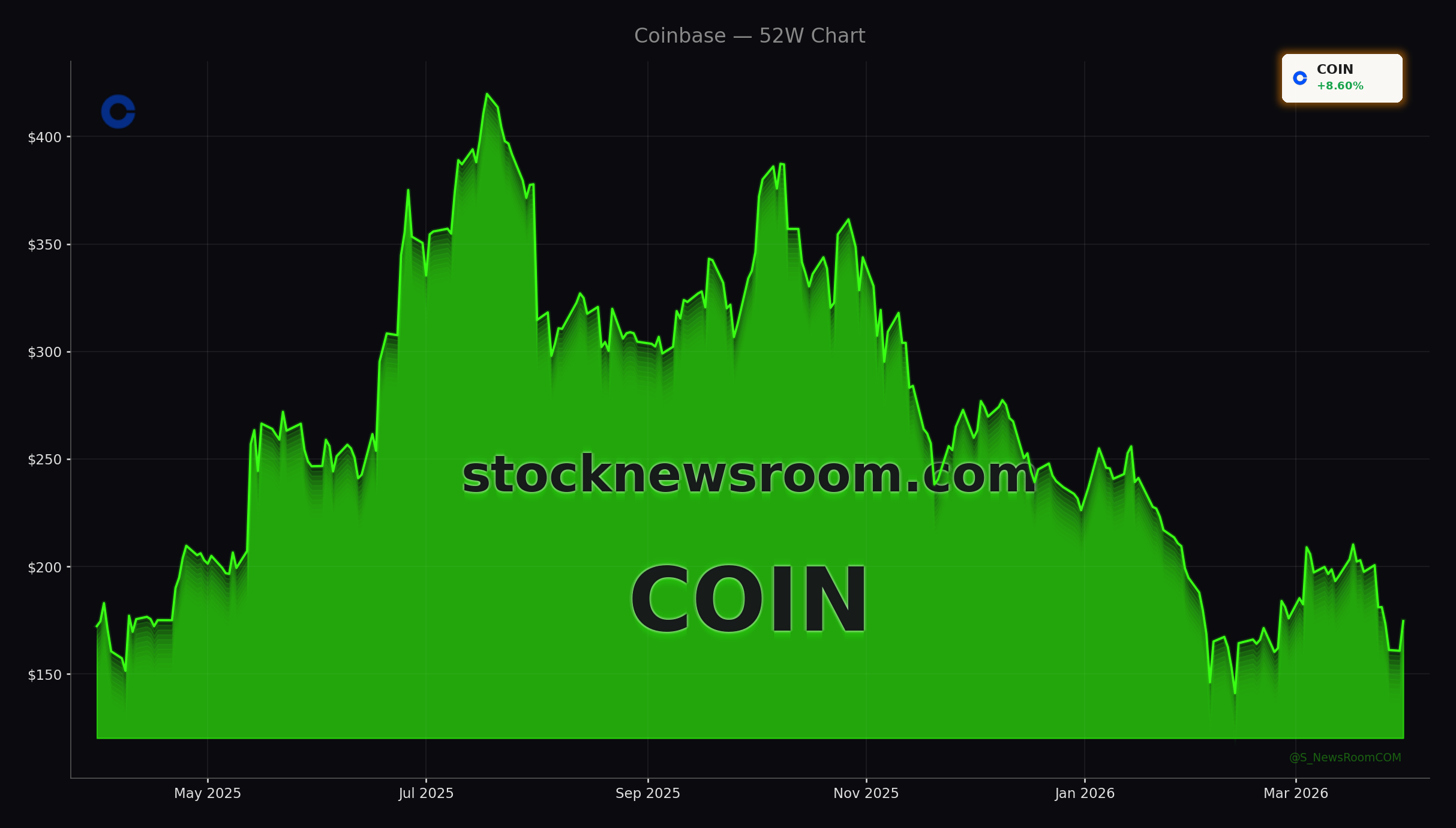

Can the Coinbase AI Strategy turn today’s crypto-fueled 8.6% rally into a durable edge in the coming agentic economy?

Why is Coinbase rallying with crypto again?
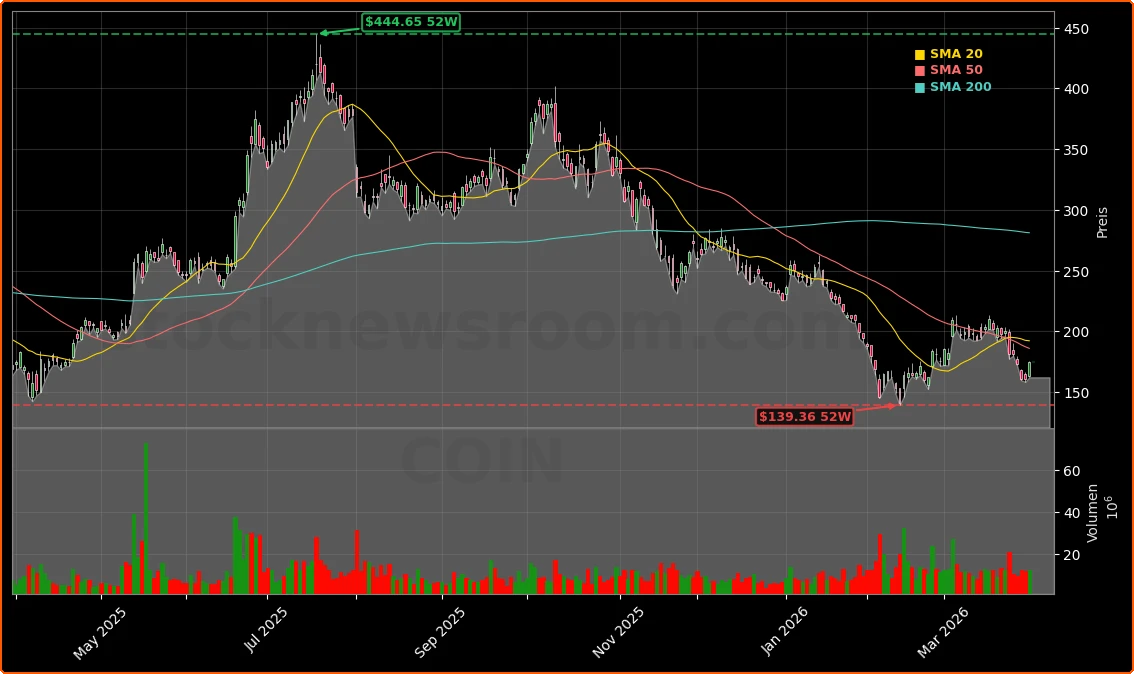
Coinbase Global, Inc. rallied nearly 9% from the opening bell, tracking a broader rebound in digital assets led by Bitcoin’s brief push above $68,000 and Ethereum’s roughly 3.5% advance toward $2,100. With COIN at $174.61 and a slight uptick to about $175 in late trading, the stock remains volatile but is increasingly trading as a proxy for the health of the regulated U.S. crypto market rather than just Bitcoin’s intraday swings.
The move comes despite growing evidence that U.S. spot Bitcoin ETFs have seen net outflows and slowing institutional demand, which has dampened some of the initial euphoria around traditional finance adoption. That backdrop makes Coinbase’s pivot toward fees from stablecoins, layer-2 infrastructure and AI-driven use cases more important for equity investors who worry about a ceiling on pure trading-volume growth.
Sentiment across crypto-exposed equities has turned more constructive, with companies like Robinhood and Circle also participating in the latest upswing. For COIN specifically, the Coinbase AI Strategy offers a differentiator that goes beyond simple correlation to Bitcoin, anchoring the investment case in on-chain activity and payments rather than only speculative trading.
How does Base fit into the Coinbase AI Strategy?
At the center of the Coinbase AI Strategy is Base, the Ethereum layer-2 network incubated by Coinbase and designed to operate as a low-cost, high-throughput settlement layer. Base released a 2026 mission and strategy update outlining upgrades explicitly built for AI agents—autonomous software entities that can hold assets, transact and interact with smart contracts without constant human instruction.
Base plans “agent-native” smart accounts, command line and Model Context Protocol (MCP) access, and tighter integration with online payment protocols like Coinbase’s x402. The goal is to give AI agents a native environment where they can “build, own and trade alongside” human participants in open crypto markets. For investors, that means Coinbase is not just facilitating human trading, but aiming to be the default financial back end for machine-driven activity as well.
That positioning matters in the broader AI race, where hyperscalers such as NVIDIA and cloud players like Apple and Tesla capture most headlines. While those companies focus on compute, chips and front-end AI applications, Coinbase is trying to secure the transaction, settlement and identity rails for the agentic economy—potentially carving out a complementary niche that Wall Street has only begun to price in.
What role do x402 and stablecoins play for Coinbase?
Another key pillar of the Coinbase AI Strategy is the x402 online payment protocol, which is being framed as a way to let AI agents “do anything with money.” Recent on-chain data shows Coinbase as the dominant facilitator of x402 transactions, processing more than 15,000 payments within a 24-hour window. That early lead gives the company a chance to define standards and capture recurring fee streams as agent-to-agent and agent-to-human transactions scale.
Stablecoins are already a meaningful contributor. Coinbase’s stablecoin revenue hit roughly $364 million in the quarter ended December 31, 2025, making dollar-linked tokens a major line item alongside spot and derivatives trading. As Base emphasizes global markets and scalable payments, the combination of low-fee layer-2 rails and high-yield, dollar-denominated balances could help insulate Coinbase from cyclical trading downturns.
Partnerships underscore this payments angle. Better Home & Finance, parent of Better Mortgage, recently doubled its warehouse credit facility to $350 million and highlighted its collaboration with Coinbase on Bitcoin-backed mortgages and broader digital-asset integrations. That kind of tie-in shows how Coinbase’s infrastructure can extend beyond pure crypto trading into real-economy credit and housing finance, broadening the TAM that equity analysts model for the stock.
How does security risk factor into the thesis?
The rise of AI agents interacting with crypto infrastructure is drawing fresh attention to security, an area that remains a structural risk for the entire sector. Recent research from blockchain security firms detailed how attackers seeded malicious AI “skills” across tools that interfaced with multiple browser wallets, including MetaMask, Phantom, Trust Wallet and Coinbase Wallet. The payloads targeted extension wallets in bulk, underlining how AI automation can be weaponized as easily as it can be monetized.
For Coinbase Global, Inc., the Coinbase AI Strategy therefore carries a dual mandate: build the rails for agentic finance while hardening defenses against more automated attack surfaces. That dovetails with a wider industry pivot, where firms like Ripple are investing heavily in AI-driven security analytics to manage protocol and token risks; it underscores that security spending will remain a core part of Coinbase’s operating expense base even as it chases higher-margin AI and stablecoin revenues.
Regulatory and reputational risks also remain in focus. Social media claims that attempted to frame prior XRP listing discussions as part of a “mafia-style protection racket” involving Coinbase have circulated again, but there is no corroborating evidence or regulatory action supporting those allegations. For institutional investors, the more material questions continue to be compliance with U.S. securities rules, the treatment of staking and yield products, and the evolving oversight of stablecoins and event-based contracts.
How are Wall Street and competitors positioned?
On Wall Street, COIN is still treated as a high-beta, high-risk name tied to crypto cycles, though the narrative is broadening. Large banks such as Morgan Stanley are advancing their own digital-asset offerings, including potential Bitcoin ETFs, while asset managers like VanEck have launched single-asset products—such as an Avalanche ETF that uses Coinbase Crypto Services for staking—to capture yield-enhanced exposure.
In AI, traditional mega-caps including NVIDIA and Apple command premium valuations, but few public companies offer direct exposure to the intersection of AI agents and on-chain payments. That gap is where the Coinbase AI Strategy seeks to differentiate, arguing that machine-native wallets, stablecoins and protocols like x402 can underpin a new transaction layer that scales alongside large language models and autonomous agents.
Analyst coverage around these themes remains mixed, with some firms emphasizing regulatory headwinds and ETF-driven volume risk, while others highlight the upside from diversifying into recurring-fee businesses. Price-target changes from houses like Goldman Sachs, Citigroup or RBC Capital could become key catalysts as they update their models to reflect stablecoin income and Base-related on-chain activity, rather than treating Coinbase purely as a transaction-fee broker.
Related Coverage
Recent volatility around prediction markets and crypto-backed mortgages at Coinbase was examined in detail in this analysis of Coinbase prediction markets and legal risks, which looked at whether innovative derivatives products can offset regulatory uncertainty after a sharp COIN sell-off. For a broader view on how AI intersects with crypto security, this piece on Ripple’s evolving AI-based security strategy explores how another major blockchain player is rethinking risk management as machine-driven activity grows across networks.
The Coinbase AI Strategy now ties together Base’s agent-focused roadmap, x402 payments and growing stablecoin income into a single story that is resonating with investors and lifting COIN in the near term. For U.S. portfolios seeking leveraged exposure to both AI and crypto infrastructure, Coinbase Global, Inc. increasingly looks like a central, if volatile, position. The next test will be whether on-chain activity, security resilience and regulatory clarity can keep pace with the ambitious vision laid out for the emerging AI agent economy.