
Can the new Coinbase Bank Charter and CLARITY Act push COIN beyond a simple crypto exchange into a regulated financial powerhouse?

How does the Coinbase Bank Charter change the game?
The conditional approval of a national trust company charter by the Office of the Comptroller of the Currency (OCC) marks one of the most consequential regulatory milestones in Coinbase’s history. The Coinbase Bank Charter would allow the company to operate a federally regulated digital‑asset custodian, giving large asset managers, pension funds and hedge funds a single, nationally supervised counterparty for crypto custody.
Coinbase already holds a limited‑purpose trust charter from New York’s Department of Financial Services, which established it as a qualified custodian for professional investors. The federal trust license goes further by creating a unified regulatory framework across states, removing a patchwork of local approvals and potentially accelerating institutional onboarding. Coinbase executives emphasize that the entity will not function as a traditional commercial bank — it will not take insured retail deposits or engage in fractional‑reserve lending — but will focus on custody, tokenized securities, payments and potentially its own stablecoin issuance.
Institutional demand for regulated crypto access continues to build despite volatility. Products like BlackRock’s iShares Bitcoin Trust (IBIT) have drawn steady inflows even during recent Bitcoin pullbacks, underscoring that long‑only investors still want compliant exposure. That backdrop could amplify the impact of the charter once Coinbase completes remaining OCC conditions such as governance setup, payment rails, and a pre‑opening supervisory exam.
What does CLARITY Act progress mean for Coinbase?
In parallel, Coinbase Chief Legal Officer Paul Grewal says lawmakers are “very close to a deal” on the CLARITY Act, a broad digital‑asset market‑structure bill that would finally delineate responsibilities between the SEC and CFTC and, crucially, set the rules for stablecoin yield products. The stablecoin provisions have been a flashpoint with traditional banks, which fear deposit flight if retail investors can earn meaningful yield on tokenized dollars at crypto platforms.
Grewal argues there is no empirical evidence of large‑scale deposit flight from banks to stablecoins, including for community banks, and insists that customer rewards are only one piece of a much larger framework needed to fulfill President Trump’s stated ambition of making the U.S. the “crypto capital of the world.” He expects movement toward a Senate Banking Committee markup within weeks and is “very confident” that a compromise on yield could come within days.
For Coinbase, the stakes are high. The company has been largely boxed out of offering U.S. customers on‑platform stablecoin yields that offshore competitors provide, constraining a potentially lucrative recurring‑revenue stream. Passage of the CLARITY Act, especially in combination with the Coinbase Bank Charter, would give the exchange a far clearer playbook for compliant yields, tokenization, and derivatives, narrowing the regulatory gap with foreign venues.
How is Wall Street pricing COIN after the charter win?
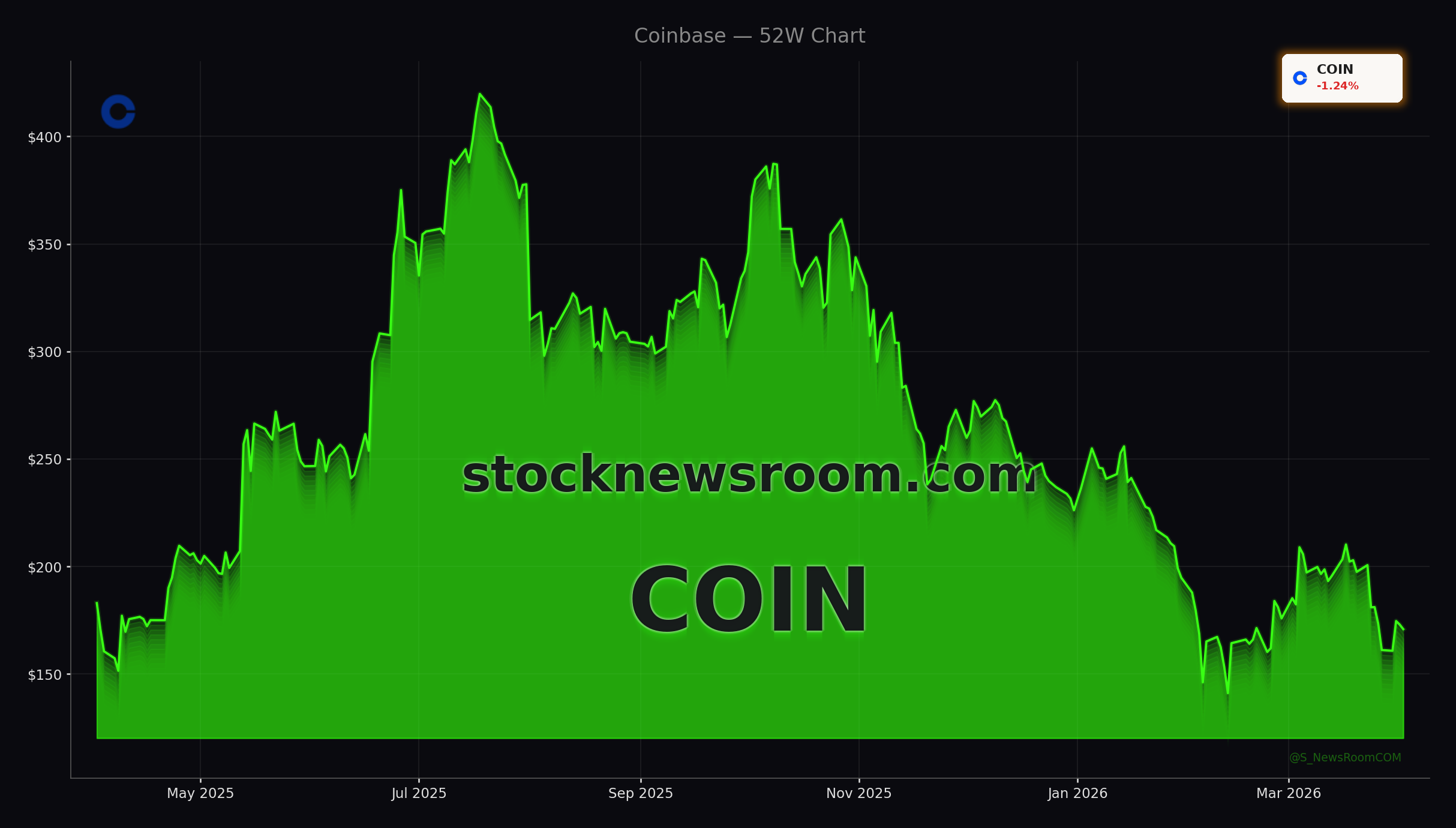
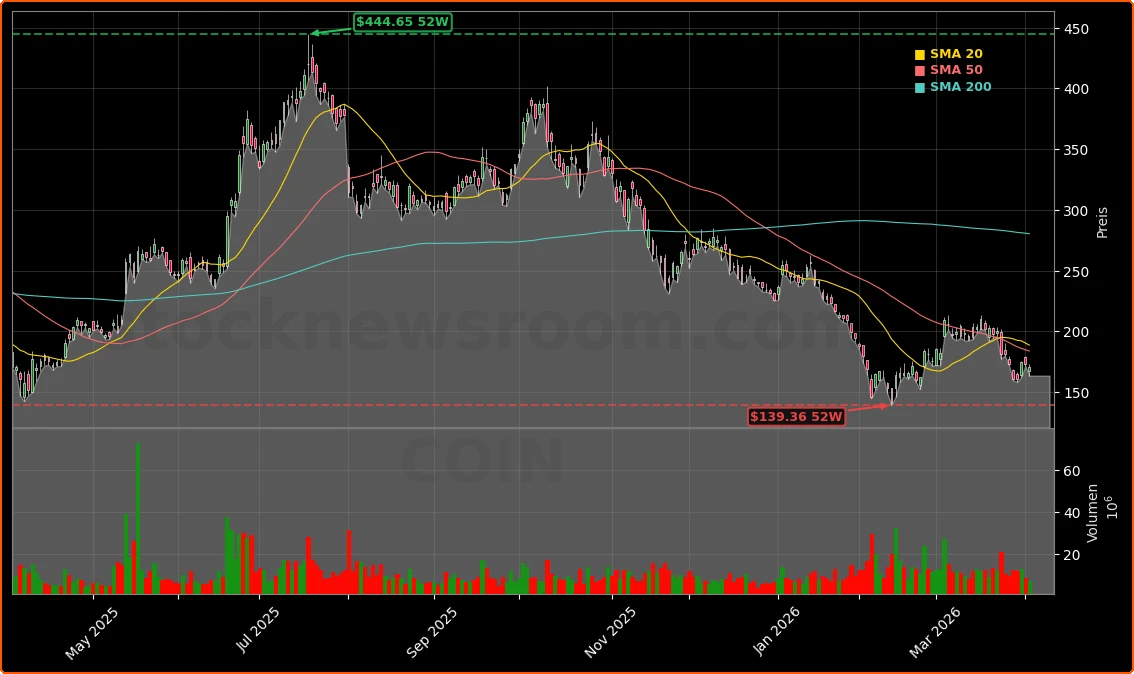
Despite the positive policy momentum, COIN remains in consolidation. At $170.91, the stock sits in the middle of a trading band many technicians see between roughly $140 and $200, broadly tracking Bitcoin’s failure to hold above the $78,000–$80,000 area. Some chart‑focused analysts expect a multi‑month basing phase before another major leg higher, arguing that a sustained breakout likely requires both stronger crypto prices and concrete implementation of the charter and CLARITY framework.
Fundamentally oriented investors are watching whether Coinbase can grow non‑trading revenue — specifically custody, staking, stablecoin economics and new payment flows — enough to reduce earnings volatility. The Coinbase Bank Charter directly targets that goal by making the company a more acceptable counterparty for large U.S. institutions that must adhere to strict custody and risk‑management rules.
Meanwhile, sentiment around COIN is visible in derivative products such as the YieldMax Short COIN Option Income Strategy ETF, which recently announced another weekly distribution. The existence of such income‑oriented short vehicles highlights how polarizing COIN remains: one camp is betting on structural growth from regulation and institutionalization, while another is monetizing downside or range‑bound price action.
How does Coinbase stack up against competitors?
Coinbase is not alone in pursuing national trust charters. Circle, Ripple, Paxos, Fidelity Digital Assets and BitGo have all received or are pursuing similar approvals from the OCC, and an expanding list of traditional players — including Morgan Stanley‑linked platforms and Citadel Securities‑backed exchanges — are crowding into regulated crypto infrastructure. The trust‑charter race echoes how NVIDIA, Apple and other incumbents are converging around AI hardware and software standards, turning regulatory positioning and perceived safety into competitive moats.
Nonetheless, Coinbase still controls a substantial share of institutional crypto assets under custody, managing roughly $245.7 billion — about 7% of the total crypto market — through its institutional arm as of mid‑2025. The company has also pushed deeper into payments via its Base layer‑2 network and the x402 open‑source payments standard, aiming to weave stablecoins directly into the web’s plumbing much as Tesla once helped normalize EV charging infrastructure.
For U.S. equity investors, the question is whether COIN belongs in the same structural‑growth bucket as leading fintech and mega‑cap tech names, or whether it should be treated as a high‑beta proxy on Bitcoin cycles. The answer may hinge on how effectively Coinbase converts the Coinbase Bank Charter and CLARITY Act into durable, fee‑based revenue streams that are less sensitive to spot trading volumes.
Related Coverage: What other risks should crypto investors watch?
Regulatory wins for Coinbase are unfolding against a backdrop of persistent smart‑contract and DeFi risks. A recent $200 million exploit at Solana’s Drift protocol, for example, has sparked renewed debate about leverage and security assumptions on high‑throughput chains. Readers can explore how protocol‑level shocks ripple into token prices and derivatives in Solana DeFi Hack Shock: $200M Drift Breach Slams SOL Price, which examines whether leveraged traders might finally be forced to de‑risk.
At the same time, Coinbase is not standing still on the technology front. Its push into AI‑driven automation and agentic tooling is reshaping how the exchange thinks about scaling compliance, customer service and on‑chain analytics. For a deeper dive into how these initiatives intersect with crypto market structure and recent price action in COIN, see Coinbase AI Strategy: COIN’s 8.6% Rally and Agentic Bet, which analyzes whether AI can give Coinbase a defensible edge as the industry matures.
We’re seeing a real recognition that rewards are important, but also other key elements of the bill are critically important to making sure that President Trump’s vision of the United States as the crypto capital of the world is fulfilled.— Paul Grewal, Chief Legal Officer, Coinbase
With the Coinbase Bank Charter advancing and the CLARITY Act edging closer to a Senate vote, Coinbase Global, Inc. is moving from regulatory defendant to potential policy beneficiary, a shift that could materially alter COIN’s risk profile on Wall Street. For U.S. and international investors, the combination of a federally supervised trust platform and clearer stablecoin rules may justify a re‑rating if Coinbase can execute on custody, payments and yield at scale. The next catalysts will be the OCC’s final sign‑off and concrete CLARITY Act text — milestones that could determine whether COIN breaks out of its current range and claims a more stable place in long‑term growth portfolios.