
Is the latest Coinbase Security controversy a minor documentation error or a red flag for how the exchange manages user risk?

How big is the Coinbase Security controversy?
The latest Coinbase Security flare-up centers on a Coinbase Commerce subdomain that functioned as a withdrawal or recovery tool and, in some flows, appeared to prompt users to input their plaintext seed phrases. Blockchain sleuths warned that such an official-looking page could normalize behavior scammers constantly exploit: convincing users to paste recovery phrases into a website. Security experts stressed that best practices in self-custody dictate seed phrases should never be typed into any online form, let alone one that can be easily spoofed.
Coinbase’s own help materials for Commerce have historically emphasized that these wallets are self-custodial and that the company cannot access or restore users’ seed phrases. A separate guide also explicitly warned customers not to paste recovery phrases into any website, creating an apparent inconsistency that has fueled criticism. While the questionable help page has since been removed and the company says it is investigating, Coinbase has yet to publish a detailed public postmortem, leaving open questions about internal review processes and documentation standards.
The controversy arrives as Coinbase continues to market itself as a security-first exchange, especially in contrast with smaller offshore platforms. Any perception that Coinbase Security practices are muddled—even at the level of documentation—could erode trust among higher-value U.S. and institutional clients who already face intense phishing and social-engineering attacks around their crypto holdings.
What do new SEC rules mean for Coinbase Global, Inc.?
At the same time, the U.S. regulatory backdrop is rapidly evolving. The Securities and Exchange Commission, together with the Commodity Futures Trading Commission, has issued interpretive guidance that carves out four categories of digital assets—digital commodities, digital collectibles, digital tools and payment stablecoins under the GENIUS Act—that are not treated as securities. The framework also sketches how securities laws should apply to protocol staking, airdrops, mining and wrapping non-security tokens, with a formal rulemaking process set to follow.
For Coinbase Global, Inc., this developing taxonomy is a double-edged sword. Clearer boundaries for non-security tokens could lower legal overhang around key trading pairs and staking services, particularly as Coinbase pushes to diversify revenues away from pure spot trading into derivatives, custody and infrastructure. Zacks Investment Research recently highlighted that a potential $25 billion partnership with Bybit could significantly expand Coinbase’s global derivatives footprint and accelerate its drive to become a full-stack crypto platform. At the same time, stricter definitions and enforcement could squeeze margins in products that regulators ultimately deem to be securities, demanding heavier compliance and capital outlays.
Adding to the mix, the SEC has approved Nasdaq’s proposal to allow some securities to trade in tokenized form, bringing blockchain rails into mainstream equity markets. That opens long-term opportunities for compliant, on-chain settlement where Coinbase could act as an infrastructure or custody partner, but it also invites new competition from traditional exchanges and fintechs already plugged into the S&P 500 and broader capital markets.
How does Coinbase Security stack up versus rivals?
The Coinbase Commerce issue lands just as security is becoming a key differentiator among exchanges courting institutional flows. Cloudflare recently rallied on Wall Street after expanding an AI-driven cybersecurity partnership with SentinelOne and being linked to a possible deal with Coinbase for stablecoin-based payments for AI agents, underscoring how tightly cybersecurity and crypto infrastructure are now intertwined. Rivals like Bitget and Kraken also market robust compliance and risk controls to win European and UK clients for products such as ARK Innovation ETF (ARKK) access and leveraged crypto exposure.
Meanwhile, Crypto.com announced its third workforce reduction in four years, cutting 12% of staff as it pivots aggressively toward AI-driven operations. The Singapore-based platform is also pushing into U.S. prediction markets and seeking a national trust bank charter for regulated custody and staking—areas where Coinbase Security credentials and U.S. regulatory relationships have historically been selling points. The more competitors secure domestic charters and demonstrate strong risk frameworks, the less unique Coinbase’s regulatory moat looks, especially if its own tools draw scrutiny from security researchers.
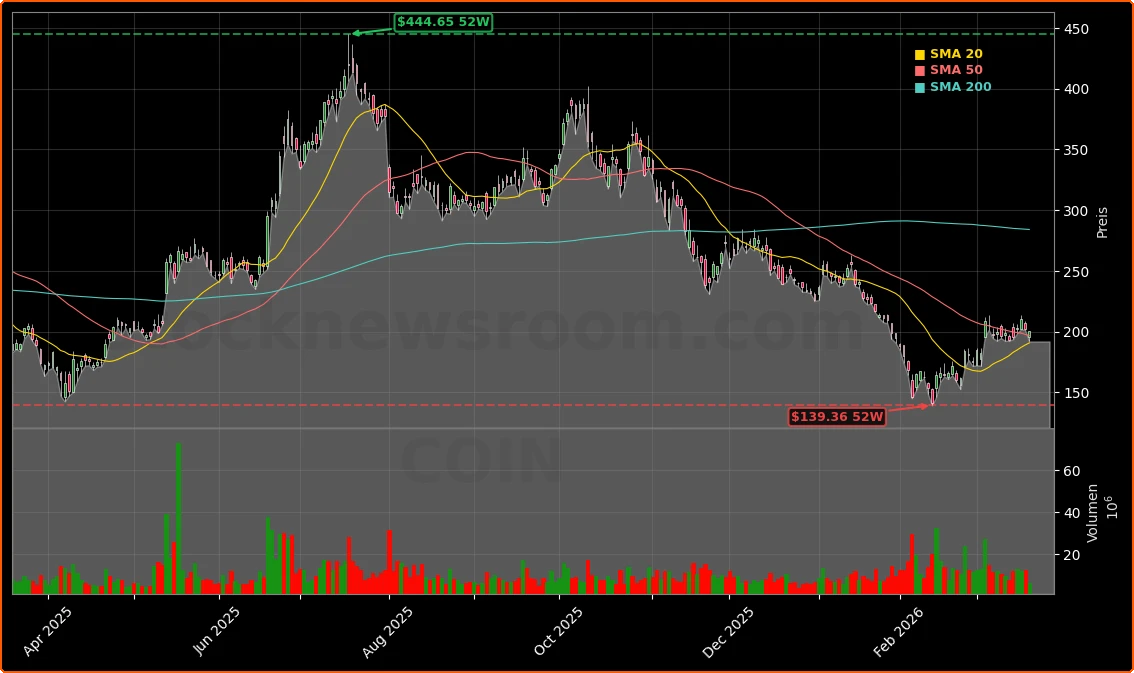
On the equity side, Coinbase’s stock now trades near $200 after a modest pullback, while the broader crypto complex digests Bitcoin’s drop back below $70,000 on renewed “higher-for-longer” rate expectations from the Federal Reserve. Analyst commentary from firms like Goldman Sachs and Morgan Stanley has emphasized that COIN’s earnings power is increasingly levered not just to crypto volumes but to the perceived robustness of its compliance and security architecture. Any hit to Coinbase Security reputation can therefore show up indirectly in valuation multiples, even before it affects customer numbers.
What should investors watch next for Coinbase Global, Inc.?
Fundamentally, U.S. investors now have to balance several narratives. On the growth side, Coinbase is broadening beyond core crypto trading into traditional investing, derivatives and potential infrastructure roles around tokenized securities and AI-related payment flows. The company also maintains deep regulatory and brand advantages versus many smaller offshore competitors, and major U.S. platforms from Apple Pay to Tesla and NVIDIA-powered AI infrastructure continue to normalize digital-asset rails in mainstream tech ecosystems.
On the risk side, insiders are taking profits—Coinbase CFO Alesia J. Haas recently sold 9,950 shares under a pre-arranged 10b5-1 plan, though she still holds more than 387,000 shares—while Bitcoin volatility and ETF flows remain sensitive to macro data and Fed policy. The GENIUS Act framework could ultimately be a tailwind by clarifying stablecoin and token treatment, but the seed-phrase controversy shows how quickly Coinbase Security optics can shift and how vigilant the company must remain as phishing and AI-enhanced scams become more sophisticated.
If Coinbase publicly tightens its Commerce documentation, reinforces guidance never to enter seed phrases into websites, and leans into growing institutional and regulatory partnerships, the latest setback may fade into the background. For now, COIN’s resilience around the $200 level suggests investors are watching closely but not yet abandoning the long-term thesis that Coinbase will be a central, security-focused on-ramp to the next phase of digital and tokenized assets.
Related Coverage
Recent policy moves around stablecoins are crucial for the company’s roadmap. A deeper dive into how the GENIUS Act could impact its USDC strategy and regulatory positioning can be found in this analysis of Coinbase’s stablecoin regulation push and GENIUS Act momentum. For a broader sector lens, particularly on how major tokens trade under shifting macro and regulatory risks, the article “Ethereum Valuation Warning: Is a 40% Drop Still Possible?” explores whether current pricing reflects a durable bottom or looming downside.
In sum, Coinbase Security is under renewed scrutiny at the same time regulators, competitors and macro forces are reshaping the crypto landscape, leaving COIN shares finely balanced between high-risk volatility and high-reward structural upside. For investors on Wall Street, the next few quarters will show whether Coinbase can turn today’s security and regulatory challenges into an opportunity to reinforce its moat and justify its premium valuation.