
Could Coinbase’s stablecoin push and the GENIUS Act turn today’s rally into a lasting new profit engine beyond trading fees?
Coinbase Global in the crosshairs of Washington and Wall Street
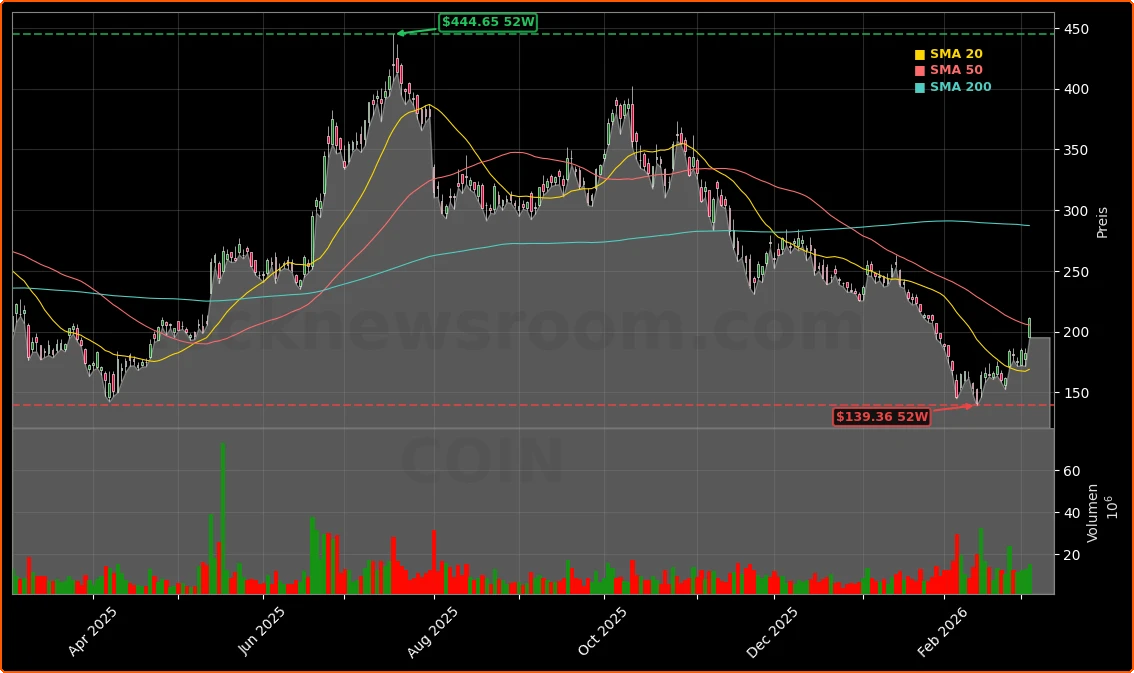
Coinbase Global is trading around $211.15, up roughly 15.8% from the prior close of $182.36, making it one of the strongest movers on the S&P 500 as crypto-linked equities rip higher alongside Bitcoin. Year to date, the stock has been volatile and, despite today’s surge, is still working to regain ground lost during earlier drawdowns, underscoring how sensitive the name remains to both token prices and policy headlines.
The latest leg higher is being powered less by spot crypto enthusiasm and more by politics. President Trump met Coinbase CEO Brian Armstrong at the White House and followed up with a public broadside against large U.S. banks for blocking digital asset market structure legislation focused on stablecoins and yield-bearing products. He urged banks to strike a deal so the law can move forward, effectively aligning the administration with Coinbase in a trillion-dollar tug-of-war over where digital “cash” and its interest income will sit — inside the traditional banking system or on-platform at crypto intermediaries.
This is the core of the Coinbase Stablecoin Regulation debate: should platforms like Coinbase be allowed to pay interest-like rewards on fully reserved stablecoins, potentially offering 3%–3.5% yields funded by safe assets such as cash and Treasuries? Banking groups see a creeping threat to their deposit base. Crypto platforms see a chance to formalize a product they are already offering in various forms and to capture a recurring, scaled revenue stream that is less cyclical than trading fees.
On Wall Street, traders are quickly embedding this optionality into Coinbase’s equity story. A stock that was already a liquid proxy on Bitcoin is now also a leveraged play on how Congress and regulators will resolve Coinbase Stablecoin Regulation and the GENIUS Act compromise process.
Coinbase Stablecoin Regulation: what’s at stake with the GENIUS Act?
The GENIUS Act (Guiding and Establishing National Innovation for US Stablecoins) is emerging as a potential cornerstone framework for U.S. dollar stablecoins. While details are still being negotiated, the broad contours would recognize fully reserved, one-to-one backed stablecoins as a distinct class of regulated digital money instruments, subject to capital, custody, disclosure, and risk-management rules. Crucially for Coinbase, a central battlefield is whether issuers and platforms may pay yield on stablecoin balances and how that yield is structured.
Coinbase has already been marketing yields in the area of 3%–3.5% per year on certain stablecoin holdings, funded by investing reserves in high-quality government securities. In a world with clear Coinbase Stablecoin Regulation, those rewards would be anchored in statute instead of resting on shifting regulatory interpretations. That could encourage billions of dollars of additional customer balances to migrate from low-yield bank deposits into stablecoins custodied at platforms like Coinbase, especially if the yields remain materially better than what mainstream banks pay on checking or savings accounts.
This is why U.S. banks are pushing back so hard. A large-scale migration of cash-like balances into stablecoins would mean fewer cheap deposits to fund lending, pressuring net interest margins. During a recent UK House of Lords inquiry, Coinbase’s international policy chief argued that fully reserved, regulated stablecoins are actually safer than uninsured bank deposits, highlighting that they sit in cash and high-quality government bonds and can be redeemed at par. At the same time, he pushed back against central bank proposals that would severely restrict the ability to offer rewards, warning that overly tight rules risk throttling innovation and leaving jurisdictions behind versus U.S. and EU frameworks such as the GENIUS Act and MiCA.
For investors, the implication is straightforward: if Coinbase Stablecoin Regulation under the GENIUS Act explicitly permits yield-bearing stablecoins under a clear prudential framework, Coinbase gains a structural advantage versus both banks and less-regulated offshore exchanges. If, instead, lobbying from the banking sector forces severe caps on yields or pushes stablecoins fully inside the perimeter of traditional banks, Coinbase’s upside from this theme diminishes and the stock reverts to being primarily a volume-and-volatility play on crypto prices.
Coinbase Global versus the banking lobby and political risk
Trump’s public intervention significantly shifted the political optics of the debate. After the meeting with Armstrong, the president posted a message on his social platform criticizing banks for blocking a crypto bill that has already cleared key legislative hurdles, calling on them to reach a compromise. He also accused parts of the financial industry of trying to undermine digital-asset regulation that had been painstakingly negotiated, implicitly framing Coinbase as a constructive actor while painting incumbent banks as obstructionists.
That framing matters. For years, crypto regulation in the U.S. was characterized more by enforcement actions and piecemeal guidance than by coherent statutory regimes. With the White House now clearly engaging in the Coinbase Stablecoin Regulation debate, the politics of digital assets are becoming more explicit — and more polarized. Coinbase, as the largest U.S. listed crypto exchange, is rapidly turning into the sector’s lead political proxy, a role that comes with leverage but also exposure.
From an investor standpoint, this cuts both ways. On the positive side, having a sitting president publicly side with Coinbase in a confrontation with the banking lobby reduces near-term tail risk that stablecoin yields will be banned outright. It also signals to large institutions that the policy trajectory is moving toward accommodation rather than prohibition. On the negative side, Coinbase’s fortunes may become more tightly linked to electoral swings and partisan fights. A different administration or a change in Congressional control could slow or reverse progress on the GENIUS Act, reintroducing uncertainty just as institutional investors are building exposure.
Still, the fact that mainstream financial giants are integrating Coinbase into their own structures suggests that, beyond politics, the market is normalizing around regulated crypto infrastructure. A recent Bitcoin ETF filing from Morgan Stanley, for example, names Coinbase Custody alongside BNY Mellon as key service providers for safeguarding the ETF’s underlying bitcoin and administering the trust. That kind of partnership blurs the lines between Wall Street and the crypto-native world and could ultimately soften bank resistance to more pragmatic Coinbase Stablecoin Regulation if they themselves benefit from the same rails.
Coinbase Global’s business mix: beyond trading into custody and stablecoin income
While spot and derivatives trading volumes still drive a significant share of Coinbase revenue, the company has been steadily diversifying into subscription-like and services income. Custody, staking, blockchain infrastructure, and fiat on-ramp services now contribute meaningfully to top line and can partially offset the cyclicality of trading fees. Adding a large, regulated stablecoin yield program under a clear Coinbase Stablecoin Regulation regime would fit well into this strategy, potentially creating a quasi-interest-income stream without Coinbase having to transform into a bank.
The mechanics are simple. Customers deposit dollars, convert them into a fully reserved U.S. dollar stablecoin managed in partnership with a specialist issuer (such as Circle with USDC), and Coinbase then earns a share of the yield generated by investing the reserves in short-duration Treasuries and cash equivalents. Customers receive an advertised annual percentage yield; the residual spread is shared between Coinbase and the issuer. With short-term Treasury yields still elevated by historical standards, this spread is lucrative.
Even relatively small shifts in behavior can be powerful at scale. If, over the next few years, tens of billions of dollars move from traditional bank accounts into Coinbase-managed stablecoins because of higher yields and better onchain utility, the incremental, recurring revenue could rival or exceed Coinbase’s current services income. That is the big-picture upside embedded in the current rally around the GENIUS Act narrative.
But investors should also weigh structural risks. As stablecoin balances grow, Coinbase’s sensitivity to interest rate cycles will increase. A steep decline in Treasury yields would compress spreads and force platforms either to slash customer rewards or to accept lower profitability. Moreover, regulators could impose strict asset-quality and duration constraints, capital buffers, and concentration caps, which would reduce profitability compared with today’s relatively unconstrained models. In other words, Coinbase Stablecoin Regulation is as much about defining the economics of the business as it is about deciding whether the product is allowed at all.
Coinbase Global among crypto equities and Big Tech proxies
On days like today, Coinbase trades more like a high-beta macro proxy than a pure-play exchange stock. Crypto-linked names such as MicroStrategy, Circle and Robinhood are all rallying, but Coinbase is leading the pack on the S&P 500 with double-digit percentage gains. For U.S. investors, it occupies a unique slot: a large-cap, highly liquid, regulated way to gain leveraged exposure to digital assets without holding tokens directly.
That positioning increasingly invites comparisons with high-beta growth leaders in adjacent sectors such as NVIDIA, Tesla and Apple. Like those names, Coinbase is now a core component in thematic and innovation-focused ETFs. Cathie Wood’s ARK Invest, for instance, recently added roughly $4 million of Coinbase shares across its ARKK, ARKW and ARKF funds on a day when the stock traded lower, leaning into weakness rather than chasing momentum. Coinbase now sits among the top holdings in multiple ARK strategies, signaling that active managers view it as a long-duration growth asset rather than a short-term trading vehicle.
Unlike mega-cap tech, however, Coinbase’s cash flows are still tightly tethered to the boom-and-bust cycle of a nascent asset class and now, increasingly, to regulatory milestones such as Coinbase Stablecoin Regulation. Whereas Apple or NVIDIA can rely on diversified hardware and software ecosystems, Coinbase is still in the process of building out fee streams that are resilient across cycles. That makes position sizing and risk management critical. For many diversified portfolios, Coinbase may be best treated less like a core holding and more like a tactical growth or thematic allocation alongside other high-volatility names.
Relative to other crypto equities, Coinbase’s scale and regulatory footprint remain differentiators. Offshore exchanges like Binance lack the same U.S. listing and disclosure requirements. Smaller listed names, including Bitcoin Depot and various miners, offer narrower business models. That makes Coinbase, for better or worse, the default proxy for how public markets price the intersection of digital assets, Washington policy, and institutional adoption.
Valuation, analyst sentiment and key risk factors
After today’s move to roughly $211 per share, Coinbase’s market capitalization implies a rich multiple on trailing earnings and a still-demanding valuation on forward metrics, even after the pullback earlier in the year. Traditional valuation anchors remain tricky: earnings and cash flow are heavily influenced by crypto prices, trading volumes, and one-off market events, while the potential revenue from stablecoins under a mature GENIUS Act framework is not yet visible in reported numbers.
Wall Street analysts remain divided. Some large banks argue that Coinbase deserves a premium multiple as the leading regulated U.S. platform with growing services income and a strong balance sheet. Others caution that regulatory overhang, including the unresolved status of many tokens under securities laws and the still-evolving Coinbase Stablecoin Regulation landscape, justifies a discount. Firms such as JPMorgan, Citigroup and others have oscillated between cautious and constructive views as crypto cycles and enforcement actions ebb and flow, and ratings range from Underweight to Overweight across the Street. Price targets have been dynamically adjusted in response to Bitcoin’s trajectory and trading activity, reflecting how intertwined Coinbase’s equity story is with the broader crypto complex.
Key risk factors for investors evaluating Coinbase at current levels include: (1) regulatory shock, if stablecoin rules end up far more restrictive than the market currently anticipates; (2) adverse enforcement outcomes in ongoing or future cases around token listings and staking services; (3) a sharp reversal in crypto prices and volumes, which would hit both trading and ancillary revenue lines; and (4) political risk, should future administrations or Congressional coalitions seek to revisit or unwind aspects of the GENIUS Act or related frameworks.
Conclusion
On the flip side, upside scenarios include: (1) passage and implementation of a balanced Coinbase Stablecoin Regulation package that permits competitive yields while enforcing robust safeguards; (2) continued integration of Coinbase infrastructure into traditional finance, exemplified by custody roles in Bitcoin ETFs and partnerships with global banks; and (3) expansion of non-trading revenue, such as Web3 infrastructure, staking (within regulatory bounds), and institutional services, which could gradually lower earnings volatility and support a higher structural multiple.
Further Reading
- Coinbase Global, Inc. (COIN) on Yahoo Finance (Yahoo Finance)
- Coinbase leads crypto stocks higher after Trump signals support for digital asset market structure bill (CNBC)
- Trump sides with crypto firms in trillion-dollar battle with banks over stablecoin yield (CNBC)
- Morgan Stanley taps Coinbase and BNY Mellon for custody in proposed Bitcoin ETF (CoinDesk)