
Can new CrowdStrike AI Partnerships with Nebius, WWT and EY really extend the company’s record Q4 momentum into a longer growth cycle?
[fxmag_hero_image]How is CrowdStrike positioned after Q4?
CrowdStrike Holdings, Inc. (CRWD) reported fiscal Q4 2026 revenue of $1.31 billion, up roughly 23% year over year, marking a slight acceleration from the prior quarter. Annual recurring revenue reached about $5.25 billion, growing 24%, with a record net new ARR addition of roughly $331 million. The company also posted its first positive GAAP net income of about $38.7 million and generated $376 million in free cash flow, ending the quarter with more than $5.2 billion in cash on the balance sheet.
Module adoption on the Falcon platform remains a key driver: around half of customers now deploy six or more modules, underscoring the stickiness of the all-in-one architecture. Guidance for Q1 fiscal 2027, calling for $1.36–$1.364 billion in revenue (about 23–24% growth), signals that demand for endpoint, cloud and identity security remains resilient even as broader SaaS valuations have come under pressure on Wall Street.
Despite these strong metrics, CRWD trades at a lofty earnings multiple and roughly the low-20s range on sales, leaving limited room for execution missteps. That is why investors have zeroed in on CrowdStrike AI Partnerships as a potential catalyst that could extend high growth rates longer than traditional endpoint security alone might allow.
What do Nebius and World Wide Technology bring?
The most eye-catching of the new CrowdStrike AI Partnerships is the global tie-up with Nebius, the Amsterdam-based AI cloud provider that just landed a multibillion-dollar infrastructure deal with Meta Platforms. CrowdStrike is embedding its Falcon platform directly into the Nebius AI Cloud, giving customers unified visibility, AI-powered detection and response across infrastructure and runtime for high-performance AI training and inference workloads built on dedicated NVIDIA GPUs.
This integration lets enterprises scale AI on Nebius without ripping out existing security policies or workflows, effectively turning Falcon into a default security layer for next-generation AI clusters. As Nebius invests billions in GPU capacity and networking, CrowdStrike’s attach opportunity could grow in parallel with the broader AI infrastructure build-out.
In the U.S., World Wide Technology is deepening the story with the launch of the “Securing AI with CrowdStrike Lab” inside its AI Proving Ground. Built on NVIDIA Enterprise AI Factory designs, the lab allows enterprises to test and validate AI systems with Falcon baked into the stack before moving into production. For CIOs and CISOs wrestling with GPU capex decisions, the WWT partnership offers a path to move from pilot projects to production-ready AI with integrated security, potentially shortening sales cycles for CrowdStrike.
How does EY’s agentic SOC shift the narrative?
The third major pillar in the latest CrowdStrike AI Partnerships is EY’s decision to standardize its Agentic SOC services on the Falcon platform, accelerated by NVIDIA AI infrastructure and software. EY is building managed services that use AI agents to triage alerts, investigate incidents and orchestrate response actions at machine speed across endpoints, cloud and identity, addressing breakout times that have compressed to under 30 minutes on average.
For CrowdStrike, this expands its reach into blue-chip enterprises that rely on EY for security operations, amplifying the impact of its Charlotte AI, Agentic Security Platform and Agentic SOAR innovations. It also reinforces the company’s positioning against mega-platform rivals like Microsoft and Apple, which are embedding security into their own clouds and devices. While Microsoft can bundle security into existing 365 and Azure deals, CrowdStrike is countering with best-of-breed AI-native security that partners tightly with infrastructure players rather than competing with them.
Wall Street has noticed. Morgan Stanley recently upgraded CRWD to Overweight, naming it a Top Pick with a price target near $593, citing the company’s AI positioning, accelerating module adoption and the potential to sustain double-digit growth. At the same time, some analysts warn that the valuation already bakes in near-perfect execution amid intense competition from hyperscale ecosystems and emerging AI security firms.
What’s the investment takeaway for U.S. investors?
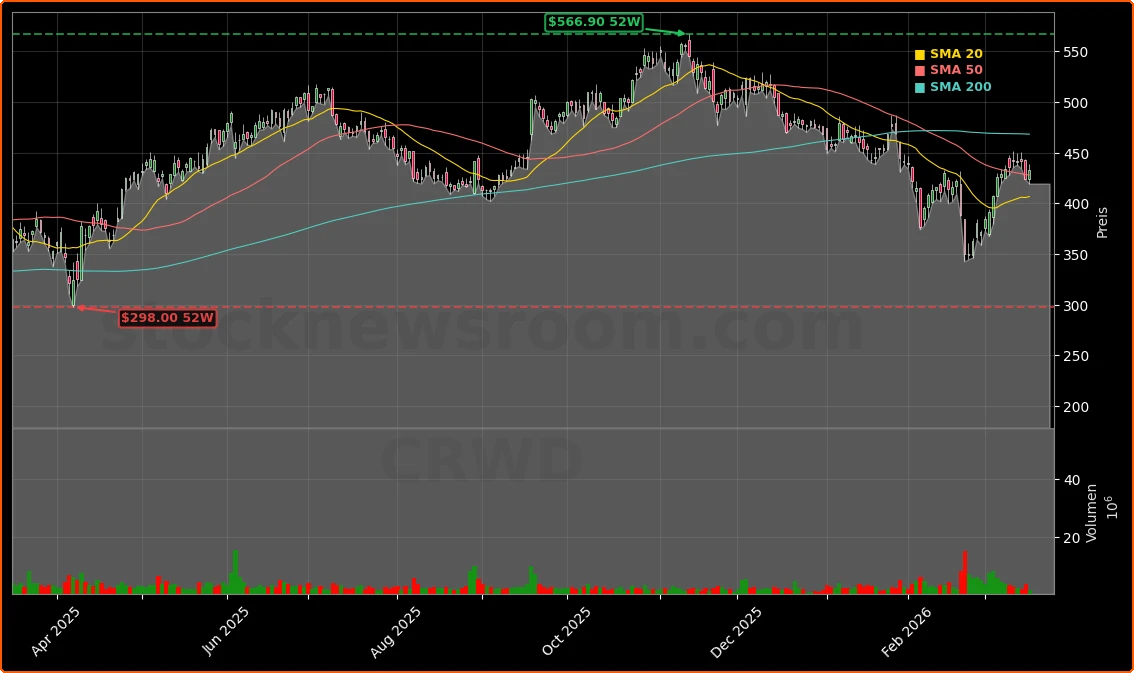
On a year-to-date basis, CRWD has lagged some high-flying AI names such as Tesla and selected cloud infrastructure stocks, even after more than quadrupling since early 2023. The stock remains around 25% below its recent peak, leaving a window for investors who believe that AI infrastructure and agentic SOC models will become standard across the S&P 500 and global enterprises.
For growth-focused portfolios, the CrowdStrike AI Partnerships with Nebius, World Wide Technology and EY suggest that Falcon is being written into the blueprints of future AI clouds, GPU factories and managed SOC services. That could help sustain elevated ARR growth beyond fiscal 2027 if execution stays on track and competitive pressures remain manageable.
The SOC cannot operate at human speed when adversaries are moving at the speed of AI.— Daniel Bernard, Chief Business Officer, CrowdStrike
In summary, CrowdStrike AI Partnerships are turning the company from a pure endpoint leader into a foundational security layer for the AI era. The combination of strong recent earnings, expanding AI distribution channels and high institutional conviction makes CRWD one of the more compelling—but also more richly valued—cybersecurity names on Wall Street. The next few quarters will show whether these AI-focused alliances translate into durable ARR acceleration and justify the premium price investors are paying today.