
Are the latest CrowdStrike Earnings a launchpad for an AI-fueled rally or a warning that growth is no longer enough?
CrowdStrike Holdings: How Did Wall Street Take the Latest CrowdStrike Earnings?
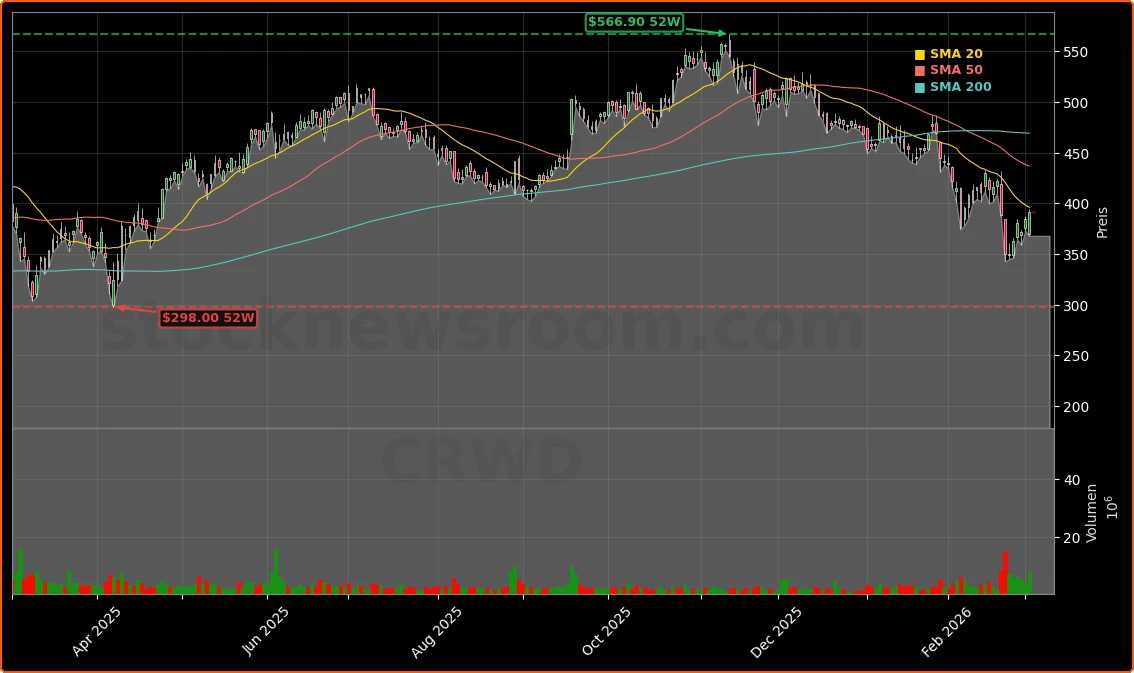
CrowdStrike Holdings entered its Q4 fiscal 2026 report under pressure, down roughly mid‑teens percent year to date alongside many enterprise software peers. The stock closed the latest regular NASDAQ session at about $391.42, up 1.7% on the day, with only a fractional dip in after‑hours trading, reflecting an overall muted response to the CrowdStrike Earnings release. That calm price action stands in contrast to the volatility seen earlier this year, when investors aggressively repriced software names on fears that generative AI might compress margins and even cannibalize existing offerings.
On the surface, the quarter checked the right boxes. Revenue in Q4 rose 23% year over year to roughly $1.31 billion, slightly ahead of consensus estimates near $1.30 billion. Adjusted earnings per share came in at $1.12, beating the $1.10 expectation. These are textbook “clean beats” on the key headline metrics, exactly what many growth investors like to see. Yet CRWD did not rip higher after hours, suggesting that investors were already pricing in a solid quarter and now want something more: either a step‑change in AI‑driven growth or proof that profitability can scale faster.
For the full fiscal year 2026, CrowdStrike posted revenue of about $4.81 billion, up from $3.95 billion the year before, but reported a GAAP net loss of $0.65 per share versus a loss of $0.06 previously. That widening loss contrasts sharply with analyst expectations for a meaningful profit, highlighting the cost of aggressive investment. Management’s messaging, however, frames FY26 as one of the company’s best years ever in terms of annual recurring revenue (ARR) expansion and platform adoption, arguing that the income statement pain reflects a deliberate strategy to capture a much larger AI‑era cybersecurity opportunity.
CrowdStrike Holdings: What Do the Latest Numbers Really Tell Us?
Looking deeper than the headline CrowdStrike Earnings, the most important datapoint in the quarter was ARR growth and the quality of customer relationships. CrowdStrike reported net new ARR of approximately $331 million in Q4, well above analyst expectations around $304 million and up roughly 47% year over year. It was the third straight quarter of accelerating net new ARR, an encouraging sign for a subscription‑driven model that ultimately lives or dies on renewals and upsells.
Total ending ARR reached about $5.25 billion, making CrowdStrike one of the fastest pure‑play cybersecurity software companies to cross that threshold. Net retention remained around 115%, while gross retention held at about 97%. In practice, that means existing customers are not only sticking with the Falcon platform, they are steadily buying more modules over time, and very few churn once they are onboarded. Those metrics are especially important in the context of the AI debate: if customers were rushing to replace CrowdStrike with cheaper, LLM‑centric tools, you would expect net retention and gross retention to start slipping. So far, that is not happening.
Revenue growth of 23% year over year in Q4 is solid but not hyper‑growth by historical software standards. With the stock still priced at a premium multiple to sales and earnings, the market now demands either a re‑acceleration in top‑line growth or a steeper slope in margin expansion. Adjusted EPS did improve year on year, but the full‑year GAAP result disappointed relative to expectations of several dollars of profit per share. Management points to ongoing investment in R&D, go‑to‑market, and AI capabilities as the main drivers of the earnings gap, effectively asking shareholders to tolerate near‑term compression for long‑term scale.
The guidance for fiscal 2027 aims to reassure on that front. Management expects revenue between $5.87 billion and $5.93 billion, with the midpoint slightly ahead of consensus near $5.86 billion. Adjusted EPS is forecast in a range of $4.78 to $4.90, also a modest beat versus the roughly $4.80 FactSet consensus. Projected ARR of $6.47 billion to $6.52 billion again sits above prior market expectations. These outlook figures help explain why the after‑hours reaction to the CrowdStrike Earnings was restrained rather than sharply negative; investors did not get a blowout raise, but they did get confirmation that demand remains resilient and profitable growth should continue.
CrowdStrike Holdings: Is AI a Threat or the Biggest Growth Tailwind?
The heart of the current investment debate on Wall Street is whether AI will erode or enhance CrowdStrike’s economic moat. Some investors fear that as large language models from groups like OpenAI and Anthropic become cheaper and more powerful, enterprises could attempt to build or buy AI‑driven security tools that replicate a portion of what Falcon does, at a lower price point. This concern has weighed not only on CrowdStrike but also on several high‑multiple software names, contributing to sector‑wide derating.
Management, by contrast, portrays AI as the main accelerant for the business. On the recent CrowdStrike Earnings call, CEO George Kurtz emphasized that the AI revolution is increasing, not shrinking, the company’s addressable market, arguing that every enterprise deploying AI needs an independent security layer for visibility, compliance, and enforcement. The Falcon platform is already deeply AI‑powered, using massive telemetry and machine learning to detect and stop threats in real time. According to Kurtz, customers are safely using more than 1,800 distinct AI applications on their endpoints, a level of complexity that would be difficult to manage without an integrated security fabric.
There are early signs that this thesis is playing out. Demand for Falcon appears to be benefiting from AI‑driven digital transformation, with corporations rolling out new workloads and models that must be protected across cloud, endpoint, and identity surfaces. CrowdStrike’s growing presence in hyperscaler marketplaces underlines the opportunity. Over the past year, the company secured nearly $1.5 billion in total contract value via the Amazon Web Services marketplace, up roughly 50% year over year, and more recently brought the Falcon platform to the Microsoft Azure Marketplace, allowing customers to spend their existing Azure commitments on CrowdStrike solutions.
At the same time, management acknowledges that the AI monetization curve is still in its early innings. When asked on the call when AI will meaningfully show up in ARR, Kurtz’s message was that it is happening already, but the real acceleration lies ahead as enterprises move from small pilots to large‑scale deployments. That nuance helps explain the reaction to the CrowdStrike Earnings: the story is fundamentally bullish, but many investors want evidence of a more dramatic AI‑driven upside surprise before re‑rating the stock higher.
CrowdStrike Holdings: How Does the Stock Stack Up Against U.S. Cybersecurity Peers?
From a U.S. portfolio perspective, CrowdStrike sits at the intersection of several powerful themes: cybersecurity, cloud infrastructure, and AI. It shares investor mindshare with names like NVIDIA on the AI side and leading security vendors including Palo Alto Networks, Zscaler, and Fortinet. While each company occupies a different niche, they are all fighting for security budget as enterprises rationalize their tool stacks and consolidate around platforms.
CrowdStrike’s competitive strength is its unified, cloud‑native, single‑agent architecture and the breadth of its Falcon modules across endpoint, identity, cloud workload, and threat intelligence. The company’s marketplace traction with hyperscalers also differentiates its go‑to‑market motion, embedding Falcon directly into existing cloud purchasing workflows. In contrast, some older, more appliance‑centric players have had a harder time repositioning themselves for cloud and AI‑driven environments.
Valuation, though, remains a central issue. Even after the year‑to‑date pullback, CRWD trades at a rich multiple of forward earnings and sales compared with the broader NASDAQ and S&P 500. That premium assumes that CrowdStrike can sustain elevated growth, defend pricing against cheaper AI‑enabled alternatives, and ultimately deliver margin expansion commensurate with a scaled software platform. For U.S. growth investors accustomed to paying up for category leaders like Apple or Tesla, that thesis is not unreasonable, but the tolerance for execution missteps is low. Any sign of slowing ARR growth, deteriorating retention, or pricing pressure could trigger a rapid de‑rating.
The broader market context matters as well. As rates stay elevated and capital becomes more discriminating, Wall Street is rewarding profitable growth and cash generation more than pure revenue expansion. CrowdStrike’s guidance for higher adjusted EPS in FY27 is aligned with this shift, yet the widening GAAP loss in FY26 could keep some fundamentally oriented managers on the sidelines until operating leverage is more clearly visible in reported numbers.
CrowdStrike Holdings: What Are Analysts and Options Markets Signaling After CrowdStrike Earnings?
Sell‑side analysts broadly remain constructive on CrowdStrike following the latest CrowdStrike Earnings, emphasizing robust demand for AI‑powered security and solid ARR momentum. Large U.S. brokers such as Bank of America, Morgan Stanley, and Citigroup have generally framed the quarter as a confirmation of the long‑term thesis rather than a catalyst for major estimate cuts. Where targets and ratings have shifted in recent months, the moves have often been tied more to sector‑wide multiple compression than to company‑specific deterioration.
Options markets going into the print had implied a sizable move for CRWD, reflecting the stock’s historical volatility around earnings and the ongoing uncertainty about AI’s impact on software valuations. The relatively small after‑hours reaction suggests that the actual results landed close to the center of the risk distribution traders were pricing in. For short‑term traders, that can reduce immediate directional conviction; for longer‑term investors, it underscores that the CrowdStrike Earnings did not fundamentally change the story, but rather nudged it incrementally in a positive direction.
On the institutional side, many growth and tech‑focused funds continue to treat CrowdStrike as a core position within the cybersecurity sleeve of their portfolios, often alongside platform names like NVIDIA in AI infrastructure and other cloud‑native leaders. The key question heading into the rest of 2026 is whether incremental data points—particularly around AI‑driven modules, cloud security wins, and marketplace performance—will be strong enough to offset macro and rate headwinds that still weigh on high‑multiple software valuations.
CrowdStrike Holdings: Does the Risk/Reward Justify a New Position Now?
For U.S. and international investors evaluating entries or adds after the latest CrowdStrike Earnings, the setup is finely balanced. On the positive side, CrowdStrike is growing revenue in the low‑20s percent range, expanding ARR at an even faster clip, holding excellent retention metrics, and guiding above consensus on both sales and adjusted EPS for the coming year. The business is at meaningful scale with over $5 billion in ARR, embedded in critical security workflows across large enterprises, and closely integrated with major cloud platforms. Those are attributes associated with durable compounders in the software space.
On the risk side, the widened GAAP loss in FY26 relative to expectations highlights the ongoing cost of investment and creates a perception gap between management’s bullish narrative and the current profitability profile. The stock’s valuation, while off peaks, still embeds a generous growth and margin trajectory. And the AI disruption debate is far from settled; although current customer behavior suggests stickiness, the technological and competitive landscape is evolving quickly, with both incumbents and new entrants leveraging LLMs to attack various layers of the security stack.
Investors with a high tolerance for volatility and a multi‑year horizon may see the post‑earnings consolidation as an opportunity to accumulate a structurally advantaged platform before AI‑driven monetization meaningfully inflects the numbers. More valuation‑sensitive or income‑oriented portfolios, however, may prefer to wait for either a more attractive entry point or clearer evidence of operating leverage flowing through to GAAP earnings and free cash flow.
Conclusion
Ultimately, the latest CrowdStrike Earnings reinforce the central trade‑off: this is a market‑leading, AI‑enabled cybersecurity franchise operating in a growing, mission‑critical category—but one that is still investing heavily, trading at a premium multiple, and operating under the cloud of an unresolved AI narrative. For Wall Street, the next few quarters will be less about whether CrowdStrike can beat estimates by a cent or two, and more about whether it can definitively prove that AI is its most powerful growth catalyst rather than its biggest existential risk.
Further Reading
- CrowdStrike Holdings, Inc. (CRWD) on Yahoo Finance (Yahoo Finance)
- CrowdStrike forecasts fiscal 2027 revenue above estimates on cybersecurity tools demand (Reuters)
- CrowdStrike Q4 Earnings, Revenue Edge By Estimates Amid Roughly In-Line Guidance (Investors Business Daily)
- CrowdStrike Reports Fourth Quarter and Fiscal Year 2026 Financial Results (Business Wire)
- CrowdStrike Holdings, Inc. (CRWD) Q4 2026 Earnings Call Transcript (Seeking Alpha)