Is the DAX facing only a brief respite or a longer shift in sentiment after the tariff ruling and new Trump tariffs?
How Does the DAX Tariff Ruling Impact the Markets?
The conflict surrounding U.S. trade policy has intensified significantly following the historic DAX Tariff Ruling by the Supreme Court. The court declared a large portion of the previous “reciprocal” tariffs imposed by Trump under a 1970s emergency law to be unlawful. Politically, this is a setback for the president; economically, however, it does not create immediate relief: Trump responded just hours later by announcing a global punitive tariff initially set at 10%, later raised to 15%, on all imports into the U.S. This new tariff will also apply to imports from the EU and the UK and is initially set for 150 days. For the export-oriented companies in the DAX, this means new uncertainty regarding margins, sales, and investment plans.
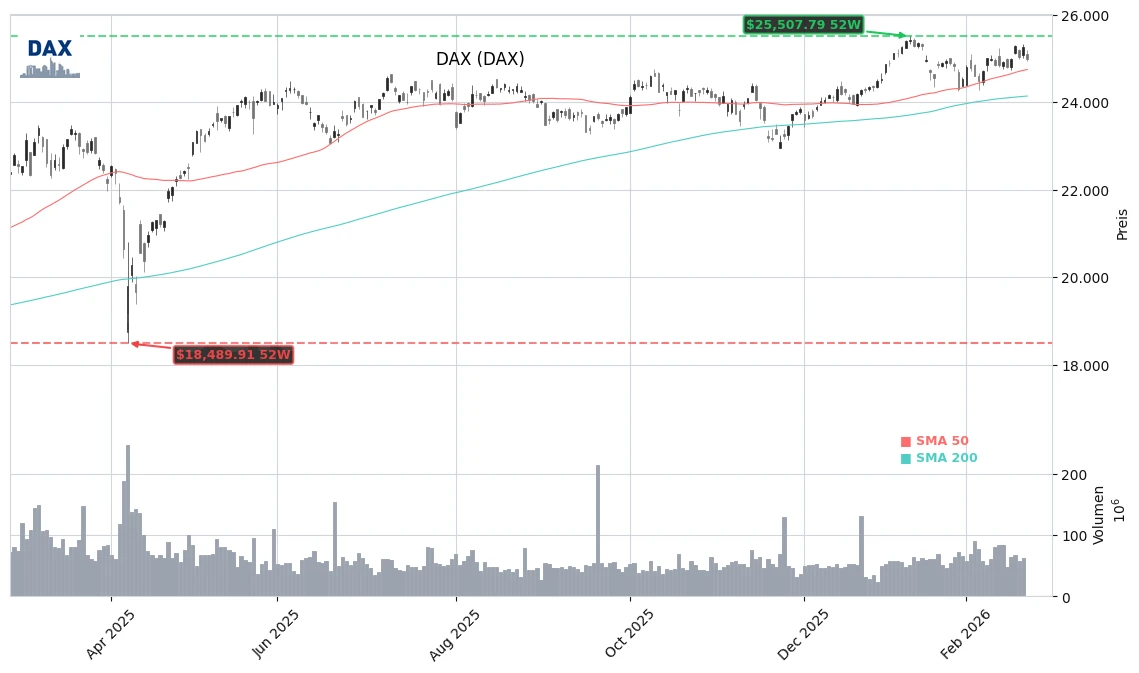
The positive market reaction from Friday afternoon to the ruling has completely evaporated. On Friday, the index had risen during the day to as high as 25,331 points—a peak since mid-January—before closing at 25,260.69 points. On Monday, however, risk aversion dominated: the DAX slipped below 25,000 points during the day, closing at 24,991.97 points. While this remains significantly above the yearly low of 18,865 points, it highlights how sensitive the market is to any escalation in the tariff dispute.
DAX Tariff Ruling, Iran, and Economic Conditions – What Weighs Heaviest?
In addition to the legal and political DAX Tariff Ruling, geopolitical risks are also increasing. Market concerns are growing over a potential military escalation between the U.S. and Iran. A possible U.S. military strike could tighten the oil market and significantly drive up energy prices, which would particularly burden the highly cyclical DAX sectors of industry and chemicals. So far, however, the oil price has reacted moderately: a barrel of Brent was priced at just over $71 around noon, slightly lower than on Friday.
On the economic front, signals are mixed. On a positive note, the German business climate improved in February: the Ifo index rose to 88.6 points, exceeding expectations. Additionally, the purchasing managers’ indices suggest that the manufacturing sector is moving slightly above the growth threshold for the first time since October. At the same time, the trade and tariff conflict shows clear signs of slowing: particularly the export industry—such as automotive suppliers and machinery—remains under pressure, while defense and infrastructure spending supports parts of the industry.
Analysts also point to robust domestic demand. Data on German retail sales and the recovering consumer confidence support the thesis that growth in 2026 will come more from domestic sources than from exports. For the DAX, this means that consumer-oriented and defensive stocks may fare better during this phase of heightened trade uncertainty than traditional cyclicals.
Technical Situation in the DAX After the Tariff Shock
From a technical perspective, the upward trend in the DAX remains intact for now despite slipping below 25,000 points, but it appears more fragile. The index has been moving sideways for weeks within a range of around 25,000 to 25,300 points, which is showing as a wedge formation with decreasing momentum on the hourly chart. On Monday, the bulls were unable to close the gap to Friday’s close at 25,260 points—a sign of waning buying interest near the record zone.
Important short-term levels now lie below at 25,000 and 24,925 points. Below these, there is technical room opening towards 24,800 points and lower, where several interim lows and moving averages provide additional support. On the upside, 25,145, 25,200, and 25,300 points are considered key resistances. Only above approximately 25,315 points would the path back to the record high of 25,507 points be clear. Many short-term market observers currently see the risk-reward ratio, given the wedge formation, tilted in favor of the bears and advise against pursuing new long positions near the highs.
How Are Analysts Responding to the DAX Tariff Ruling and Trump Tariffs?
The DAX Tariff Ruling itself is largely viewed by economists as a long-term positive, as it limits the arbitrary use of emergency laws for tariff imposition. In the short term, however, Trump’s response with temporary 15% tariffs increases uncertainty and complicates planning for businesses. Ifo President Clemens Fuest speaks of growing risks for the German economy, despite initial signs of recovery.
Major firms like Goldman Sachs, Morgan Stanley, and Deutsche Bank emphasize in their current Europe and Germany strategies the relatively moderate valuation of the DAX in international comparison. Citigroup highlights in its comments that German blue chips, despite tariff risks, benefit from a more stable domestic economy and attractive dividend profiles. RBC Capital Markets points out that Germany, with expected payouts of over €55 billion from DAX companies in fiscal year 2025 and further increasing dividends until 2027, remains interesting for long-term income investors.
Uncertainty is what stock investors dislike the most—and that is exactly what has returned to the markets with the new tariff chaos.
— Clemens Fuest, President of the Ifo Institute
Bottom Line
At the same time, many strategists urge caution: as long as it remains unclear whether the U.S. Congress will support Trump’s tariff policy and how trade negotiations between the EU and the U.S. will be restructured after the ruling, the environment remains vulnerable to setbacks. In the short term, some analysts recommend tactically using the increased volatility to selectively accumulate quality stocks during pullbacks, rather than aggressively chasing the index near its highs.
Related Sources
- DAX Performance Index on Yahoo Finance (Yahoo Finance)
- German retail sales inch up in December (Reuters)
- German Consumer Sentiment Picks Up as Outlook Brightens (WSJ)
- DAX: More Than Good Enough To Compete With EWG, But Don’t Chase Now (Seeking Alpha)