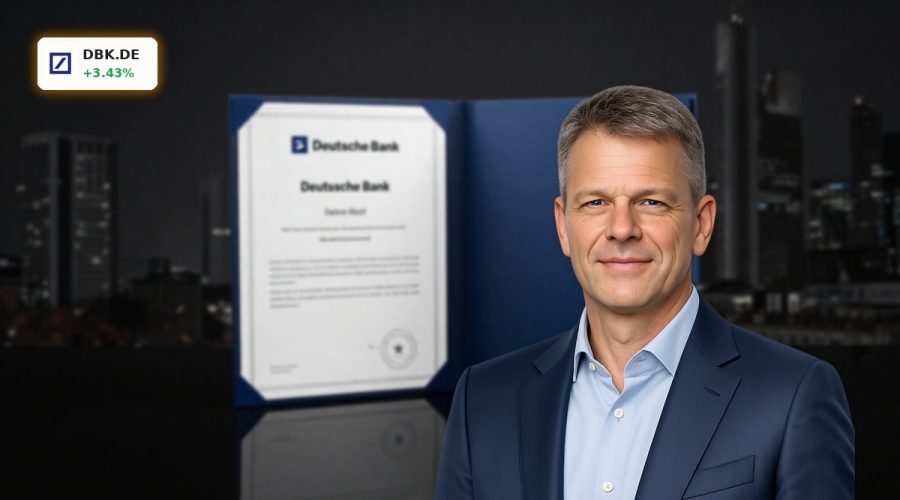
Is the latest Deutsche Bank ownership change by Qatar a quiet de-risking move or a strategic bet on a long-term turnaround?
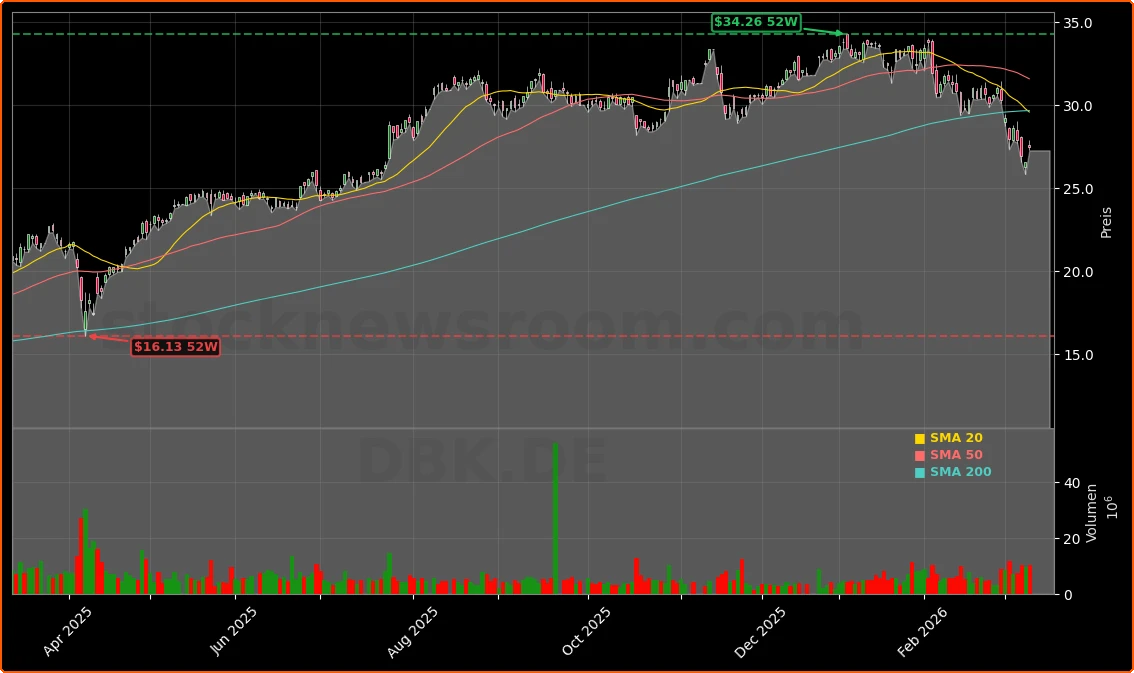
Deutsche Bank AG – Stimmrechtsmeldungen und Analystenkommentar are back in focus on a volatile day for European financials. After several sessions of pressure on bank stocks, Deutsche Bank is up about 3.4% at $27.46 in Frankfurt trading, recovering from recent losses and outpacing many European peers.
What is the new Deutsche Bank ownership change?
The centerpiece of the latest Deutsche Bank ownership change is an updated regulatory filing under Germany’s Securities Trading Act (WpHG). Supreme Universal Holdings Limited, based in the Cayman Islands and controlled along a chain leading to H. H. Sheikh Hamad bin Khalifa al-Thani, has reported a revised position in Deutsche Bank.
The filing shows that Supreme now holds 2.70% of Deutsche Bank’s voting rights via shares, down from a previously reported level of 3.05%. In addition, Supreme controls 0.77% of voting rights through financial instruments classified under Section 38 (equity-based instruments tied to shares), bringing the total interest to 3.47% of voting rights based on a total of 1,910,578,977 shares outstanding.
For U.S. investors used to disclosures under SEC rules, this resembles a blend of 13D/13G style ownership reporting and derivatives transparency, offering a granular view of how a major strategic investor manages exposure through both cash equities and structured instruments.
How is Qatar’s stake in Deutsche Bank structured now?
Digging deeper into the structure behind this Deutsche Bank ownership change, Supreme’s position combines outright shareholdings with a complex equity collar and stock lending setup. The company directly holds more than 51.5 million Deutsche Bank shares, representing the 2.70% voting stake. On top of that, Supreme has entered into equity collar arrangements, effectively selling call options and purchasing put options over the same number of shares.
Crucially, Supreme has lent the relevant shares to counterparties as collateral via a series of stock loan transactions, all maturing mostly in late 2028. In return, Supreme retains only a contractual claim for the retransfer of the shares at the end of the loan terms. These retransfer claims, which are reported as instruments under Section 38, account for the additional 0.77% of voting rights.
This structure allows the Qatari investor to hedge downside risk and monetize part of the position, while still maintaining a meaningful economic and potential governance footprint in Deutsche Bank. The move does not constitute an exit but rather a recalibration of risk and exposure—something institutional investors in New York and London frequently do in large, concentrated positions in banks like JPMorgan Chase or Goldman Sachs.
Why does the Deutsche Bank ownership change matter for Wall Street?
From a Wall Street perspective, the significance of this Deutsche Bank ownership change lies less in the small percentage shift and more in what it signals. First, Qatar-linked capital remains committed to Deutsche Bank, with total voting rights now slightly higher at 3.47% when instruments are included, versus the prior 3.05% purely in shares. That suggests ongoing strategic interest rather than a directional bearish bet.
Second, the use of collars and stock lending highlights how major shareholders can unlock liquidity without dumping stock into the market. For U.S. investors holding Deutsche Bank alongside U.S. money-center banks and global investment banks within diversified financial sector ETFs, this reduces fears of a sudden overhang from large block sales.
Third, the clarity of the WpHG disclosure may reassure governance-focused investors, including U.S. mutual funds and pension plans, who scrutinize ownership concentration and potential influence on management decisions such as capital returns and investment banking strategy.
How is Barclays viewing Deutsche Bank now?
On the analyst front, the tone remains supportive. The British investment bank Barclays has reiterated its “Overweight” rating on Deutsche Bank and kept its price target unchanged at EUR 39. Analyst Flora Bocahut argues that the recent sell-off in European banks reflects a bout of heightened risk aversion rather than a deterioration in underlying fundamentals.
Bocahut highlights that Deutsche Bank’s earnings momentum and the quality of assets under management remain solid, making the shares one of her preferred picks in the European banking universe. With the stock currently trading around $27.46 and below the Barclays target when converted into dollars, she sees further upside if sentiment toward European financials normalizes.
For U.S. investors benchmarking against the S&P 500 Financials and large U.S. banks such as Bank of America, Deutsche Bank offers exposure to the eurozone credit cycle and capital markets at a valuation that some may view as discounted relative to U.S. peers.
What about bonuses and competitiveness versus U.S. banks?
Beyond the Deutsche Bank ownership change and analyst calls, compensation is another piece of the investment puzzle. Deutsche Bank is reportedly planning to lift its 2025 bonus pool for investment bankers by more than 5%. While meaningful, that still trails U.S. giants like Goldman Sachs, JPMorgan Chase, and Bank of America, which are targeting bonus increases of at least 10%.
The discrepancy underscores the ongoing battle for talent between European and U.S. institutions. For investors on Wall Street, the question is whether Deutsche Bank can remain competitive in high-margin advisory and trading businesses without significantly compressing returns through higher compensation costs. The moderate bonus uplift suggests a balancing act: rewarding key teams while maintaining cost discipline, a critical factor in sustaining return-on-equity targets.
Recent weakness in European bank stocks is more about risk aversion than deteriorating fundamentals, and Deutsche Bank remains one of our preferred names in the sector.
— Flora Bocahut, Analyst at Barclays
Conclusion
In summary, the latest Deutsche Bank ownership change shows Qatar’s Supreme Universal Holdings fine-tuning, not abandoning, its strategic stake, while Barclays’ reaffirmed EUR 39 target underscores continued analyst confidence. For international investors, this combination of stable anchor ownership, transparent hedging structures, and supportive research views keeps Deutsche Bank firmly on the radar, and the next quarters will reveal whether execution and earnings can turn today’s discounted valuation into long-term upside.
Further Reading
- Deutsche Bank AG investor relations – shareholding notifications (Deutsche Bank)
- Barclays equity research coverage of European banks (Barclays)
- European bank stocks stabilize after recent sell-off (Reuters)
- Deutsche Bank AG – Stimmrechtsmeldungen und Analystenkommentar bei Yahoo Finance (Yahoo Finance)