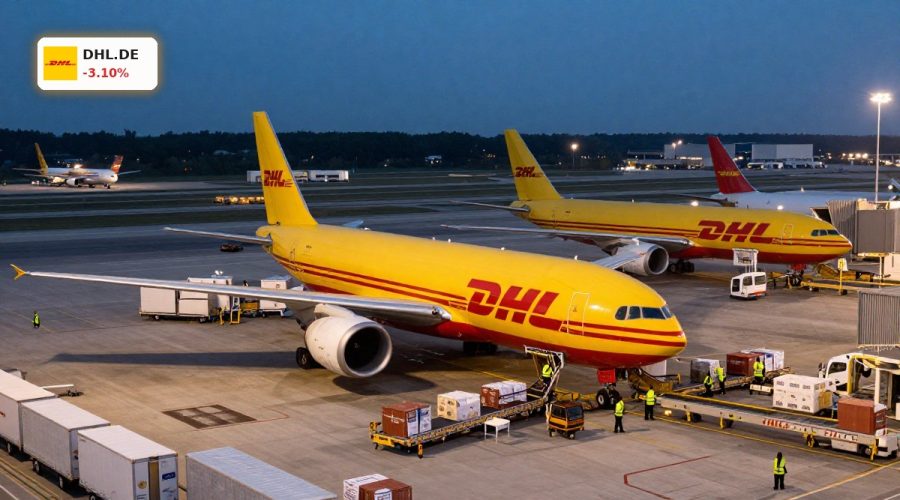
Can DHL Group’s quietly improving margins and higher dividend turn a lukewarm market reaction into a long-term buying opportunity?
DHL Group: How the latest numbers hit the stock
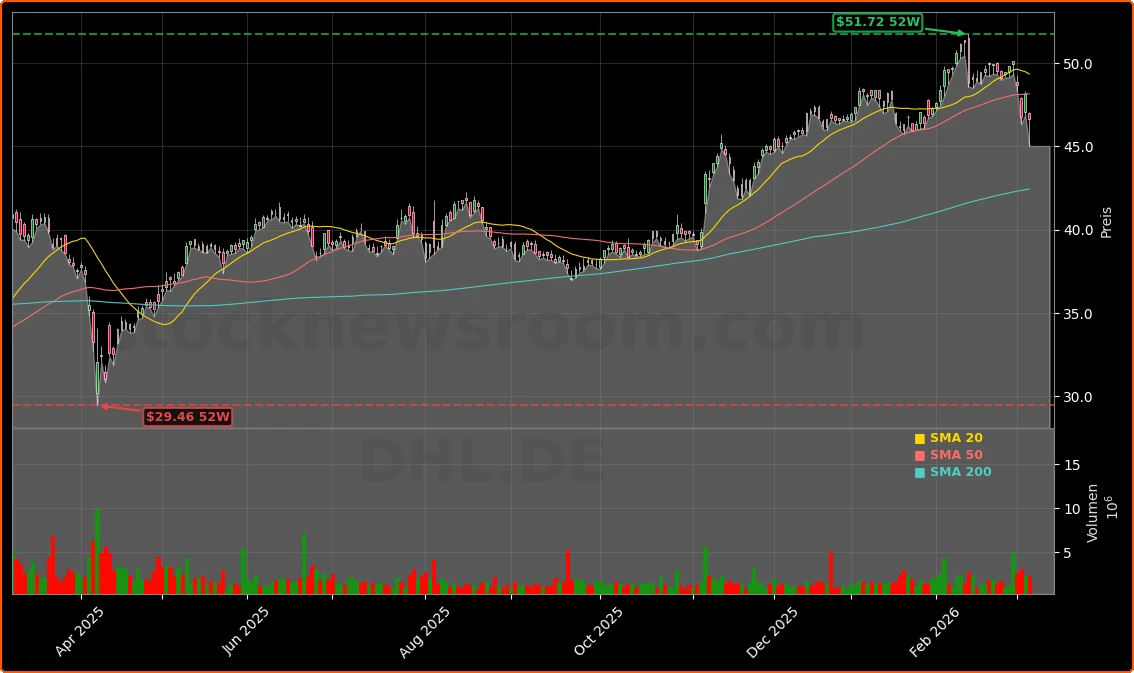
DHL Group shares recently traded around EUR 46.63, about 3.1% below the previous close of EUR 48.12, reflecting a cool reaction from the market to the new set of figures and guidance. The move came in a broader environment of heightened geopolitical risk and fragile sentiment across European equities, even as major U.S. indices such as the S&P 500 and NASDAQ remain close to their highs. From a U.S. investor’s perspective, DHL now offers a blend of moderate earnings growth, a higher dividend and a conservatively framed outlook that may not immediately excite momentum traders, but that could appeal to long‑term, income‑oriented portfolios.
The core of the latest DHL Group Earnings story is a small revenue decline offset by stronger profitability. Reported group revenue slipped 1.6% to EUR 82.9 billion, largely due to currency headwinds and lower transport volumes on certain routes into the United States. That topline softness, however, did not translate into weaker earnings. Operating profit (EBIT) rose 3.7% to around EUR 6.1 billion, beating the company’s own minimum target of EUR 6.0 billion and modest consensus expectations. The EBIT margin improved by 0.4 percentage points to 7.4%, underlining that the company’s active capacity management and structural cost savings have real bite.
Net profit attributable to shareholders increased by just over 5% to roughly EUR 3.5 billion, and earnings per share climbed from EUR 2.86 to EUR 3.09. For global investors used to the more volatile earnings trajectories of U.S.–listed cyclicals, the DHL profile looks relatively steady: mid‑single‑digit profit growth in a difficult macro environment, with no sign of balance‑sheet stress and clear discipline on capital allocation.
DHL Group Earnings: Profitability vs. macro headwinds
A key takeaway from the DHL Group Earnings is how management leaned hard into cost control and network optimization to protect margins. The company reports that structural cost improvements delivered around EUR 600 million more savings in 2025 than originally planned. This over‑delivery helped offset pressure in segments exposed to global freight pricing and weaker industrial demand. It also offers a template for how a global logistics network can be run more like an asset‑light, cash‑focused compounder than a pure volume play.
The positive surprise was concentrated in the high‑margin express business, where time‑critical shipments delivered better‑than‑expected earnings. By contrast, the ocean and air freight arm underperformed as falling freight rates and softer demand for container transport over land weighed on profitability. This split matters for investors: express logistics typically requires less capital intensity and offers stronger pricing power, while freight forwarding is more commoditized. Management emphasized that the freight division is still far more profitable than before the pandemic thanks to restructured operations and lower structural costs, but the near‑term cyclical headwinds remain.
Domestic mail and parcel operations in Germany came in slightly below expectations, reflecting continued structural pressures in letter volumes and a competitive parcel market. International parcel and supply chain logistics, on the other hand, were broadly in line with market forecasts. In supply chain logistics, DHL runs warehouses, manages returns and provides complex logistics solutions for global customers, a segment that often behaves more defensively than cyclical freight. For investors constructing diversified exposure across logistics, the intra‑group mix is important: DHL’s blend of express, parcels and contract logistics looks structurally more resilient than a pure freight‑forwarding model.
DHL Group: Dividend raise and cash flow discipline
Another important angle in the latest DHL Group Earnings is shareholder returns. The board and supervisory board plan to propose a dividend increase from EUR 1.85 to EUR 1.90 per share. Based on the prior day’s closing price, that implies a dividend yield of roughly 3.9%, which is attractive relative to many U.S. industrials and in line with the more generous payout culture seen in parts of the European market. For U.S. investors accessing DHL via over‑the‑counter listings or European brokerage accounts, this combination of yield and modest earnings growth can be a compelling total‑return profile, albeit with euro currency risk.
Free cash flow is another pillar supporting the investment case. The company generated around EUR 3.2 billion of free cash flow in 2025, beating market estimates. This cash generation underpins both the dividend and the flexibility to continue targeted investments in growth markets and sectors. Management continues to invest in network capacity, automation and green logistics solutions, while maintaining a disciplined capital structure. From a Wall Street perspective, these cash metrics reduce the risk of surprise equity raises or forced deleveraging, issues that sometimes plague more leveraged transport names.
Analyst commentary has generally recognized this cash flow strength. Bernstein’s Alex Irving noted that Q4 2025 operating profit was in line with expectations and that the full‑year result slightly exceeded consensus. Deutsche Bank Research analyst Andy Chu and Barclays analyst Marco Limite both highlighted that adjusted EBIT came in marginally ahead of forecasts and praised the higher‑than‑expected cost savings in 2025. At the same time, the very fact that cost savings have overshot expectations has led Limite to caution that there is less room for incremental efficiency gains in 2026, which may weigh slightly on the earnings consensus for the new year.
DHL Group: Management guidance and 2026 outlook
Perhaps the most market‑sensitive aspect of the DHL Group Earnings is the cautious outlook for 2026. CEO Tobias Meyer, whose contract was recently extended to March 2031, emphasized that the world economy remains volatile and that management is not counting on a strong rebound in global trade. DHL expects no major upswing in the global economy in 2026 and has therefore guided to an EBIT of around EUR 6.2 billion, below the approximately EUR 6.4 billion embedded in prior market expectations.
Some analysts see this as a prudently conservative stance. Andy Chu of Deutsche Bank called the outlook “reasonably conservative,” particularly in light of ongoing cost pressures and macro uncertainty. The company’s guidance for free cash flow of around EUR 3 billion in 2026 also sits slightly below prior consensus. Jefferies analyst Michael Aspinall expressed some disappointment that, given the strong cost performance in 2025, the new targets were not more ambitious. However, he acknowledged that the underlying assumption of a subdued economic environment could prove too cautious if global growth surprises to the upside.
For U.S. investors, the tone of guidance is important because it echoes what many large‑cap multinationals on the S&P 500 have been communicating: the cycle is mature, geopolitical risk is high and managements prefer to under‑promise. DHL’s forward view is not bearish, but it clearly does not hinge on a sharp upcycle in freight rates or industrial production. That makes the stock more of a steady compounder story than a classic cyclical recovery play. If world trade volumes pick up faster than modeled, there is room for positive earnings revisions in 2026 and beyond.
DHL Group vs. U.S. logistics and tech peers
In a global portfolio, DHL Group inevitably gets compared to U.S. and international peers. On the logistics side, U.S. investors will naturally benchmark the company against UPS and FedEx, as well as against e‑commerce and cloud‑driven heavyweights like Amazon that are increasingly building their own logistics infrastructure. DHL’s edge lies in its global express network and its strong presence in contract logistics, where it often runs warehouses and fulfillment solutions for major multinationals rather than competing directly as an online retailer.
When extended to a broader industrial and technology context, DHL’s growth and margin profile sits between asset‑heavy transport names and asset‑light digital platforms. Its mid‑single‑digit earnings growth in a tough year may look pedestrian compared with high‑growth names like NVIDIA or Tesla, but the risk profile is fundamentally different. DHL’s earnings are tied to global trade flows, industrial production and e‑commerce volumes, which are cyclical but diversify across regions and end markets. For diversified investors who already have significant exposure to tech leaders such as Apple or semiconductor firms, a position in DHL can add a different macro factor: world trade and physical goods movement.
Valuation, of course, is the swing factor. With the stock pulling back after the guidance, DHL trades at a moderate earnings multiple relative to its own history and to some U.S. peers, while offering a near‑4% dividend yield. If management delivers on its modestly growing EBIT and maintains free cash flow around the EUR 3 billion mark in 2026, total shareholder returns could be solid even without multiple expansion. Conversely, if global freight pricing remains under pressure longer than expected or if geopolitical tensions significantly disrupt trade lanes, the earnings trajectory could flatten and justify the market’s cautious reaction.
What DHL Group Earnings signal for macro and portfolios
Beyond the company‑specific narrative, the DHL Group Earnings provide a useful real‑economy signal. A large, diversified logistics provider with deep exposure to both consumer and industrial flows is essentially a barometer for global trade. Slightly lower revenue but improving margins and cash flow suggest that volumes and pricing are not booming, yet neither are they collapsing. Instead, DHL’s numbers point to a sluggish but functioning global trading system, with companies focusing on efficiency and resilience rather than aggressive expansion.
For multi‑asset and equity portfolio managers on Wall Street, this has several implications. First, it supports the case that global industrial cyclicals may continue to grind higher on efficiency gains rather than enjoy a sharp V‑shaped recovery. Second, it underlines the importance of stock selection within logistics: companies with diversified business mixes, disciplined cost structures and strong balance sheets are better positioned to manage through a low‑growth environment. Third, it highlights the role of dividends and buybacks as key drivers of total return when topline growth is muted.
Thanks to active capacity management and structural cost improvements, we have exceeded our financial targets while continuing to invest in growth markets and sectors worldwide.
— Tobias Meyer, CEO of DHL Group
Conclusion
Within this framework, DHL Group occupies a niche as a relatively low‑beta, income‑generating logistics play with exposure to secular themes like e‑commerce, supply chain digitalization and near‑shoring. The upgraded dividend, robust free cash flow and extended CEO mandate suggest continuity and strategic consistency. At the same time, the cautious 2026 guidance and limited remaining cost‑cutting upside mean that investors should not expect explosive earnings upside without a stronger macro tailwind.
Further Reading
- DHL Group – Annual Report 2025 (Financial Highlights and Strategy) (DHL Group Investor Relations)
- Deutsche Post DHL: Analyst Commentary on 2025 Results and 2026 Guidance (Reuters)
- Global Logistics and Freight Market Outlook 2026 (Bloomberg)
- DHL Group bei Yahoo Finance (Yahoo Finance)