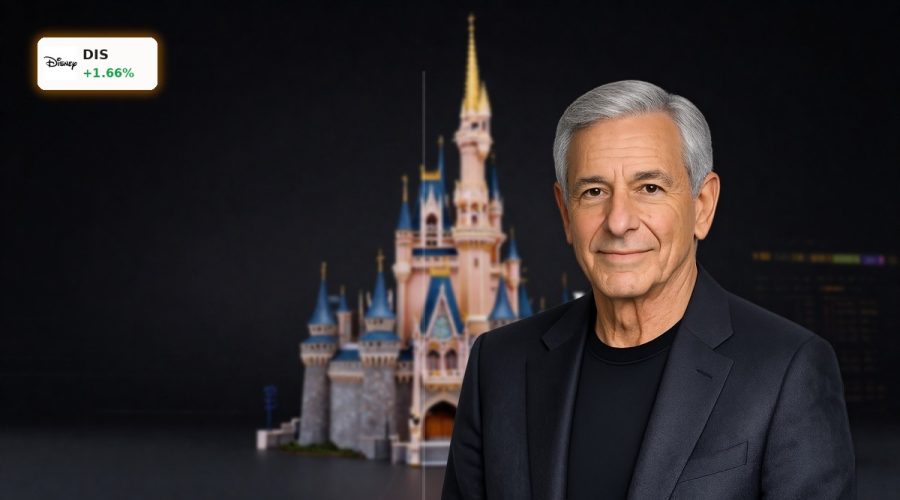
Can the Disney CEO Transition finally unlock the value investors expected from Bob Iger’s return but never fully received?
[fxmag_hero_image]
How is Disney’s stock positioned into the CEO shift?
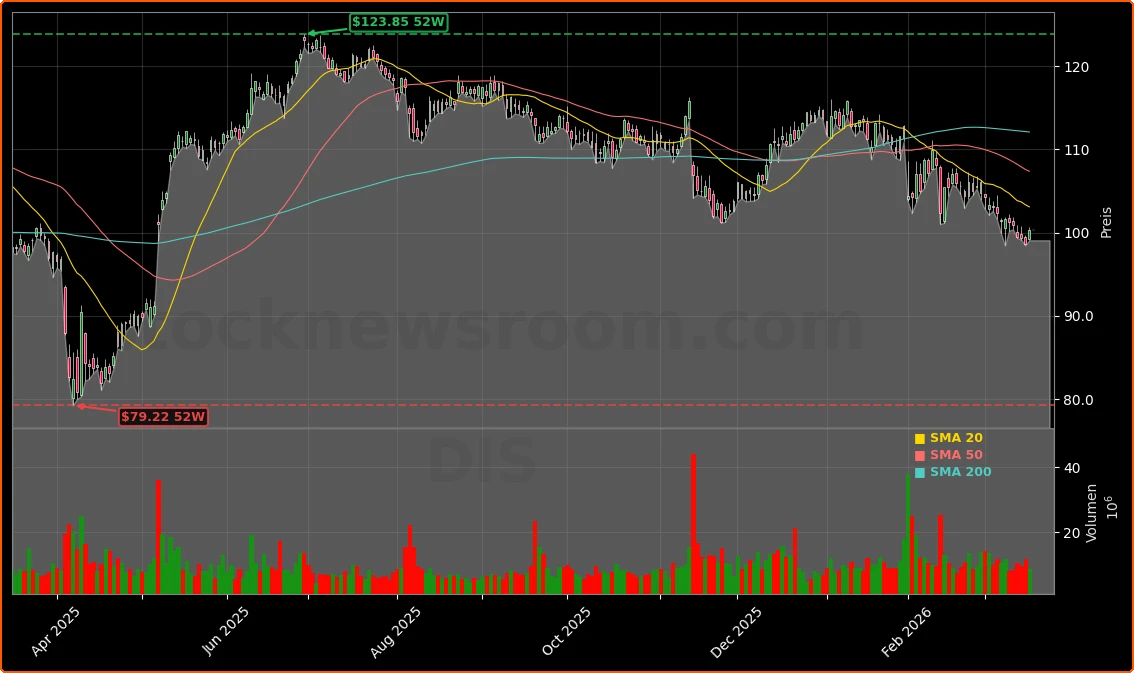
The Walt Disney Company (DIS) edged up 1.66% Tuesday to $100.30, with pre-market quotes near $100.35 early Wednesday, leaving the stock well below consensus Wall Street price targets around the mid‑$130s. Over Iger’s second stint, beginning with his surprise return in November 2022, the stock has gained roughly 9%, while the S&P 500 has surged about 70%, underscoring investor frustration ahead of the Disney CEO Transition.
DIS now trades on a forward price‑to‑earnings multiple near the mid‑teens, a historically low range for the company and closer to a classic value play than a growth stock. Commentary from institutional holders such as DigitalBridge, which recently boosted its position to nearly 299,000 shares worth over $34 million, reflects growing interest in Disney as a discounted blue chip rather than a momentum name. For portfolio managers benchmarked against the S&P 500 or NASDAQ, the new leadership story adds a catalyst on top of that compressed valuation.
What does Josh D’Amaro bring to Disney?
Josh D’Amaro, previously chairman of Disney Experiences, officially steps in as CEO at today’s shareholder meeting. He has overseen parks, resorts, cruise lines and Imagineering since 2020, steering those businesses out of the pandemic slump into record profitability. In fiscal 2025, the experiences division delivered about $10 billion in operating income, the largest contributor to Disney’s $17.6 billion total, and posted a record $1.9 billion operating profit in fiscal Q4 alone.
That track record is central to investor hopes for the Disney CEO Transition. D’Amaro is expected to double down on high‑return capital projects in domestic and international parks, expand the cruise footprint, and knit experiences more tightly to hit franchises from Marvel, Star Wars and Pixar. For U.S. shareholders, that means an emphasis on relatively predictable, cash‑generative businesses that can support dividends and buybacks even as the company navigates disruption in linear TV and streaming.
Can Disney fix streaming and ESPN faster than Netflix?
On the media side, Wall Street will scrutinize how D’Amaro and his senior team re‑energize Disney+ and address ESPN’s subscriber erosion. Disney+ has recently swung closer to profitability as price hikes and cost cuts bite, and new experimental content on the platform helps maintain engagement. Still, Disney’s direct‑to‑consumer segment remains in an arms race for attention and content spending against rivals like Netflix and Apple TV+.
Analysts continue to compare Disney’s setup with that of Netflix and, increasingly, tech‑driven media platforms such as NVIDIA-powered cloud gaming and content ecosystems. While Netflix’s ad‑tier growth and $1.5 billion in 2025 ad revenue have impressed Wall Street, Disney’s edge lies in leveraging its park and consumer‑products engine to monetize IP across multiple channels. The CEO’s challenge is translating that advantage into consistent streaming margins while stabilizing ESPN as sports rights become more expensive and viewing habits move online.
What are the key risks and opportunities for U.S. investors?
Beyond strategy, governance and execution risk hover over the Disney CEO Transition. Reports of internal tensions following a recent corporate reshuffle, including senior creatives now reporting to President and Chief Creative Officer Dana Walden, highlight the need for D’Amaro to maintain morale in Disney Entertainment while pushing for efficiency. The company is also paying $50 million to settle a class action tied to ESPN’s carriage in virtual pay‑TV bundles, and has agreed to consider more flexible channel packages — a move that could reshape future affiliate revenue.
Against that backdrop, DIS has reintroduced a dividend yielding around 1.5% at current prices, a feature that may appeal to more conservative U.S. investors seeking income alongside potential capital appreciation. With beta around 1.4, the stock is still more volatile than the broader market, but less so than high‑growth peers. If D’Amaro can sustain experiences growth in the low‑double‑digit range while achieving durable streaming profitability, the multiple could re‑rate toward other global media leaders like Tesla-adjacent content partners and big‑cap tech platforms.
For now, the market is giving Disney the benefit of the doubt. The Disney CEO Transition crystallizes a new narrative: from turnaround under a returning legend to an execution story under an operator deeply rooted in the parks business. The next few quarters — and the first strategic moves D’Amaro announces — will determine whether that narrative translates into sustained outperformance on Wall Street.