
Can DocuSign’s latest earnings beat and fast-growing AI platform finally convince investors that DOCU’s turnaround story is real?
[fxmag_hero_image]
How did DocuSign Earnings stack up?
DocuSign Inc. posted GAAP net income of $90.3 million, or $0.44 per share, for the quarter ended January 31, 2026, up from $83.5 million, or $0.39 per share, a year earlier. On an adjusted basis, DocuSign Earnings came in at $1.01 per share, beating the consensus estimate of $0.95. Revenue rose about 8% year over year to $836.9 million, ahead of expectations of roughly $827 million.
Subscription revenue, the core of the business, climbed to $819 million from $757.8 million, offsetting a slight dip in professional services and other revenue to $17.9 million. Several Wall Street commentaries highlighted that the quarter also featured record billings and more than $1 billion in free cash flow for the fiscal year, underlining the company’s cash-generation capacity even amid a broader software multiple compression on the NASDAQ.
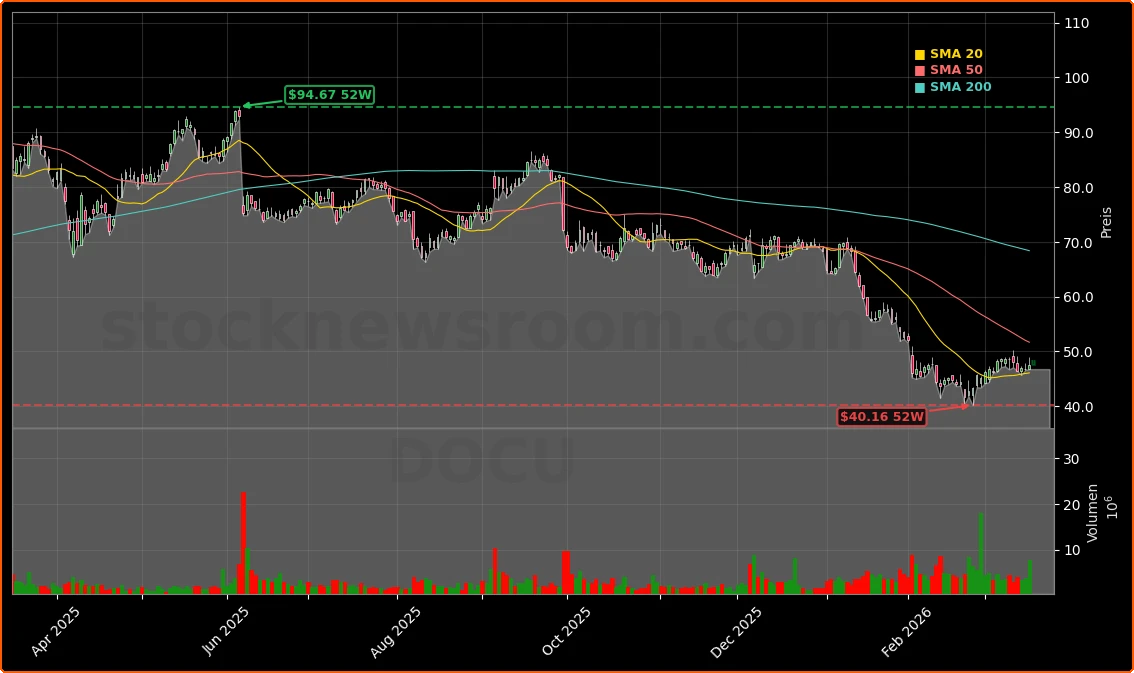
Despite the initial pop following the DocuSign Earnings release, the stock still trades around $47.54 in regular hours (up 1.54% on Tuesday) and roughly $48.40 in premarket trading, leaving it well below past 52‑week highs. For U.S. investors, the numbers suggest operational momentum that is not yet fully reflected in the share price.
What is driving DocuSign’s AI growth story?
A key takeaway from the quarter is how much of the growth narrative now hinges on DocuSign’s AI-native Intelligent Agreement Management (IAM) platform. CEO Allan Thygesen stressed that IAM has scaled to an annualized run rate of about $350 million in just 18 months, with accelerated adoption across the customer base as enterprises look to automate and analyze contract workflows.
Rather than being disrupted by generative AI, DocuSign is positioning itself alongside leaders like NVIDIA and Apple in leveraging AI to deepen product moats. IAM is pitched as an “agreement system of action,” turning static documents into structured, queryable data that can be surfaced across business systems. Management argues that the strong return on investment is pushing customers toward larger and longer-term commitments, which could improve net revenue retention and long-run margin visibility.
For investors comparing the stock with other software names pressured by AI fears, such as Tesla on the auto-tech side or large-cap cloud peers, the rapid IAM uptake helps counter the bear case that e-signatures are a commoditized feature. It shifts the debate from point-solution pricing pressure to full lifecycle agreement management, a category where DocuSign still claims clear market leadership.
How strong is the outlook and capital return?
Alongside the solid DocuSign Earnings, management issued guidance that topped expectations. For the current quarter, the company forecasts revenue between $822 million and $826 million, implying about 8% year-over-year growth at the midpoint and ahead of analyst models near $812 million. For the new fiscal year, DocuSign projects revenue of $3.48 billion to $3.5 billion, again slightly above the roughly $3.42 billion Wall Street had penciled in.
The board also authorized a $2 billion increase to the share repurchase program, bringing the total available for buybacks to $2.6 billion. Given the stock’s steep pullback, the expanded authorization could be meaningfully accretive if executed aggressively, especially with the company generating over $1 billion in annual free cash flow. In addition, Brian Roberts, a general partner at Andreessen Horowitz, is joining the board, adding another venture and growth-oriented voice to governance.
While there were no fresh rating changes disclosed around the release, several major firms, including Citigroup, Morgan Stanley and Goldman Sachs, have previously highlighted valuation and competitive dynamics as key swing factors for DOCU. The latest DocuSign Earnings print, AI traction and buyback scale are likely to feed into upcoming target price revisions and could nudge sentiment more constructive if execution continues.
AI is great for DocuSign. In just 18 months, our AI-native Intelligent Agreement Management platform scaled to a $350 million run-rate, with accelerated adoption across the customer base.— Allan Thygesen, CEO of DocuSign Inc.
In sum, DocuSign Earnings delivered a clean beat, reinforced the AI-led strategy and paired it with sizable capital returns at a time when the stock is still under significant pressure. For U.S. investors seeking exposure to digital transformation and AI-enabled workflow software, DocuSign remains a volatile but increasingly cash-rich name to watch into the next quarters.