
Is the latest DraftKings Forecast signaling a buying opportunity or the start of a deeper rerating on regulatory risk?

Is Wall Street Repricing DraftKings Inc. Risk?
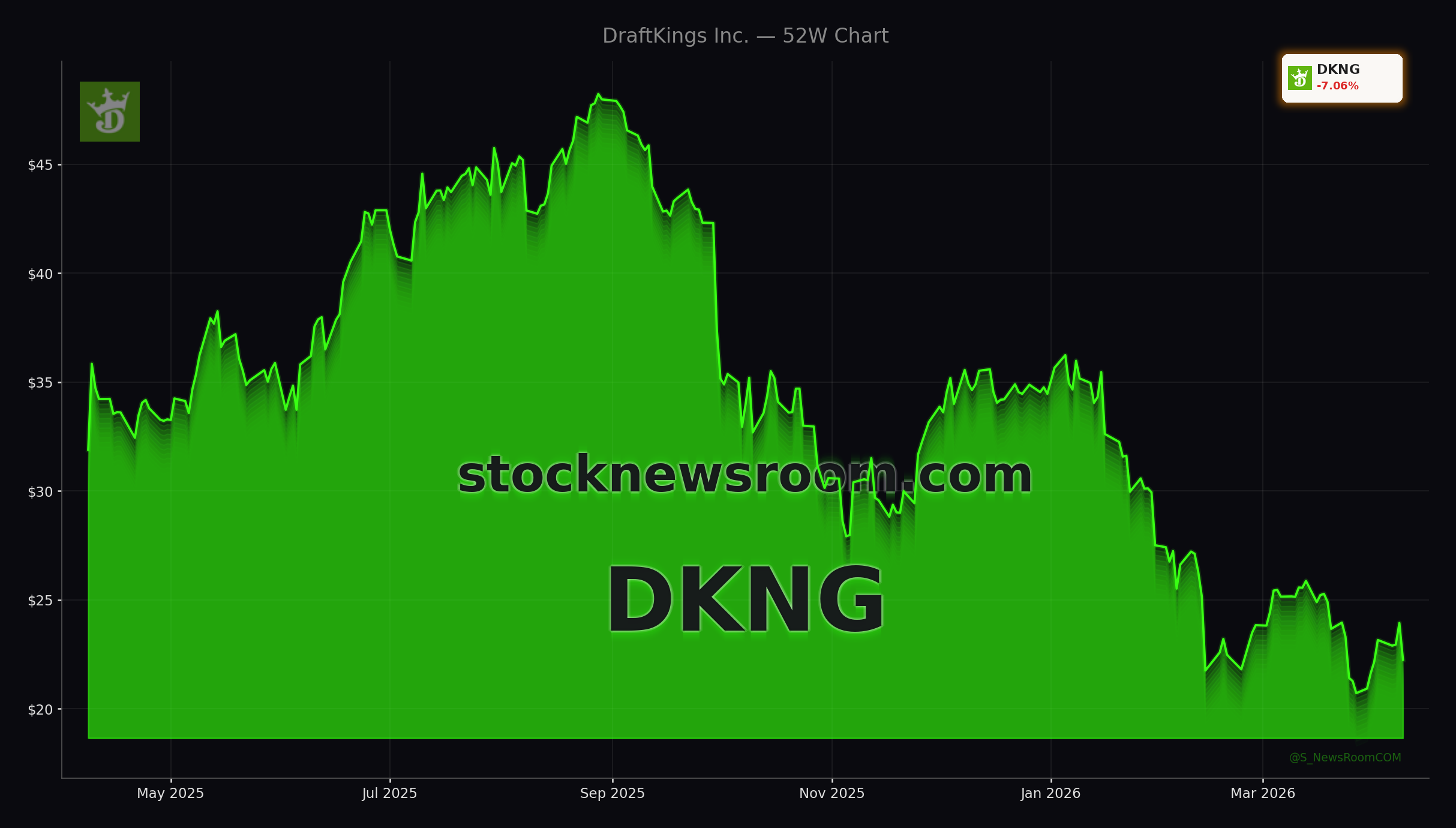
DraftKings Inc. (DKNG) fell about 7% to $22.25 on Thursday, underperforming the NASDAQ and extending a year-to-date slide of more than 30%. The drop followed news that Ohio lawmakers are weighing a bill that would sharply restrict sports betting, including a potential ban on mobile wagering, prop bets, in-game betting and parlays. That would directly hit some of DraftKings’ highest-margin products in a large, sports-obsessed state and has jolted sentiment around regulatory risk across the US.
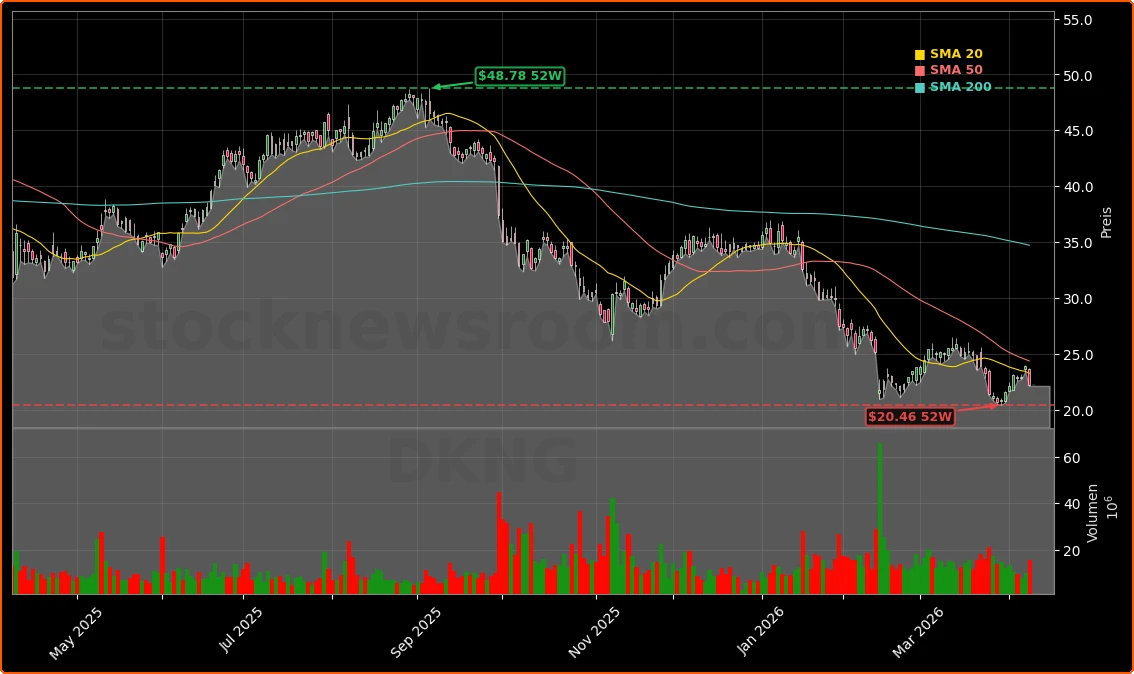
The selloff comes even though the stock already trades roughly 26% below its 52‑week high and only slightly under a $24.13 fair‑value estimate from 24/7 Wall St., which implies less than 1% upside. At around these levels, the market appears to be discounting both regulatory uncertainty and a more cautious DraftKings Forecast for 2026 growth, despite a strong fundamental backdrop.
For US portfolio managers, that combination pushes DKNG into classic “show‑me” territory: the core business is profitable and scaled, but the path to multiple expansion now depends on delivering new revenue streams without triggering tougher rules or margin erosion.
How Strong Is DraftKings Inc. After Record Results?
The paradox behind the latest DraftKings Forecast is that the fundamentals look better than ever. In Q4 2025, DraftKings generated $1.989 billion in revenue, up nearly 43% year over year, and reported adjusted diluted EPS of $0.36, double consensus estimates. Adjusted EBITDA surged to $343.2 million, roughly four times the prior-year level, and 2025 marked the first full‑year GAAP profit in company history.
Operationally, the underlying sportsbook metrics are moving in the right direction. Hold rates during the NFL season improved to about 16%, while parlay mix in handle jumped nearly 500 basis points in Q4, both supporting structurally higher margins. That progress matters as DraftKings competes head‑to‑head with FanDuel owner Flutter, as well as diversified consumer-tech rivals like Apple and Tesla that increasingly coexist in growth-focused US portfolios.
Yet shares slid after earnings as investors homed in on 2026 revenue guidance of $6.5 billion to $6.9 billion, implying a deceleration from roughly 27% growth in 2025. Management also guided to adjusted EBITDA of $700 million to $900 million next year, signaling continued heavy investment. That spending is largely tied to its new Predictions product, but crucially, guidance excludes any revenue contribution from that platform.
DraftKings Forecast: Can The Predictions Platform Deliver?
The most important swing factor in any medium‑term DraftKings Forecast is the company’s push beyond traditional sports betting into a broader Predictions marketplace. CEO Jason Robins has called this the most exciting opportunity since the 2018 repeal of PASPA, pointing to a roughly $10 billion addressable market and the potential for “hundreds of millions” in annual revenue over time.
Early usage data has been encouraging. On Super Bowl Sunday, the Predictions platform reportedly hit triple its prior record for daily trading volume, and DraftKings has since expanded its reach through a new partnership with Crypto.com | Derivatives North America, opening the door to more sophisticated market‑style contracts. None of that upside is baked into current 2026 revenue guidance, meaning any traction would be additive to the base case.
However, investors cannot ignore execution risk. DraftKings plans to spend aggressively on customer acquisition and product build‑out, and outcome volatility remains a structural issue; in Q3 2025, sportsbook revenue fell more than 9% year over year purely due to customer‑friendly results, compressing net revenue margin to about 5%. Overlay that with fresh questions from the CFTC and lawmakers about what constitutes legal prediction markets, and the new platform becomes both a growth lever and a regulatory lightning rod.
How Are Analysts And Institutions Positioning?
Despite the recent drawdown, the Street remains broadly constructive. Across the analyst community, there are roughly 25–27 Buy ratings versus 8 Holds and no formal Sell calls, with an average 12‑month price target in the high $30s to low $40s. Sahm Capital, for example, cites strong revenue growth, improving net margins and manageable leverage as key supports for the long‑term bull case, even as it notes a drift lower in consensus targets compared with late 2025.
Institutional interest remains solid as well. Janus Henderson recently disclosed a 5.1% passive stake totaling over 25 million Class A shares, underscoring that large asset managers still view DraftKings as a core exposure to US online betting growth. Insider activity has been dominated by RSU vesting and tax‑related share withholdings, including grants to CEO Jason Robins and senior finance executives, rather than outright open‑market selling.
Looking beyond the next quarter, the 24/7 Wall St. DraftKings Forecast projects a gradual re‑rating if management executes: price targets step up from $24.13 in 2026 to $31 in 2027, $38.50 in 2028, $46 in 2029 and $55 in 2030. Those numbers assume successful monetization of Predictions, continued sportsbook margin gains and incremental iGaming legalization—assumptions that will need to be validated against an increasingly politicized backdrop.
What Risks Could Derail The DraftKings Inc. Story?
The Ohio proposal crystallizes several key risks for any DraftKings Forecast. First, state-level regulation can change quickly and target precisely the products—mobile, in‑game and parlay betting—that drive much of the company’s profitability. Second, tax regimes are shifting: recent increases in New Jersey, Louisiana and Illinois already pressure contribution margins and could prompt copycat moves elsewhere.
Competitive risk is also rising. FanDuel parent Flutter has strengthened its US listing profile, while technology‑heavy names like NVIDIA and Apple compete for growth capital allocation within diversified funds. Meanwhile, newer entrants and adjacent platforms with massive user bases, such as large retail brokerages, are experimenting with gamified trading and prediction products that could encroach on DraftKings’ addressable market.
Investors also must weigh event risk: more quarters like Q3 2025, when outcomes skewed sharply toward customers, would amplify earnings volatility just as the company is trying to prove that its new platform can produce stable, high‑margin revenue.
Related Coverage
Regulatory risk around Predictions has been building for weeks. A detailed breakdown on StockNewsroom explores how a new US Senate bill could reshape the company’s trajectory in “DraftKings Regulation -8.1% Shock as Senate Targets Predictions”, examining whether tighter oversight becomes a long‑term competitive advantage or a growth cap. Investors tracking DKNG should read that piece alongside this DraftKings Forecast to understand how federal and state actions might intersect.
In summary, the current DraftKings Forecast balances record profitability and strong sportsbook fundamentals against an unproven Predictions platform and mounting regulatory scrutiny. For US investors, DKNG looks fairly valued on the core business alone, with upside hinging on clean regulatory clarity and visible revenue from Predictions over the next 12–18 months. The next few quarters of product launches, statehouse debates and earnings reports will decide whether DraftKings earns a premium multiple in growth portfolios or remains a volatile trading vehicle alongside other high‑beta names like Tesla.