Will the new US Senate bill turn DraftKings’ predictions push into a regulatory landmine or a long-term competitive edge?

How is DraftKings reacting on Wall Street?
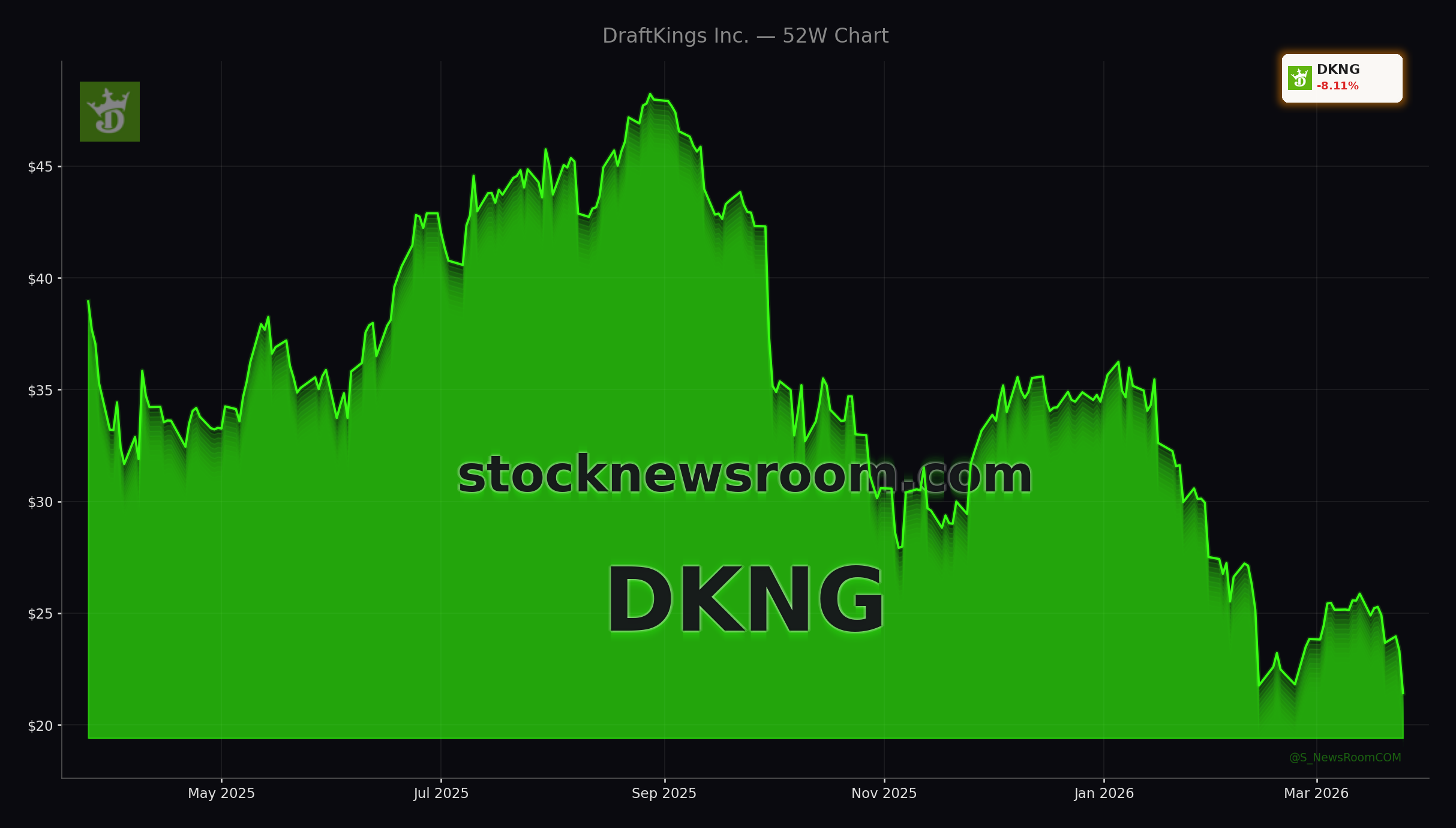
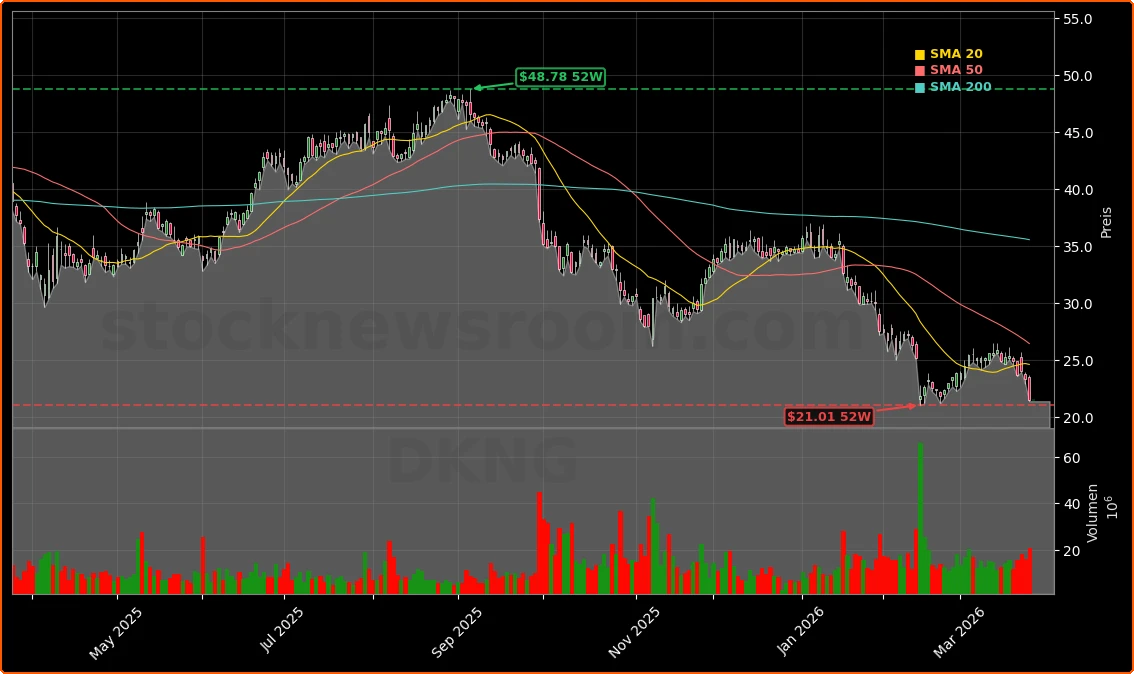
DraftKings closed Wednesday at $21.42, down from a previous close of $23.46, with only a modest after-hours bounce to $21.46 as of 8:00 p.m. ET. The move compounds what was already a painful stretch: DKNG is down more than 30% year-to-date and over 40% over the past 12 months, badly underperforming the S&P 500 and broader consumer discretionary peers. While many growth names tied to the NASDAQ have stabilized in recent weeks, DraftKings continues to trade under pressure as regulatory headlines overpower otherwise strong operating results.
The selloff stands in stark contrast to Monday’s action, when major gambling stocks rallied after lawmakers first floated curbs on unregulated prediction markets. DraftKings, Flutter Entertainment’s FanDuel parent, and MGM each rose as investors initially framed the proposal as primarily a threat to privately held platforms like Kalshi and Polymarket rather than to established, licensed operators. That narrative flipped sharply once it became clear the Senate bill could directly limit the sports-related event contracts underpinning DraftKings Predictions.
Why is DraftKings hit harder than rivals?
Unlike Penn Entertainment or regional casino operators that remain focused on traditional sportsbooks and iGaming, DraftKings has made its predictions platform a core pillar of its medium-term growth story. DraftKings Predictions operates under federal oversight via the Commodity Futures Trading Commission (CFTC), and management has highlighted it as a scalable “event contracts” business designed to complement its core sportsbook and daily fantasy offerings.
On the Q4 2025 earnings call, CEO Jason Robins described Predictions as a “massive, incremental opportunity” and signaled that the company would allocate significant growth capital to expand the product through 2026 and beyond. That capital deployment thesis is now directly challenged by the proposed legislation, which seeks to restrict or ban event contracts tied to sports outcomes across prediction markets.
By contrast, Penn Entertainment’s limited exposure to this niche means its equity has been relatively insulated. The divergent reaction underscores that DraftKings Regulation risk is no longer just a broad sector concern; it is specifically about how deeply the company has integrated prediction markets into its long-term strategy.
Does the bill help or hurt DraftKings Regulation?
The market’s whipsawing response highlights the two-sided nature of DraftKings Regulation risk. On the bullish side, if the Senate bill ultimately clamps down on lightly regulated prediction platforms that had been edging into sports wagering, established operators like DraftKings, Flutter, and MGM could see competitive pressure ease. Fewer gray-area competitors could translate into higher handle, better pricing power, and improved customer retention for licensed sportsbooks over time.
However, the bear case currently has the upper hand. The latest draft of the bill appears to sweep broadly across sports-related event contracts, putting DraftKings Predictions squarely in the regulatory crosshairs. Investors now have to discount the possibility that a business line previously modeled as a high-margin growth driver may be delayed, limited in scope, or reshaped entirely by Washington. Layered on top of concerns about insider selling and a stock already down more than 40% in a year, this new DraftKings Regulation uncertainty makes it harder for bulls to argue for a rapid re-rating.
For comparison, large-cap tech and consumer names like Apple and Tesla have also faced periodic regulatory scares, but diversified revenue bases and index-heavy ownership often cushion volatility. DraftKings, by contrast, remains a pure-play online betting operator with a concentrated set of growth levers, so each legislative headline hits the multiple directly.
What do earnings and analysts say now?
Fundamentally, DraftKings entered 2026 on solid footing. Q4 2025 revenue reached $1.99 billion, up 42.8% year over year, and the company posted its first-ever full-year GAAP net income of $3.71 million. Management guided full-year 2026 revenue to a range of $6.5 billion to $6.9 billion, signaling confidence in continued double-digit growth despite a tougher macro backdrop and intense competition from FanDuel, BetMGM, and other US online sportsbooks.
Wall Street analysts remain broadly constructive, with a consensus price target around $36 and the majority of firms rating the stock a Buy or Outperform. Research desks at major banks such as Morgan Stanley, Goldman Sachs, and Citigroup have highlighted DraftKings’ market share gains, its emerging “super app” strategy, and improving profitability trends as key pillars of the bull thesis. Nonetheless, those same teams have also flagged DraftKings Regulation as a key swing factor that could either reduce competition or diminish the upside from the predictions business, depending on how the final bill is written.
Given the scale of the recent drawdown, some investors see an opportunity if regulators ultimately carve out space for licensed operators to continue offering certain event contracts. Others, particularly risk-averse portfolio managers benchmarked to the S&P 500 or NASDAQ 100, may prefer to wait for clearer signs from the Senate before re-engaging with the stock.
For now, the central question is no longer whether DraftKings can grow — its recent results show that it can — but how much of that growth will be allowed under evolving federal rules. DraftKings Regulation will likely remain a key driver of volatility for DKNG, especially as committee hearings, amendments, and public comments begin to shape the final contours of the bill. Long-term investors will be watching both Capitol Hill and the company’s next earnings update to gauge whether Predictions remains a “massive, incremental opportunity” or becomes a more modest, tightly regulated adjunct to the core sportsbook business.