Is the latest bearish Eli Lilly Forecast a rare buying opportunity or the start of a painful valuation reset in GLP-1 leaders?

Is the Eli Lilly Forecast now too bearish?
Eli Lilly and Company (LLY) has shifted from market darling to S&P 500 laggard in a matter of days after HSBC cut its rating to “Reduce” from “Hold” and slashed its price target to $850. The bank argued that the total addressable market for obesity drugs is being overstated and warned that price competition and U.S. reimbursement pressure could hit margins. That stance contrasts with the prevailing Eli Lilly Forecast on Wall Street, where many institutions still model robust multi‑year growth driven by GLP‑1 therapies for diabetes and obesity.
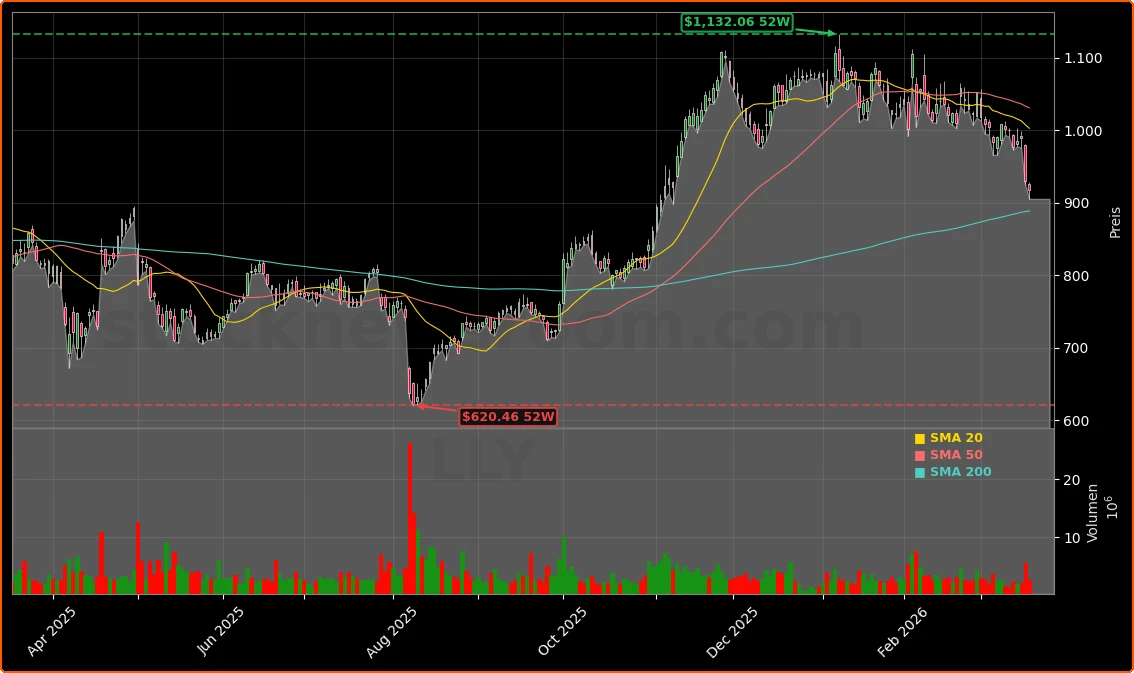
Market reaction was swift: LLY briefly led decliners in the S&P 500, before stabilizing near the $890–$920 band that acted as resistance in April 2025. With the stock now roughly 1%–2% below that former ceiling, technicians see the zone as a potential support area where prior sellers may turn into buyers, helping to put a floor under the price.
Eli Lilly Forecast vs. healthcare sector reset
The HSBC call lands just as healthcare broadly has fallen out of favor. The Health Care Select Sector SPDR is down almost 4% year to date, making it one of the weakest S&P 500 sectors while investors crowd into AI winners like NVIDIA and mega‑cap growth stories such as Apple. Yet strategists at Morgan Stanley have started to argue that investors should “favor the quality factor and healthcare for more defensive exposure,” noting that the sector historically falls far less than the broader market in drawdowns.
Valuation is a key fault line in the Eli Lilly Forecast debate. The sector ETF trades at just under 18x forward earnings versus nearly 21x for the S&P 500, but LLY still commands a hefty premium to peers because of its GLP‑1 leadership. Bears like HSBC and Zacks highlight the risk that rising competition from rivals such as Roche and others in the obesity space could compress that premium. A recent analysis comparing Roche and Lilly pointed out that Roche offers lower P/E and higher dividend yield, while also partnering with AI leaders like NVIDIA for drug discovery infrastructure.
GLP-1 data: support or risk for Eli Lilly?
Fundamentally, the growth engine remains intact. GLP‑1 therapies for type 2 diabetes and obesity continue to show strong demand, and new cardiovascular outcomes data are adding to their clinical relevance. A recent study reported that interruptions in GLP‑1 treatment for diabetes patients can significantly raise the risk of heart attack, stroke and death, underscoring the medical case for long‑term therapy persistence. Bulls see this as supportive for the long‑run Eli Lilly Forecast on volumes and duration of use.
On the other hand, the same data also raise political and payer sensitivity around pricing in the U.S., exactly the issue HSBC and Zacks flagged. As drugs move deeper into primary care and prevention, Washington’s focus on overall drug spending could intensify. Competitive launches, including potential oral GLP‑1 candidates from multiple players, may also cap pricing power even if absolute demand stays high.
Technical turning point for Eli Lilly and peers
From a trading standpoint, several signals suggest the selloff could be nearing exhaustion. LLY is now trading below the lower band defined as two standard deviations under its 20‑day moving average, a region where statistically only about 5% of price action occurs. Technicians classify this as oversold territory. Combined with the retest of the prior breakout area around $890–$900, this has sparked interest among swing traders looking for a reversal setup.
Sector context matters as well. Other high‑quality healthcare names, from device makers like Stryker to insurers such as UnitedHealth, also trade at discounts to the S&P 500 despite expectations for mid‑single‑digit revenue growth and double‑digit earnings growth over the next two years. For diversified U.S. portfolios that already hold high‑beta names like Tesla or AI beneficiaries such as NVIDIA, adding healthcare exposure here could improve overall risk‑return characteristics.
Institutional flows remain mixed. A Swedish insurer recently trimmed its LLY position modestly, hinting at some profit‑taking after the huge multi‑year run. At the same time, congressional trading disclosures show that some lawmakers have been net buyers of select big‑cap healthcare, reflecting an ongoing belief in the sector’s defensive and structural growth profile.
The combination of hitting major support while being statistically oversold gives Eli Lilly an unusually attractive setup for investors who can tolerate volatility.— Senior healthcare portfolio manager at a New York asset firm
Overall, the Eli Lilly Forecast now hinges on whether GLP‑1 growth can offset looming pricing and competition headwinds while the stock digests its valuation premium. For long‑term investors, the latest pullback looks less like the end of the story and more like an important reset that will define the next phase of returns.