Can the latest Eli Lilly Investment wave in GLP-1 plants and AI supercomputing still justify a trillion-dollar style valuation?
How does the Eli Lilly Investment in Pennsylvania change the story?
The centerpiece of the current Eli Lilly Investment strategy is a new $3.5 billion manufacturing facility in Fogelsville in Pennsylvania’s Lehigh Valley. The site, slated to be operational by 2031, will focus on producing the company’s next generation of weight-loss therapies based on GLP‑1 technology. State officials describe it as the largest life-sciences capital project in Pennsylvania’s history, underscoring how aggressively the company is scaling to meet U.S. demand for obesity and diabetes drugs.
Lehigh Valley beat more than 300 competing locations after previously losing out to Virginia for an earlier active pharmaceutical ingredient and drug product plant. The new complex benefits from proximity to STEM-focused universities, an established advanced manufacturing base and favorable logistics, including highway and rail links to major East Coast population centers. For investors, the project extends the visibility of Lilly’s obesity franchise well into the 2030s, supporting the case that today’s premium valuation is tied to long-term cash flow, not a short-lived product cycle.
This Eli Lilly Investment push is part of a broader $27 billion U.S. manufacturing program encompassing four “mega” facilities. Together, they aim to reduce supply bottlenecks that have periodically constrained sales of Zepbound and Mounjaro, the GLP‑1 drugs that have driven much of the stock’s 400%+ gain over the past five years.
What role does AI play for Eli Lilly and competitors like NVIDIA?
Beyond bricks and mortar, another high-profile Eli Lilly Investment is in artificial intelligence. The company is collaborating with NVIDIA to build what it describes as the most powerful AI supercomputer in the pharmaceutical industry, paired with a dedicated research lab bringing together drug discovery scientists and AI engineers. Management’s goal is to compress the time and cost of discovering new molecules, particularly in areas like oncology and immunology, and to diversify beyond current weight-loss blockbusters before patent cliffs loom in the next decade.
For U.S. investors watching the AI trade dominate the S&P 500, this tie-up positions Eli Lilly and Company at the intersection of two powerful themes: obesity therapeutics and AI-driven R&D. While near-term revenue will still be driven primarily by GLP‑1 products, successful deployment of AI infrastructure could give Lilly a pipeline edge over rivals such as Novo Nordisk and traditional Big Pharma peers like Pfizer and Johnson & Johnson. It also helps explain why growth-oriented funds that already hold AI leaders like Apple and Tesla are comfortable paying a premium multiple for Lilly relative to the broader market.
Is valuation still justified after the rally?
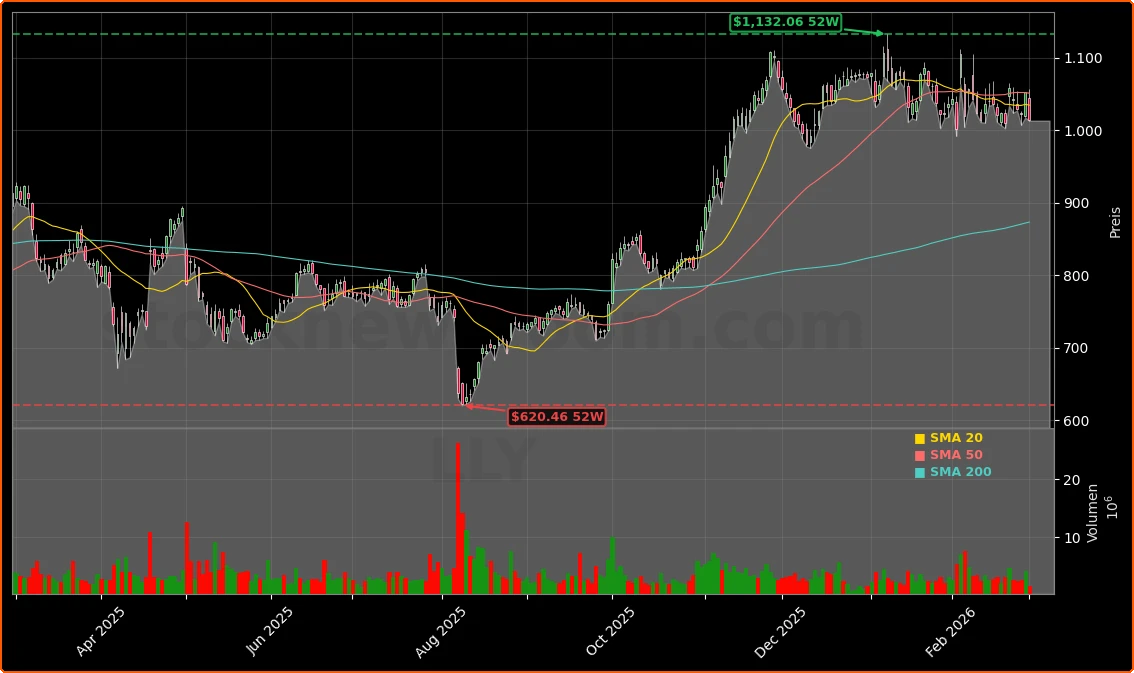
At around $1,014 per share, Lilly trades at roughly 46 times earnings, far above the S&P 500’s mid‑20s average. Yet institutional demand remains strong. Recent 13F filings show firms such as Kingsview Wealth Management and Davis R M Inc. adding to positions, contributing to institutional ownership above 80%. A MarketBeat review of filings highlights that some managers are trimming stakes on strength, but the net trend has favored accumulation during pullbacks.
On the sell-side, major Wall Street banks remain constructive. Consensus price targets cluster just under $1,230, implying roughly mid‑teens upside from current levels. Analysts at Zacks have cited Lilly as a key large-cap pharma to watch as sector sentiment improves, while bullish commentary from The Motley Fool has framed the stock as a core long-term holding that could help patient investors compound into multimillionaire status when combined with dividends and reinvestment. Importantly, Lilly has more than doubled its dividend over the past five years, giving total-return investors a growing income stream to complement capital gains.
How does Eli Lilly compare to obesity rivals?
The obesity-treatment market is expected to exceed $150 billion by the mid‑2030s, creating room for multiple winners. Novo Nordisk still leads in some formulations, including an approved weight-loss pill, but that advantage may prove temporary if Lilly brings its own oral GLP‑1 candidates to market. Meanwhile, other pharma players, including Pfizer, are trying to rebuild pipelines and enter the space, though they lag behind the two frontrunners on clinical and commercial execution.
We’re poised for explosive innovation and growth in the life sciences industry — and that’s exactly why Eli Lilly chose us for their $3.5 billion investment.
— Josh Shapiro, Governor of Pennsylvania
Conclusion
For U.S. investors, the key differentiator is the scale and timing of the Eli Lilly Investment program. Manufacturing build-outs in Virginia and Pennsylvania, coupled with AI-driven R&D initiatives, are designed to lock in a durable competitive moat just as competitors scramble to catch up. That combination of capacity, technology and early-mover advantage helps justify why many portfolio managers view Lilly as a core healthcare holding despite short-term volatility and a rich multiple.
Further Reading
- Eli Lilly and Company (LLY) on Yahoo Finance (Yahoo Finance)
- Up Over 400% in 5 Years, Is It Too Late to Invest in Eli Lilly Stock? (The Motley Fool)
- Eli Lilly and Company Shares Purchased by Davis R M Inc. (MarketBeat)
- 4 Large-Cap Pharma Stocks to Watch as Industry Recovery Gains Steam (Zacks Investment Research)