Can Ethereum’s surging on‑chain activity outweigh a painful price slump and still justify ETH as a core long‑term holding?
Ethereum in today’s market: where does it fit for Wall Street portfolios?
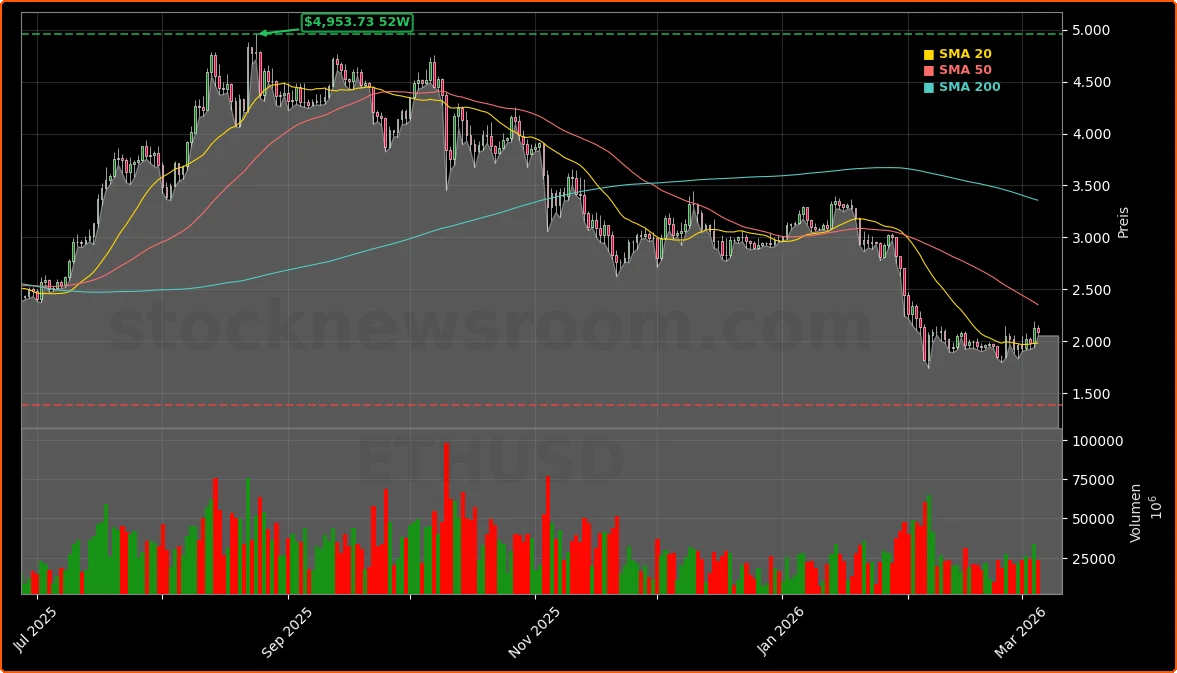
Ethereum sits in a very different place than during the last crypto cycle. Price wise, ETH has slumped to about $2,093, roughly 2.4% below the prior close, and far below its all‑time highs, leaving many investors nursing double‑digit drawdowns. At the same time, it has matured into core infrastructure for decentralized finance (DeFi), stablecoins and, increasingly, decentralized applications beyond pure speculation. For U.S. investors who already understand Bitcoin as “digital gold,” the key question of this Ethereum Analysis is whether ETH deserves a role more akin to a high‑beta tech infrastructure asset within a diversified portfolio.
Over the past several years, ETH’s performance has been underwhelming versus both Bitcoin and top NASDAQ names: it is up only in the mid‑teens percentage range over three years, with a steep pullback of around 38% in the last three months. That volatility is higher than most individual S&P 500 constituents and closer to speculative tech or small‑cap growth. Yet the underlying network fundamentals have arguably never looked stronger. This disconnect between price and usage is the core of the investment debate.
Grayscale’s recent commentary on the digital asset space emphasizes that sharp drawdowns following strong runs do not automatically mark the start of another multi‑year crypto winter. Instead, they can represent re‑entry points when long‑term structural adoption is intact but valuations reset. That framing is helpful here: ETH is roughly 40–50% below highs but continues to gain traction as core infrastructure in finance, much like how cloud or GPU providers became indispensable even through equity bear markets.
Ethereum Analysis: is the network still the backbone of DeFi and stablecoins?
Any serious Ethereum Analysis has to start with usage. Today, Ethereum functions as the base settlement layer for a large share of DeFi, hosting roughly $55 billion of the sector’s approximately $96 billion in total value locked (TVL). Its nearest smart‑contract rival, Solana, manages less than $7 billion, underscoring Ethereum’s dominant liquidity pool despite Solana’s lower transaction costs and higher raw throughput. Liquidity in DeFi is analogous to assets under management in traditional funds: it is a rough proxy for how much economic activity trusts the chain.
Stablecoins tell a similar story. More than half of the roughly $309 billion stablecoin market resides on Ethereum, with about $159 billion in circulation on its rails. Stablecoins are crucial because they are the transactional grease of the crypto economy—used for trading, lending, remittances, and on‑chain payments. By hosting the lion’s share of dollar‑linked liquidity, Ethereum captures deep network effects: users go where liquidity is; developers go where users are; institutional capital follows both.
Developer and user metrics reinforce this dominance. In Q4 2025 alone, a record 8.7 million smart contracts were deployed on Ethereum, and daily active wallet addresses nearly doubled during 2025 to more than 651,000. Those figures point to an ecosystem that is still innovating and expanding even as token prices remain under pressure. For comparison, this is akin to a cloud platform posting record app deployments and daily active users during a tech sell‑off—something investors in names like NVIDIA or Apple have learned to treat as more important than quarter‑to‑quarter price swings.
This is why several long‑term‑oriented research shops still frame ETH as a “no‑brainer” core holding for investors willing to stomach volatility and think beyond a one‑ or two‑year horizon. From a portfolio construction view, that implies treating ETH not as a short‑term trade but as infrastructure exposure, with sizing and risk controls similar to how one might approach high‑growth software or semiconductor leaders.
Vitalik Buterin’s strategic pivot: beyond pure finance toward digital safe havens
Recent comments from Ethereum co‑founder Vitalik Buterin add a qualitative layer to this Ethereum Analysis. Buterin has publicly wrestled with the gap between Ethereum’s founding ideals—digital self‑determination, open coordination, resistance to coercion—and the reality that much on‑chain activity has skewed toward speculation and gambling on fast, high‑throughput chains. He argues that Ethereum too often stands on the sidelines when it comes to improving everyday life in areas like privacy, digital security and freedom.
Critically, Buterin is not promising that Ethereum will “fix the world.” Instead, he emphasizes Ethereum’s role as a neutral, owner‑less digital space where people can coordinate, hold assets, sign agreements and build shared rules without a single platform operator changing the terms unilaterally. He frames Ethereum as part of an ecosystem of “protection and refuge technologies,” designed to reduce the risk of total digital control and to create islands of stability in chaotic environments.
That framing has investment implications. It suggests that future development priorities will not only focus on DeFi throughput but also on full‑stack infrastructure: wallet design and security, identity, privacy tools, and potentially how artificial intelligence interfaces with on‑chain systems. One recent line of bullish research specifically highlights Ethereum as a leading contender for hosting decentralized AI projects, seeing its composability and developer base as advantages for AI‑driven applications. If that thesis proves out, Ethereum’s addressable market extends well beyond finance into the broader digital economy, potentially increasing long‑term demand for block space and, by extension, for ETH.
From a U.S. investor standpoint, this evolution bears some resemblance to how leading cloud or chip companies broadened from narrow niches into foundational technology for entire industries. The key risk is execution: Ethereum must translate ideals about privacy and censorship resistance into user‑friendly products that solve real problems beyond the crypto‑native crowd.
Network upgrades Glamsterdam and Hegota: can they unlock the next leg of adoption?
The technical roadmap is another core pillar of this Ethereum Analysis. Two major protocol upgrades are scheduled for 2026. The first, Glamsterdam, expected in the first half of the year, is designed to lay the groundwork for parallel transaction processing. By enabling the chain to handle multiple transaction streams concurrently, Glamsterdam aims to increase throughput and help drive down average transaction costs. It will also introduce a series of changes intended to lower gas fees for end users—still one of the most common complaints about using Ethereum directly.
The second upgrade, Hegota, is targeting late 2026 and focuses on the supply side of network security. Its primary goal is to reduce the hardware cost of running validator nodes. Cheaper validators mean more potential participants can help secure the network, improving decentralization and resilience. The exact scope of Hegota is still evolving, but it is expected to bundle additional optimizations that make Ethereum more robust under heavy load and more attractive for institutions concerned with operational risk.
Historically, major Ethereum upgrades—whether the transition to proof‑of‑stake or prior scaling improvements—have produced cycles of hype followed by “sell the news” pullbacks. Investors should not assume that Glamsterdam or Hegota alone will overcome macro headwinds such as higher real rates, regulatory uncertainty or geopolitical risk. However, they do extend Ethereum’s technological moat versus other smart‑contract platforms and may accelerate migration of high‑value applications onto the chain or its layer‑2 ecosystem.
In effect, these upgrades can be viewed similarly to how chipmakers or cloud providers roll out new architectures: they may not instantly show up in revenues—or in this case, token price—but they sustain and deepen the product’s competitiveness. Long‑term allocators typically want to enter before the benefits are fully reflected in valuation.
Demand signals: ETFs, derivatives and on‑chain behavior
Beyond technology, this Ethereum Analysis has to grapple with market structure and flows. Recent on‑chain and derivatives data indicate that aggressive selling pressure may be easing. Net taker volume in ETH derivatives, a metric capturing the imbalance between buyers and sellers, has flipped from prolonged negative territory back to positive. Historically, such shifts have often preceded short‑covering rallies and liquidity‑driven rebounds after episodes of forced selling.
ETH’s Coinbase Premium Index—measuring the price difference between Coinbase and offshore exchanges—has turned positive again, reaching levels last seen in December 2025. A positive premium implies U.S. spot buying pressure, often from higher‑quality or longer‑horizon accounts. Analysts monitoring this metric argue that if the premium continues to rise, it could act as fuel for a more sustained recovery.
Spot Ether ETFs add another data point. After a period of outflows and risk‑off sentiment, these products recently posted about $169 million in net daily inflows, signaling renewed institutional interest. That pattern resembles what played out after early waves of volatility in spot Bitcoin ETFs, where initial selling gave way to steady allocations from advisers and multi‑asset managers once operational and regulatory hurdles were cleared.
On the behavioral side, anecdotal wallet activity suggests that some early adopters remain long‑term believers. One wallet that bought roughly 100 ETH in 2015 for about $30 and then sat dormant for nearly a decade moved only half its holdings to an exchange recently, leaving the remaining roughly $100,000‑plus worth of ETH untouched. That kind of partial de‑risking rather than full exit is consistent with a “HODL plus trim” approach many early crypto investors now adopt—raising some cash while leaving core exposure intact.
Staking demand also remains strong. More than three million ETH reportedly sit in the validator entry queue, an all‑time high. High staking participation acts as a float reducer, locking coins in network security and reducing liquid supply—a dynamic that can amplify price moves when demand spikes.
Competitive landscape: Solana, Bitcoin and where Ethereum fits
For U.S. investors, no Ethereum Analysis is complete without situating ETH among its major competitors. Bitcoin remains the macro bellwether, widely framed by firms like Schwab Network and institutional ETF providers as a digital alternative asset roughly analogous to a high‑volatility version of gold. Ethereum, by contrast, is increasingly pitched as the programmable settlement layer of Web3, with cash flows and network usage that look more like application infrastructure.
Solana is the most credible alternative smart‑contract platform today, boasting lower transaction fees and faster block times. Its success proves there is demand for high‑throughput, low‑cost chains, especially for trading and consumer‑facing applications. Yet Ethereum’s much larger TVL, stablecoin base and developer activity show that security, decentralization and ecosystem depth still carry significant weight. The current dynamic parallels competition between hyperscale cloud providers and niche high‑performance alternatives: the latter can excel in specific workloads, but the former often retain the broadest platform effects.
From an asset‑allocation viewpoint, that suggests ETH could reasonably sit alongside Bitcoin as a core digital asset exposure, while smaller positions in rival smart‑contract tokens function more as satellite bets. Some long‑term‑focused research houses explicitly recommend pairing Bitcoin and Ethereum for decade‑long holding periods, arguing that Ethereum’s diversified ecosystem provides upside that complements Bitcoin’s store‑of‑value profile.
Investors should also weigh regulatory trajectories. Ether’s inclusion in large‑cap crypto index products and ETFs, alongside Bitcoin, XRP, Solana and Cardano, reflects growing institutional comfort. Lower management fees in such products—one major large‑cap crypto ETF recently cut its fee from 2.5% to around 0.6%—also reduce friction for mainstream investors to gain ETH exposure without directly managing wallets.
Risk factors: volatility, transparency and macro headwinds
Despite the constructive aspects of this Ethereum Analysis, ETH carries material risks. Price volatility remains extreme: recent swings have seen the asset drop more than 20% in a week and nearly 40% over three months. Technical analysts emphasize that the $1,750–$1,800 area is a critical support zone; a decisive break below could re‑open the path to multi‑year lows, while a firm reclaim of $2,100–$2,200 would support the case for a recovery toward $2,400–$2,600 or higher.
Another underappreciated risk is privacy—or the lack thereof. Unlike privacy coins, Ethereum operates on a fully public blockchain where every transaction is permanently visible. While this transparency is attractive for regulators and institutional compliance, it complicates the narrative of Ethereum as a privacy‑enhancing technology unless additional layers and tools are widely adopted. At the same time, rising concerns about surveillance and centralized control in the broader digital sphere could drive demand for more robust privacy and censorship‑resistance features, which Ethereum’s roadmap is only starting to address at the application level.
Macro and regulatory uncertainties loom large as well. Higher real interest rates, tighter liquidity conditions and episodic risk‑off events can pressure all risk assets, with crypto often hit hardest. In the U.S., delays in legislative clarity—such as setbacks around bills designed to define digital asset treatment—can weigh on valuations in the short term even as longer‑term regulatory support slowly improves. Crypto remains a policy‑sensitive asset class, exposed to headlines in ways most S&P 500 names are not.
Finally, competition risk is real. If alternative chains or new architectures can match or surpass Ethereum’s security and decentralization while offering far lower costs and better user experiences, Ethereum’s dominance could erode. For now, however, its entrenched network effects and continuous upgrades argue that displacement is a multi‑year, not imminent, scenario.
The Ethereum thesis today is less about chasing the next short-term pump and more about owning a core piece of open financial and coordination infrastructure as it matures through multiple market cycles.
— StockNewsroom Ethereum Analysis
Conclusion
For investors used to analyzing high‑growth tech stocks like Tesla or NVIDIA, the mental model is familiar: Ethereum combines strong fundamentals and optionality with substantial execution, regulatory and market‑cycle risk. Position sizing, time horizon and diversification are more important than calling exact bottoms.
Further Reading
- Ethereum (ETH-USD) Price, History & News (Yahoo Finance)
- Got $1,000? This Cryptocurrency Is a No-Brainer Buy for Long-Term Holding (The Motley Fool)
- Long-Term Outlook vs. Short-Term Volatility (Grayscale Investments)
- Bitcoin & Ethereum “Buy” 50% Below Record Highs, ETFs Adding Exposure (Schwab Network)