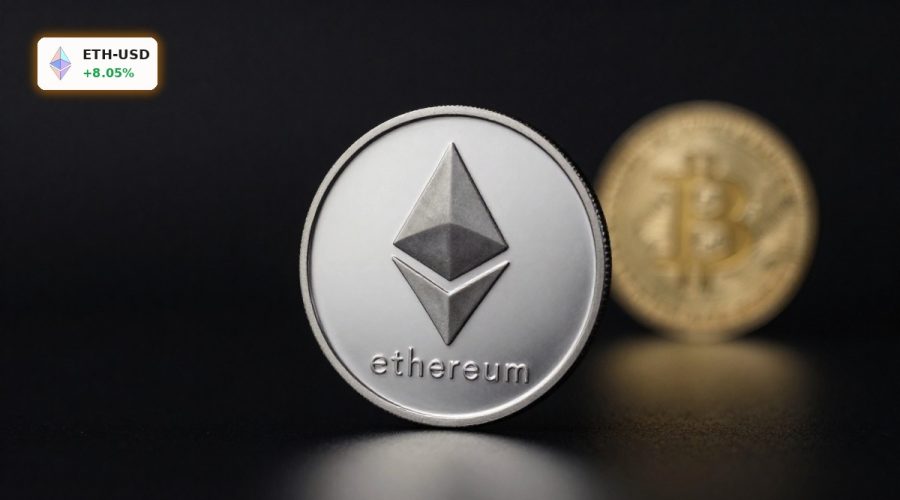
Can Ethereum’s latest 8% surge above $2,000 mark the start of a new leadership era over Bitcoin?
Market context: Is Ethereum ready for a new leadership cycle?
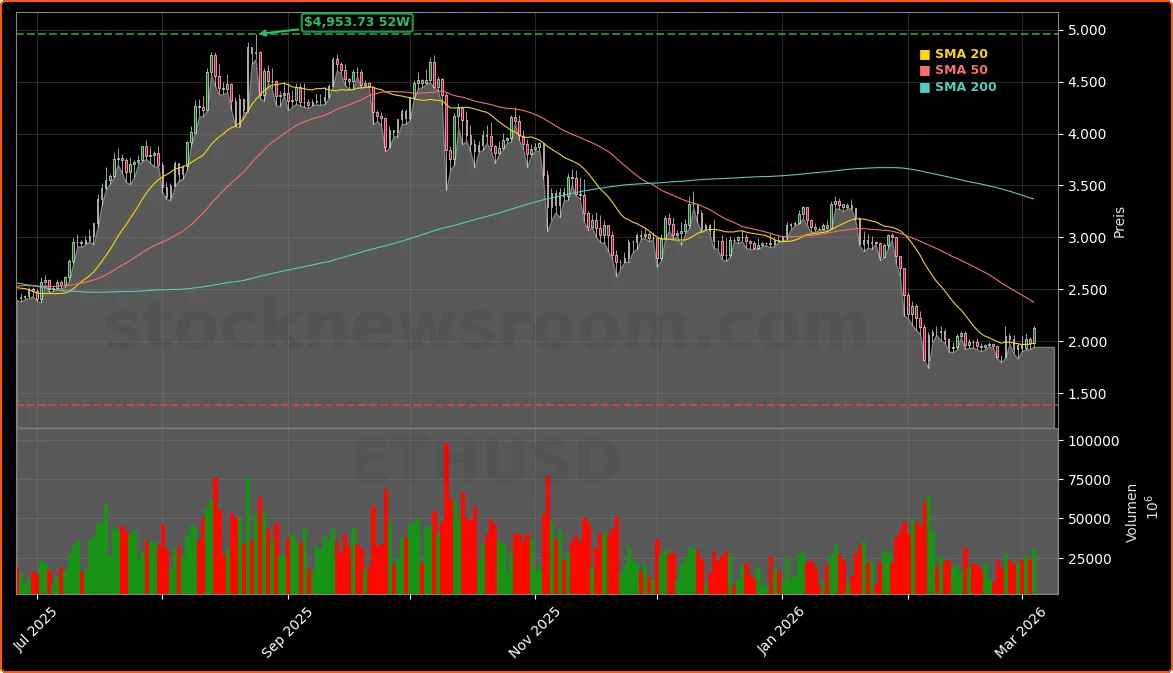
Ethereum (ETHUSD) is changing hands near $2,134, up more than 8% from the previous close around $1,983. The rebound above $2,000 is technically meaningful because the asset spent parts of recent months oscillating in a broad range roughly between $1,600 and $1,800 on the downside and the low $2,000s on the upside. That lower band has repeatedly acted as a cyclical trough, attracting medium- to long‑term buyers who see value whenever ETH revisits that zone.
From a trading perspective, several short‑term inflection levels are in focus. On the downside, the $1,600–$1,800 corridor still marks the key support area where dip‑buyers previously stepped in. On the upside, market participants have flagged the $2,090–$2,150 range as a near‑term trigger zone. A convincing break higher could open a path toward the next major resistance band around $2,400–$2,625, where prior rallies have stalled and profit‑taking tends to increase. None of these levels represent all‑time highs, which remain far above the current quote, so ETH is still trading at a significant discount to its historical peak.
Sentiment indicators across digital assets were recently in extremely pessimistic territory. Historically, such extremes have made room for sharp upside surprises once selling pressure exhausts itself. Against this backdrop, this Ethereum Analysis focuses on whether today’s move above $2,000 is just a technical bounce or the early signal that Ethereum is gearing up for a more durable leadership phase versus Bitcoin.
Ethereum Analysis: Can Ethereum’s technology justify a premium over Bitcoin?
The core argument for Ethereum overtaking Bitcoin rests on technology and utility. Bitcoin was designed primarily as a decentralized store of value and medium of exchange. Its protocol is intentionally conservative, with limited scope for complex applications. Ethereum, by contrast, was built as a programmable base layer for decentralized applications (dApps), smart contracts, and entire financial ecosystems, often referred to as decentralized finance (DeFi).
Since Ethereum’s transition to a proof‑of‑stake (PoS) consensus mechanism, the network now relies on validators who stake ETH rather than energy‑intensive miners solving cryptographic puzzles. This dramatically reduced the blockchain’s energy footprint and made it easier for institutional investors that face environmental, social and governance (ESG) constraints to consider exposure. Bitcoins proof‑of‑work (PoW) mechanism still depends on large‑scale mining operations using specialized hardware and substantial electricity, which has raised questions about long‑term sustainability.
Looking ahead, a critical risk for Bitcoin is the economics of mining after future halving events. Each halving cuts block rewards roughly in half, putting pressure on mining profitability. If rewards no longer cover costs for electricity, hardware depreciation and infrastructure, some miners may be forced to shut down or consolidate, potentially impacting network security. Ethereum does not face the same reward‑halving dynamic under PoS, and its fee‑burning mechanism can even make ETH net‑deflationary during periods of high activity.
For U.S. investors comparing the two, this Ethereum Analysis suggests that ETH offers a more versatile “tech” narrative. Bitcoin looks increasingly like digital gold, whereas Ethereum functions as both asset and operating system for Web3. That distinction matters for valuation: BTC may be valued primarily on scarcity and macro hedging attributes, while ETH can additionally be evaluated on network usage, gas fees, staking yields and developer activity.
How does Ethereum stack up against U.S. tech benchmarks like NVIDIA and Apple?
On Wall Street, capital allocation is ultimately a relative game. Investors are not deciding in a vacuum whether Ethereum is interesting; they are deciding whether ETH deserves a spot alongside growth leaders such as NVIDIA, Apple and other high‑multiple technology names in the S&P 500 and NASDAQ. The comparison is not apples‑to‑apples, but the market increasingly treats large digital assets as part of the broader risk‑asset universe.
Ethereum’s investment case resembles a high‑beta technology platform more than a traditional currency. Like leading chip designers or platform companies, its value is closely tied to the strength of its developer ecosystem, the number of applications built on top, and the volume of economic activity it hosts. Where an equity investor might track revenue, margins and user growth for a company like NVIDIA, a crypto investor watches metrics such as total value locked (TVL) in DeFi, NFT trading volumes, transaction counts and staking participation on Ethereum.
Correlations underscore this point. During risk‑on phases, ETH has tended to move in tandem with growth stocks and crypto‑sensitive equity names, including some mega‑cap tech constituents of the NASDAQ. That makes Ethereum potentially additive for investors willing to embrace volatility in pursuit of higher upside, but it also means ETH can amplify drawdowns during equity market stress. As a result, sophisticated portfolios often size Ethereum allocations modestly relative to large equity positions, treating it as a satellite exposure rather than a core holding.
This Ethereum Analysis therefore frames ETH as a technology‑driven asset that competes for risk capital with high‑growth equities. When generative AI, cloud infrastructure and chip cycles drive enthusiasm in names like NVIDIA or Tesla, some marginal dollars may flow away from crypto. Conversely, when regulatory clarity on digital assets improves or when traditional tech valuations look stretched, Ethereum can attract incremental capital as an alternative source of growth exposure.
What could shift institutional sentiment toward Ethereum and Bitcoin?
Macro and regulatory factors remain central for institutional adoption. On the monetary side, any change at the helm of major central banks that is more open to digital assets could be a genuine game changer. Discussions in Europe and the U.S. about how to regulate stablecoins, staking products and crypto custody continue to shape how large asset managers, banks and pension funds approach exposure.
On Wall Street, the development of regulated vehicles such as spot and futures‑based exchange‑traded funds (ETFs) has already transformed Bitcoin from a niche asset into a product that mainstream advisors can allocate to. Ethereum is on a similar trajectory, with dedicated ETH‑based funds and institutional‑grade custody services expanding. If future regulatory decisions further normalize staking yield and on‑chain activities in a compliant framework, institutional demand for ETH could accelerate.
A key differentiator in this Ethereum Analysis is the sustainability angle. Because the network runs on proof‑of‑stake, it is far less energy‑intensive than Bitcoin. That can make ETH more palatable for ESG‑constrained mandates that cannot justify exposure to high‑emission assets. This factor may not matter for every hedge fund, but it can be decisive for large insurers, endowments and sovereign wealth funds that must report on their carbon footprint and ESG scorecards.
At the same time, investors must weigh ongoing policy risks. U.S. regulatory bodies are still debating how to classify various crypto assets—securities, commodities or something else entirely. Any restrictive stance on staking products, DeFi protocols or on‑chain derivatives could dampen Ethereum’s growth narrative. For now, however, the direction of travel for infrastructure—custody, reporting, and risk management—appears supportive of gradual institutionalization.
ETH versus BTC: Is Ethereum on track to become the new “elite” crypto asset?
Proponents of Ethereum’s ascendancy argue that ETH is on course to become the next “elite” crypto asset because it is more useful. Smart contracts allow entire financial instruments and marketplaces to be coded directly on‑chain, from lending platforms to derivatives, gaming economies and identity systems. This breadth of use cases gives Ethereum multiple demand drivers beyond simple speculation or macro hedging.
By contrast, Bitcoin’s use case is narrower but deeply entrenched. It is the oldest, most widely recognized crypto asset, and its fixed supply of 21 million coins underpins its digital gold narrative. Central banks, corporations and high‑net‑worth individuals who primarily want an inflation hedge or non‑sovereign store of value may still default to Bitcoin, at least in the near term.
Where this Ethereum Analysis diverges from maximalist views is in framing the competition as dynamic rather than binary. Ethereum does not need to completely displace Bitcoin to succeed; it only needs to capture a growing share of the total crypto market capitalization and attract a sustained flow of new projects, users and institutional investors. Over time, if Bitcoin miners struggle with post‑halving economics and if Ethereum continues to refine its scalability and security, ETH could gain relative importance as the core asset underpinning Web3.
For U.S. portfolios, that means allocation decisions may evolve from a BTC‑only posture toward a more nuanced crypto basket. In that construct, Ethereum can represent the innovation and application layer, while Bitcoin continues to serve as a macro hedge and store of value. The balance between the two will depend on how each asset responds to technological, regulatory and macro changes in the coming cycles.
Portfolio implications: How should U.S. investors position around Ethereum?
ETH’s current price zone—above $2,000 but still far below past peaks—presents a strategic question for Wall Street. The previously observed support between $1,600 and $1,800 has functioned as a cyclical low several times, encouraging investors with multi‑year horizons to build positions during pullbacks. As long as that band holds, the risk‑reward for gradual accumulation looks attractive to those who believe Ethereum’s technological moat will deepen.
However, the path will likely be volatile. Crypto remains one of the highest‑beta exposures within liquid markets, routinely posting daily moves that would be unusual even for small‑cap growth stocks. Prudent risk management suggests sizing Ethereum at a small percentage of overall portfolio value, using position limits, and avoiding leverage unless an investor has both high risk tolerance and a clear trading plan.
This Ethereum Analysis favors a barbell approach for many U.S. investors: maintain core exposure to established equities in the S&P 500 and NASDAQ—such as Apple and other mega‑cap tech names—while carving out a small, opportunistic sleeve for crypto assets like Ethereum. Within that sleeve, dollar‑cost averaging into ETH during periods of negative sentiment and elevated fear indices can help mitigate timing risk. Tactical traders, on the other hand, may focus on key technical zones such as $2,090–$2,150 as breakout levels toward the $2,400–$2,625 area.
Ethereum’s shift to proof-of-stake and its central role in Web3 applications position ETH less as a speculative token and more as a high-beta technology platform competing for capital alongside growth stocks.
— StockNewsroom.com Crypto & Macro Strategy
Conclusion
Analyst coverage of ETH remains less formalized than for listed equities, but large sell‑side institutions including Citigroup and Goldman Sachs have repeatedly highlighted the structural importance of Ethereum’s smart‑contract ecosystem in their digital‑asset research. While these notes stop short of traditional stock‑style ratings, their inclusion of ETH alongside major asset classes in allocation discussions signals growing mainstream acceptance.
Further Reading
- Ethereum Whitepaper (Ethereum Foundation)
- How Ethereum’s Merge to Proof-of-Stake Changed Its Energy Profile (International Energy Agency)
- 2024 Global Crypto Ownership and Adoption Report (Gemini Research)
- Ethereum Markt- und Technologieanalyse bei Yahoo Finance (Yahoo Finance)