
Is Ethereum’s latest leveraged rally a buying opportunity or a warning shot for investors watching Wall Street and on-chain tech shifts?

Is leverage driving the latest Ethereum rally?
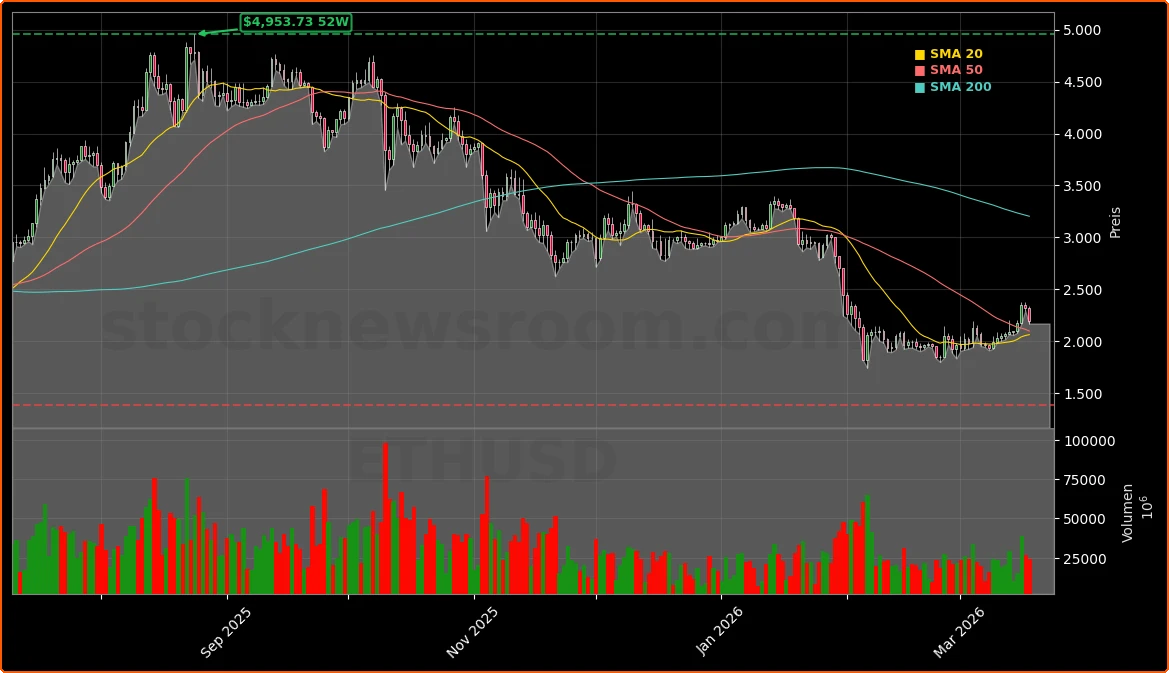
From a U.S. investor perspective, the recent rebound in ETH from roughly $1,760 to above $2,300 looked like a classic high‑beta crypto recovery. A closer Ethereum Market Analysis of derivatives data, however, shows the move has been heavily fueled by leverage. Open interest in Ethereum futures has climbed back toward seven million ETH, matching levels seen before the October 2025 deleveraging that erased tens of billions in notional positions across the market.
That surge signals that the upswing was powered not only by spot buying from ETFs and retail traders, but also by a wave of leveraged longs. When open interest is this elevated, even a modest downside move can trigger forced liquidations and amplify volatility, a dynamic that today’s 6% pullback to about $2,194 is already hinting at. For U.S. traders on major venues such as Binance and Bybit, this means tighter risk management and position sizing are crucial as ETH trades in a crowded long environment.
At the same time, aggregate open interest has not collapsed, suggesting capital is rotating rather than exiting. Some platforms, including Bitfinex and Kraken, are seeing outflows, while others are attracting fresh leverage. That redistribution often precedes larger directional moves, keeping both upside breakouts toward $2,500–$2,800 and deeper corrections on the table.
How do ETFs and institutions on Wall Street fit in?
While derivatives dominate the short‑term tape, spot flows from institutional products are quietly reshaping the longer‑term picture. ETH is now formally treated as a digital commodity in the United States, easing a key regulatory overhang and strengthening the case for exchange‑traded products on NYSE and NASDAQ. Recent weeks have brought more than $160 million in net inflows into U.S. spot Ethereum ETFs, followed by additional tens of millions in the latest sessions, according to fund flow trackers watched closely on Wall Street.
Fund sponsors are also refining how they price and benchmark Ether exposure. The Grayscale Ethereum Staking ETF switched to the CoinDesk Ether Benchmark Rate to determine net asset value, aiming to reduce manipulation risk and better reflect liquidity across major trading venues. Meanwhile, BlackRock’s staking‑enabled ETH products, along with rivals highlighted by analysts at Seeking Alpha and Zacks, are giving U.S. portfolio managers a framework to evaluate ETH as a yield‑generating financial asset, not just a volatile token.
This institutional layer matters for any Ethereum Market Analysis focused on U.S. multi‑asset portfolios. With ETH still trading roughly 50% below its record highs, commentators on Schwab Network and other outlets argue that the combination of discounted prices, staking yield and steadily improving infrastructure makes Ethereum an increasingly credible satellite allocation alongside large‑cap tech names like NVIDIA, Apple and Tesla in growth‑oriented strategies.
What does the Fast Confirmation Rule change for the network?
Beyond price, a major protocol development is now in testing that could directly impact exchanges and layer‑2 networks widely used by U.S. traders. Ethereum client teams are implementing an opt‑in Fast Confirmation Rule (FCR) that can cut typical bridge or deposit times from around 13 minutes to roughly 13 seconds, an 80–98% reduction for most L2s and centralized exchanges.
Today, many platforms rely on waiting for multiple blocks or full finality before crediting deposits from Ethereum mainnet, which slows user experience and capital rotation. Others use informal “k‑deep” confirmation rules with weaker guarantees. FCR introduces a standardized, formally defined way to treat recent blocks as safe enough for operational purposes, without requiring a hard fork of the network. Once integrated into nodes, APIs, exchanges and rollups, this rule could make on‑chain capital flows much more responsive, particularly during fast‑moving macro events that already roil the S&P 500 and NASDAQ.
In parallel, the Ethereum Foundation is signaling a long‑term commitment to decentralized finance infrastructure, redirecting tens of millions of dollars’ worth of ETH from its treasury into the Morpho lending protocol. Morpho has quickly grown into one of the largest DeFi lenders by total value locked, with backing from large traditional players such as Apollo Global Management and an architecture designed to function without admin keys. For U.S. investors tracking the health of the broader DeFi ecosystem, this is a vote of confidence in permissionless, audited protocols as a core use case for Ethereum.
How should U.S. investors read this Ethereum Market Analysis?
Combined, these trends suggest an asset at the intersection of speculative leverage, institutional adoption and meaningful technology upgrades. On the one hand, elevated futures open interest raises the risk of sharp liquidations and near‑term drawdowns, especially if macro headlines on inflation or Federal Reserve policy spark risk‑off moves across equities and crypto alike. ETH’s intraday slide to about $2,194, following a recent run above $2,300, underlines that vulnerability.
Ethereum is increasingly behaving like a mainstream financial asset, with leverage, yield and infrastructure improvements all converging to shape its risk profile for global investors.— StockNewsroom.com Ethereum Desk
On the other hand, sustained ETF inflows, a friendlier U.S. regulatory stance and protocol enhancements like the Fast Confirmation Rule improve the structural backdrop. As ETH attempts to hold above the $2,300–$2,400 resistance band over coming weeks, the balance between deleveraging risk and ongoing institutional demand will likely determine whether the next leg points toward $2,700–$3,000 or back into consolidation around $2,000.