Is today’s Ethereum valuation a rare long-term opportunity or just a calm pause before another painful leg lower?
Is Ethereum really undervalued now?
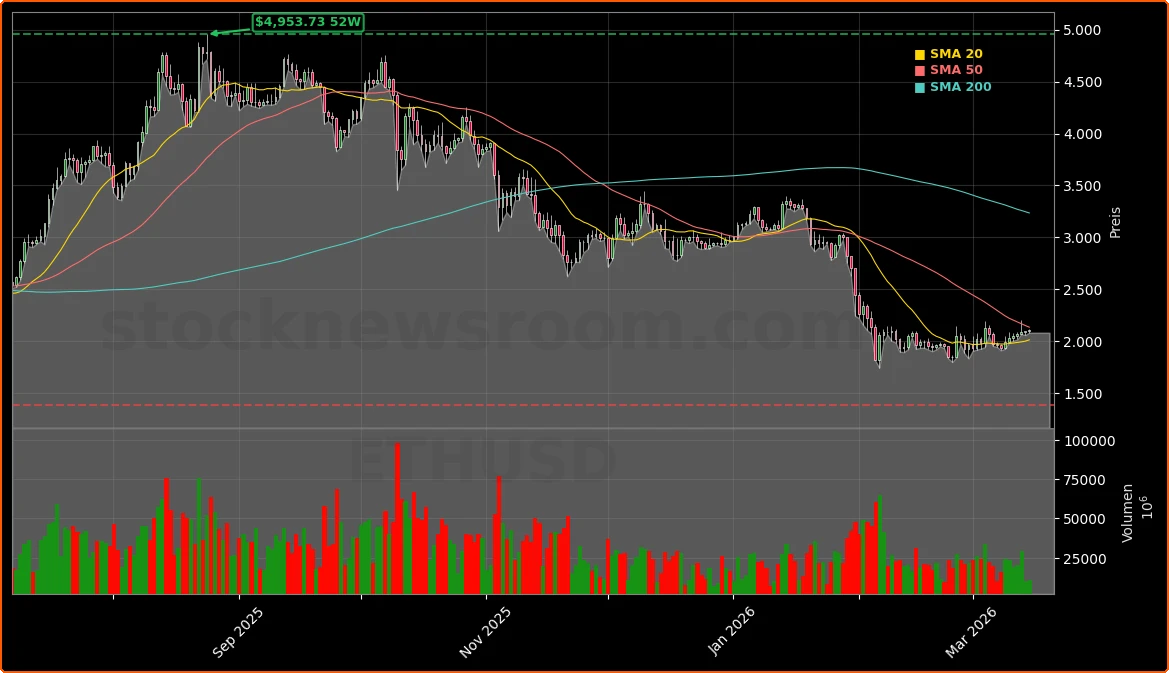
Ethereum (ETHUSD) is trading near $2,111, up roughly 1.7% on the day, yet well below its cycle highs and far from its all‑time peak above $4,000. Under the surface, on‑chain metrics are flashing a complex picture of Ethereum Valuation: potentially cheap on historical measures, but with clear room for more downside if the current crypto downturn deepens. For U.S. investors used to valuing equities on earnings and cash flow multiples, mapping those frameworks onto a decentralized network token like Ethereum requires a different playbook built around usage, developer activity and capital flows.
One of the key gauges investors watch is the Market Value to Realized Value (MVRV) ratio. MVRV compares Ethereum’s current market capitalization with its realized capitalization—the aggregated price at which all existing coins last moved on-chain. When MVRV is above 1, most holders sit on unrealized profits; when it falls below 1, a majority are under water, historically signalling late‑stage bear markets. Recent data show Ethereum’s MVRV around 0.9, implying that on average, holders are at a loss and ETH is trading below the cost basis embedded in the blockchain’s transaction history.
That sub‑1 reading has fueled a narrative that Ethereum is entering a zone of undervaluation, especially compared with the euphoric peaks when MVRV has spiked well above 2.5 in past cycles. However, history also shows that MVRV can stay depressed for months and even push toward 0.5 in full‑blown crypto winters. For long‑term investors on Wall Street, the current Ethereum Valuation may resemble a stock that has rerated back to its historical average, but has not yet fully washed out froth from the previous bull cycle.
Beyond MVRV, some on‑chain analysts track Ethereum’s Realized Price Bands—zones that represent the aggregate cost basis of different cohorts of holders. In prior downturns, spot prices have often fallen to the lower realized band before a durable bottom. That lower band currently sits close to $1,150, suggesting ETH could theoretically fall another 40% from today’s levels if macro conditions deteriorate or crypto sentiment sours again. That prospect complicates the case for aggressive dip‑buying, especially for U.S. investors who have other risk assets available in the S&P 500 and NASDAQ.
How do on-chain metrics shape Wall Street?
Traditional equity analysis revolves around revenue, margins, earnings growth and discounted cash flow models. Crypto assets like Ethereum do not publish income statements, but the network does output a continuous stream of on‑chain data that investors can interpret as economic indicators. Metrics such as transaction count, gas fees, active addresses, and the total value locked in decentralized applications resemble a form of “network income” and activity. When those indicators rise, it reinforces a stronger Ethereum Valuation by anchoring price to observable usage rather than pure speculation.
For institutional investors in New York and other global centers, tools that convert on‑chain statistics into familiar valuation ratios are becoming more common. Some managers build “network P/E‑style” models by comparing Ethereum’s market cap to annualized fee revenue burned or captured on the blockchain. Others track the relationship between ETH prices and staking yields, analogous to how bond investors weigh yield spreads. The shift to proof‑of‑stake during 2022’s Merge intensified this dynamic, turning ETH into a yield‑bearing asset when locked in validators or pooled through staking services.
The growth of Ethereum’s decentralized finance (DeFi) ecosystem also matters for valuation. As more lending protocols, derivatives platforms and stablecoin issuers settle on Ethereum or its Layer 2 rollups, the token accrues utility as the core collateral and settlement asset of that ecosystem. This network effect is reflected in developer metrics: by late 2025, Ethereum supported roughly 31,869 active developers, by far the largest base among smart‑contract platforms. That human capital is an intangible asset which does not show up in a balance sheet but anchors long‑term Ethereum Valuation in a way similar to how Wall Street views the developer ecosystems at Apple or NVIDIA as critical moats.
Yet on‑chain data are only one part of the picture. For many U.S. investors, the real inflection point has been the financialization of ETH via regulated products. Spot Ethereum ETFs listed in the United States in 2024 gave investors a simple way to allocate to ETHUSD without managing private keys or dealing with crypto exchanges. Initially, the lack of staking rewards in those funds limited their appeal relative to owning ETH directly. That changed in late 2025 as the first U.S. ETFs that incorporate staking yields went live, creating a bridge between on‑chain economics and traditional portfolio construction.
What do Ethereum staking ETFs change?
The arrival of U.S.-listed staking ETFs tracking Ethereum represents a structural shift in how Wall Street can access and value the asset. Products like the REX‑Osprey ETH + Staking ETF and Grayscale’s Ethereum Staking ETF give investors exposure not only to ETH’s spot price but also to the native yield generated by locking tokens into proof‑of‑stake validators. For many portfolio managers, that yield component transforms Ethereum from a pure speculative “digital commodity” into a hybrid growth‑and‑income asset.
From a valuation standpoint, staking yields can be compared with Treasuries, corporate bonds or dividends from blue‑chip equities. While those comparisons are imperfect—staking involves smart‑contract and slashing risks—they still offer a reference point. If ETH staking yields significantly exceed yields on investment‑grade bonds after fees and slippage, some investors may argue that current Ethereum Valuation is too low relative to the cash‑like income stream. Conversely, if yields compress as more capital stakes and block rewards adjust, the token might look more fully valued unless underlying network usage and fee generation accelerate.
There is also a technical supply effect. Staking removes ETH from liquid circulation, effectively shrinking the tradable float. When combined with fee burning under Ethereum’s EIP‑1559 mechanism, this can make ETH’s supply growth flat or even deflationary during periods of high network usage. For equity investors, this resembles a company running both a dividend and aggressive share repurchase program, supporting per‑token value even if aggregate market cap does not spike. If staking ETFs draw substantial assets, they could lock up a meaningful share of circulating ETH and tighten supply on centralized exchanges.
However, the flip side is concentration risk. If a handful of large asset managers control a growing share of staked ETH via ETFs, it could centralize validator power in ways that concern decentralization‑focused investors. Regulators may also scrutinize how staking returns are generated and distributed, especially if they resemble unregistered securities offerings. All of these factors play back into Ethereum Valuation through the prism of regulatory risk—a variable that U.S. investors cannot ignore after years of enforcement actions and shifting guidance from the SEC and CFTC.
Can Ethereum keep its No. 2 spot in crypto?
Another layer influencing how investors think about Ethereum Valuation is its relative position in the broader crypto hierarchy. ETH remains the world’s second‑largest cryptocurrency by market capitalization, trailing only Bitcoin. Its market cap currently sits above $250 billion, with Binance’s BNB the closest non‑stablecoin competitor at around one‑third of that size. Despite this gap, prediction markets have started to price in a non‑trivial chance that Ethereum could lose its No. 2 ranking over the coming years.
On platforms that let traders bet on real‑world outcomes, odds have swung as high as roughly 57% that some other asset will overtake ETH’s market cap by a set future date. This sentiment reflects a mix of technical and narrative pressures. Competing Layer 1 smart‑contract platforms like Solana and Cardano emphasize higher throughput and lower fees, while emerging ecosystems focus on specific niches like gaming or high‑frequency DeFi. If any of these challengers manage to attract sustained developer and user momentum, Ethereum’s relative share of crypto’s total market value could shrink even if its absolute price rises.
For investors on Wall Street, this is analogous to evaluating whether a dominant tech platform like Apple can maintain its industry share in the face of aggressive competitors. Losing the No. 2 spot could dent the blue‑chip perception that currently underpins Ethereum Valuation, potentially raising the risk premium investors demand to hold the asset. On the other hand, even a smaller relative share could still support compelling returns if the overall crypto market continues to expand and Ethereum remains a critical settlement layer for high‑value transactions.
Importantly, ETH and Bitcoin are increasingly viewed by some institutional investors as the “large‑cap core” of a diversified digital asset allocation—similar to how mega‑cap growth stocks anchor equity portfolios. In that framing, as long as Ethereum maintains a clear technological and ecosystem advantage, short‑term shifts in rank may matter less than the health of its fundamental network metrics and regulatory access in major markets like the United States.
How does Ethereum stack up against rivals?
From a technology and usage standpoint, Ethereum faces real competition. Its base Layer 1 chain processes fewer transactions per second than newer proof‑of‑stake networks such as Solana and Cardano, and users have often complained about high gas fees during peak activity. These weaknesses are not new, and they are at the core of the bear case against a rich Ethereum Valuation: if faster, cheaper rivals can deliver comparable security and developer tooling, capital could migrate away, compressing ETH’s premium.
Ethereum’s response has been two‑pronged. First, the network’s shift to proof‑of‑stake dramatically reduced energy consumption and opened the door to scaling improvements. Second, its ecosystem has embraced Layer 2 “rollups”—networks that batch transactions off‑chain and settle them on Ethereum, boosting throughput while inheriting Ethereum’s security guarantees. As these Layer 2s mature, they increasingly resemble sector‑specific mini‑economies, from high‑frequency trading venues to gaming‑focused chains, all denominated in ETH at the settlement layer.
For valuation, the key question is whether this multi‑layer architecture allows Ethereum to capture enough of the economic value created on top of it. If most user interactions happen on Layer 2 while only a fraction of fees and MEV (miner/validator extractable value) flow back to L1 stakers, ETH’s cash‑flow‑like characteristics may be less compelling. Conversely, if the system is designed so that high Layer 2 activity drives persistent demand for ETH security and settlement, current prices could underestimate long‑term fee revenue and staking yield potential.
U.S. investors can think of this as similar to how cloud infrastructure providers like NVIDIA’s data‑center partners or large platform companies extract value from the broader software ecosystem. Owning ETH is akin to owning equity in the base platform rather than in any single application. As long as developers continue to favor Ethereum as their primary smart‑contract environment, that platform equity story remains intact and supports a structurally higher Ethereum Valuation compared with smaller, more experimental networks.
What role do developers and dApps play?
Developer activity is one of the most underappreciated drivers of long‑term Ethereum Valuation. At the end of 2025, Ethereum boasted just under 32,000 active developers, making it the largest smart‑contract development ecosystem by a wide margin. This matters because each additional team building a decentralized application, NFT project, DeFi protocol or enterprise solution on Ethereum deepens the network’s functionality and stickiness.
In technology investing, Wall Street has seen this movie before. Platforms with the most developers—think mobile operating systems or cloud environments—tend to attract the most users and, ultimately, the most value creation. For Ethereum, the resulting positive feedback loop looks like this: more developers lead to more applications; more applications attract more users and capital; that increased activity drives higher fees and staking returns; and those improved economics justify a richer Ethereum Valuation. It is the crypto analogue of how app ecosystems fueled the growth of smartphones and cloud platforms.
This developer edge also intersects with Ethereum’s road map. Major upgrades branded as The Verge, The Purge and The Splurge aim to streamline the protocol’s architecture, boost scalability and simplify node operations. If successful, these changes could lower the cost of participation for both developers and validators, reinforcing the network’s dominance. Crucially, this is a multi‑year process that may not immediately reflect in ETH’s spot price, but it forms the backdrop against which institutional investors evaluate whether to treat Ethereum as a long‑duration growth asset.
For U.S. investors used to tracking product road maps at large tech names, these protocol upgrades function similarly to multi‑year capex and R&D plans. Delays, technical setbacks or governance disputes could weigh on sentiment and compress Ethereum Valuation multiples, just as missed product cycles hurt hardware or software stocks. Conversely, smooth execution that unlocks new use cases—such as scalable on‑chain order books or low‑latency DeFi—could lead analysts at major banks like Goldman Sachs or Morgan Stanley to adopt more constructive long‑term assumptions for ETH’s addressable market, even if they do not publish formal price targets.
How are U.S. analysts viewing Ethereum?
Unlike equities, where every major Wall Street bank regularly issues detailed price targets and ratings, crypto research at traditional institutions is still an evolving field. Nonetheless, many global banks now maintain digital‑asset strategy teams that cover Bitcoin, Ethereum and a handful of other large‑cap tokens. Recent commentary has framed ETH as a “blue‑chip” crypto asset alongside Bitcoin, with incremental catalysts from staking yields and regulatory clarity around ETFs.
Strategists at firms such as Citigroup and Goldman Sachs have previously highlighted Ethereum’s role as the dominant smart‑contract platform and the backbone of DeFi and NFTs. Their frameworks often compare Ethereum’s potential market share of global financial infrastructure modernization to the way cloud computing disrupted enterprise IT. While they rarely commit to explicit price targets like they do with equities, they do discuss scenarios in which continued growth in tokenized assets, stablecoins and decentralized exchanges could support a materially higher Ethereum Valuation over the next decade.
Other banks, including RBC Capital Markets and Morgan Stanley, have been more cautious in their public commentary, emphasizing risks related to regulation, competition and technological complexity. From a risk‑management perspective, they tend to recommend small, diversified allocations for qualified clients rather than concentrated bets. In that context, ETH is often positioned as a core building block of any crypto exposure due to its liquidity and depth, even if the recommended sizing remains modest compared with traditional asset classes.
Importantly, this gradual institutionalization of Ethereum coverage influences how family offices, hedge funds and even some pension advisers think about the asset. The more that large banks integrate ETH into standard asset‑allocation research—discussing correlations with the S&P 500, hedging properties versus inflation, and portfolio optimization—the easier it becomes for fiduciaries to justify a small ETHUSD position. That demand channel, while still young, is an important intangible pillar of Ethereum Valuation that does not show up directly in on‑chain data.
What downside risks still threaten ETH?
Despite multiple bullish pillars—from staking yields to developer dominance—Ethereum remains a volatile high‑beta asset with clear downside risks. The most immediate is macro: tightening financial conditions, risk‑off sentiment on Wall Street or a deep equity bear market could all pressure cryptocurrencies broadly. In those environments, ETH tends to trade more like a high‑growth tech stock than a safe‑haven asset, often underperforming the S&P 500 and even NASDAQ during acute sell‑offs.
On the crypto‑specific side, a retest of lower Realized Price Bands around $1,150 cannot be ruled out if the current cycle deteriorates into a deeper bear phase. That would equate to more than 40% downside from current levels, a drawdown that could trigger forced liquidations among leveraged traders and add mechanical selling pressure. For U.S. investors who entered through ETFs or brokerage platforms during 2024–2025, such a move would likely translate into visible unrealized losses and could test conviction in the “digital asset allocation” thesis.
Regulation is another major overhang. While U.S. authorities have allowed spot Ethereum ETFs to list and trade, the broader regulatory framework for staking, DeFi and stablecoins remains fluid. A more aggressive posture from the SEC, CFTC or banking regulators could impose new restrictions on how ETH is custodied, staked or used as collateral. For example, tighter rules on custodial staking services could impact yield‑focused ETFs, altering the income profile that some investors factor into their Ethereum Valuation models.
Technological risk also lingers. Large‑scale protocol upgrades introduce the possibility of bugs or unintended economic side effects. While Ethereum’s track record of coordination and testing is strong, no complex software system is risk‑free. A major outage or exploit at the base protocol level would be a severe blow to investor confidence and could lead to a rapid repricing of ETH risk, much as a critical product flaw can cause abrupt multiple compression in high‑growth tech stocks.
How can U.S. investors approach Ethereum today?
For American investors weighing Ethereum exposure in 2026, the central question is not simply whether ETH goes up or down next month, but how to integrate it thoughtfully into a diversified portfolio. One pragmatic approach is to view ETH as a high‑volatility satellite allocation around a traditional core of equities, bonds and cash. In that framework, position sizes are kept modest—often low‑single‑digit percentages of total assets—while rebalancing rules help capture upside and limit downside.
Investors comfortable with direct crypto custody may choose to hold ETH in their own wallets and engage in staking through decentralized or centralized services, capturing native yield at the cost of additional operational complexity. Others may prefer broker‑friendly vehicles like spot and staking ETFs, which wrap the asset in a familiar structure and integrate more easily with tax reporting and compliance requirements. Each route carries its own trade‑offs in terms of fees, counterparty risk and flexibility.
From a timing perspective, the current environment presents a classic dilemma. On‑chain metrics such as MVRV suggest that ETH is no longer in the euphoric, overvalued territory associated with cycle peaks. At the same time, the presence of a lower Realized Price Band far below spot underscores that Ethereum Valuation could become cheaper still before the next sustained bull run. Rather than trying to perfectly time the bottom, some investors opt for dollar‑cost averaging strategies, spreading purchases over months or quarters to smooth entry risk.
Risk‑tolerant investors with a long multi‑year horizon may see today’s ETHUSD levels as an attractive entry relative to the potential growth of decentralized finance, tokenized real‑world assets and Web3 applications. More conservative investors might wait for clearer signs of macro stabilization or protocol‑level catalysts before increasing exposure. In either case, alignment between risk tolerance, investment horizon and position sizing is crucial, just as it is when evaluating high‑growth names in sectors like electric vehicles where companies such as Tesla have historically exhibited sharp boom‑and‑bust cycles.
Ethereum has evolved from a speculative token into the base layer of an emerging financial and computing stack, and its valuation increasingly reflects that structural role rather than just cyclical hype.
— Digital Asset Strategy Team, fictitious buy-side firm
Conclusion
In conclusion, Ethereum Valuation sits at the intersection of on‑chain economics, regulatory evolution and institutional adoption. ETH appears inexpensive relative to prior cycle peaks and some network‑based valuation metrics, yet it still carries substantial downside risk if macro conditions worsen or crypto sentiment turns sharply lower. For U.S. investors who believe in the long‑term potential of programmable money and decentralized applications, a measured, well‑sized allocation to Ethereum can be a compelling complement to traditional assets. The coming years—shaped by staking ETFs, major protocol upgrades and intensifying competition—will determine whether today’s Ethereum Valuation ultimately proves to be a brief pause in a longer‑term uptrend or a plateau before a more significant repricing.
Further Reading
- Ethereum Price, Market Cap and Charts (CoinGecko)
- Ethereum On-Chain Data and MVRV Metrics (CryptoQuant)
- Ethereum Network Developer Report 2025 (Electric Capital)
- Ethereum bei Yahoo Finance (Yahoo Finance)