
Are the latest Evotec Earnings and an 8% share price surge the start of a real turnaround or just another relief rally?

How did Evotec Earnings move the stock?
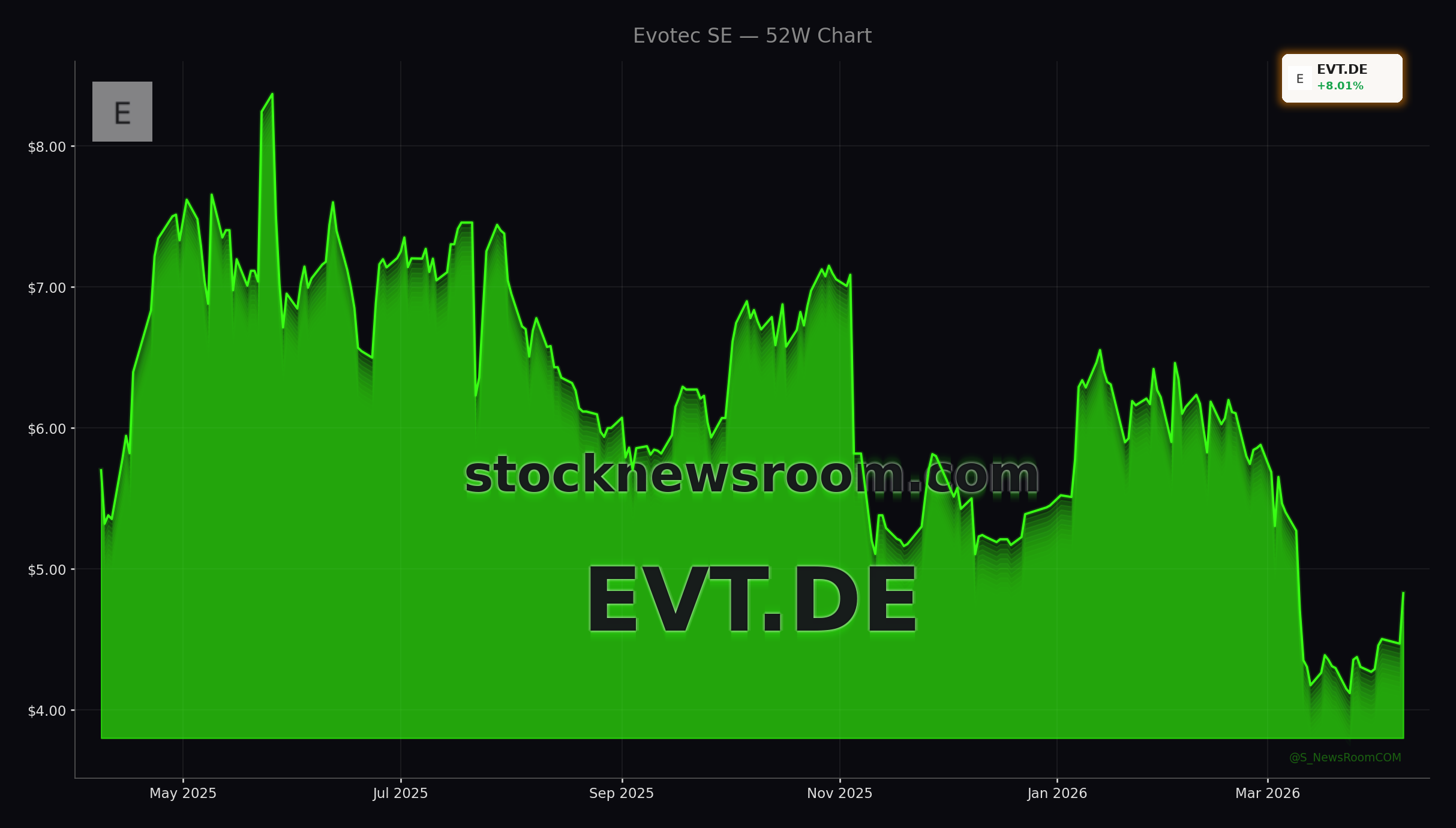
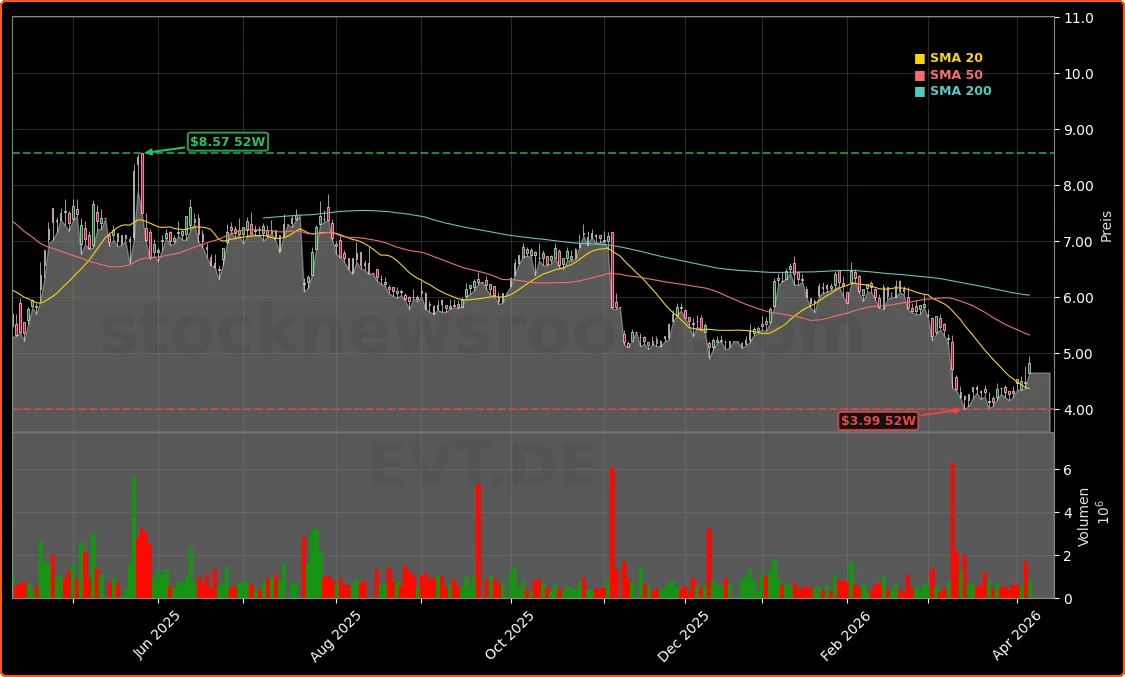
Evotec SE (EVT.DE) jumped nearly 8% to about $4.83 in European trading, extending a short‑term recovery from a base around EUR 4. The move roughly halves the stock’s year‑to‑date losses, though the share price remains deep in a multi‑year downtrend that has lasted more than four and a half years. For investors on Wall Street, the rally looks more like a relief bounce than a clear change in fundamentals, as the valuation is still driven by expectations of a distant profit inflection rather than current earnings power.
The latest Evotec Earnings matched market expectations and helped ease some near‑term fears about liquidity and execution risk. However, the company’s price‑to‑earnings metric remains negative, underlining that this is still a loss‑making growth story. In contrast to mature U.S. large‑caps like Apple or NVIDIA, which generate strong free cash flow and sit in the S&P 500, Evotec is positioned more like an early‑stage platform play that depends on partnerships, milestones and eventual pipeline success.
What do the latest Evotec Earnings show?
For the most recent fiscal year, Evotec generated revenues of EUR 788.4 million, or about EUR 810.4 million on a constant‑currency basis, slightly below the roughly EUR 797 million booked in the prior year. In the fourth quarter alone, revenue came in at EUR 253.3 million, at the upper end of management’s guidance range and slightly better on a constant‑currency view at EUR 266.7 million.
On profitability, the company reported a full‑year adjusted EBITDA of EUR 41.1 million, with the fourth quarter contributing EUR 58.0 million, more than doubling year on year. That improvement, however, was heavily influenced by a one‑time license payment of EUR 65 million. Stripping out such effects, the underlying margin picture remains weak. Evotec still posted a net loss of EUR 103.5 million for the year, even though that deficit was cut by about EUR 92.6 million compared with the previous period.
This mix of modest revenue slippage and cosmetically better Evotec Earnings, driven by non‑recurring items, explains why the stock reaction is positive but measured. Institutional investors focused on sustainable cash generation are likely to remain cautious until the company proves it can consistently deliver profit without depending on exceptional income.
Is Evotec’s business model turning the corner?
Evotec’s strategic plan centers on slimming down its structure, refocusing on higher‑margin segments and freeing up capital through asset disposals. One visible step was the sale of its site in Toulouse to Sandoz, aimed at strengthening the balance sheet. The group continues to operate as a contract research and development partner for big pharma and biotech, a model broadly comparable to certain U.S. drug discovery platforms, albeit at a smaller scale and outside major indices like the NASDAQ‑100.
A key bright spot is the company’s JEB division, which delivered a 39% revenue increase to EUR 259.4 million last year. By contrast, revenue in the more traditional drug and pharmaceutical research businesses fell 13.5% to EUR 611.4 million, underscoring the need to rebalance the portfolio toward faster‑growing, higher‑value services. Management has described 2026 as another “transition year”, signaling that the real payoff from the restructuring is expected beyond the current planning horizon.
Chief executive Christian Wojczewski has pointed to the second half of 2026 as the period when operating performance should begin to improve visibly, with a “clear plan for a stronger performance from 2027 and beyond.” That timeline places Evotec firmly in the camp of long‑duration turnaround stories, alongside smaller U.S. biotech platforms that also require investors to look several years out for meaningful earnings contributions.
How do estimates and valuation stack up?
On current projections, Evotec is expected to remain loss‑making in 2026, with consensus pointing to a negative P/E ratio of roughly -10.3 based on an anticipated net loss of about EUR 67.5 million. Analysts then see a modest return to the black in the following year, with forecast net income around EUR 8.1 million. That small profit, if achieved, would mark an important psychological milestone but would still leave the stock trading primarily on optionality around further growth and margin expansion.
Compared with profitable U.S. drug developers and diversified healthcare giants that populate the S&P 500 and NASDAQ, Evotec’s risk/return profile looks higher and more speculative. For U.S. investors used to large, cash‑rich names like Tesla or established pharma players, Evotec’s story will appeal mainly to those seeking under‑the‑radar European biotech exposure and willing to absorb volatility in exchange for potential upside from platform scaling and deal flow.
While specific Wall Street price‑target changes have not been highlighted around these Evotec Earnings, the fundamental message from research desks at global banks such as Goldman Sachs, JPMorgan and Citigroup is likely to focus on execution risk: the company must convert its strong partnership pipeline and JEB momentum into durable margins. Until that happens, many firms will likely maintain neutral or cautious stances, even if they acknowledge the strategic logic of the restructuring.
We have a clear plan for a stronger performance from 2027 and beyond.— Christian Wojczewski, CEO of Evotec SE
In summary, Evotec Earnings show that the company is moving in the right direction by reducing losses and stabilizing its platform, but the path to meaningful profitability remains long. For internationally diversified portfolios, the stock may fit as a small speculative satellite position rather than a core holding, especially given its ongoing negative earnings profile. The next set of results in this unfolding transition will be critical in confirming whether the second‑half 2026 improvement and the targeted upswing from 2027 can turn today’s fragile optimism into a more durable investment case.