
Is the Exxon Mobil Iran War fallout a temporary accounting storm or the start of a deeper hit to cash flows and production?

How is Exxon Mobil Iran War risk hitting Q1?
Exxon Mobil (XOM) guided that its Q1 2026 earnings will be hit by about $6.5 billion in total impacts linked to the Iran war and broader Middle East conflict. The biggest swing factor comes from a $3.5 billion to $4.9 billion negative effect from commodity hedging and inventory accounting. Because the company must mark derivatives to period-end prices before the underlying physical barrels and cargoes are sold, it is recording a temporary loss that management says should unwind over coming quarters as trades settle.
On top of that, Exxon estimates $400 million to $800 million of earnings pressure from volume disruptions at production and refining operations, and another $600 million to $800 million from trading losses tied to undeliverable physical cargoes. Despite these headwinds, the company still expects adjusted Q1 earnings per share around $1.80 at the midpoint, above Q4 2025’s roughly $1.71 but slightly below current Wall Street consensus near $1.90. Importantly for long‑term holders, management stresses that excluding the timing distortions, core earnings would be higher than in the prior quarter.
Why did the stock drop despite higher oil?
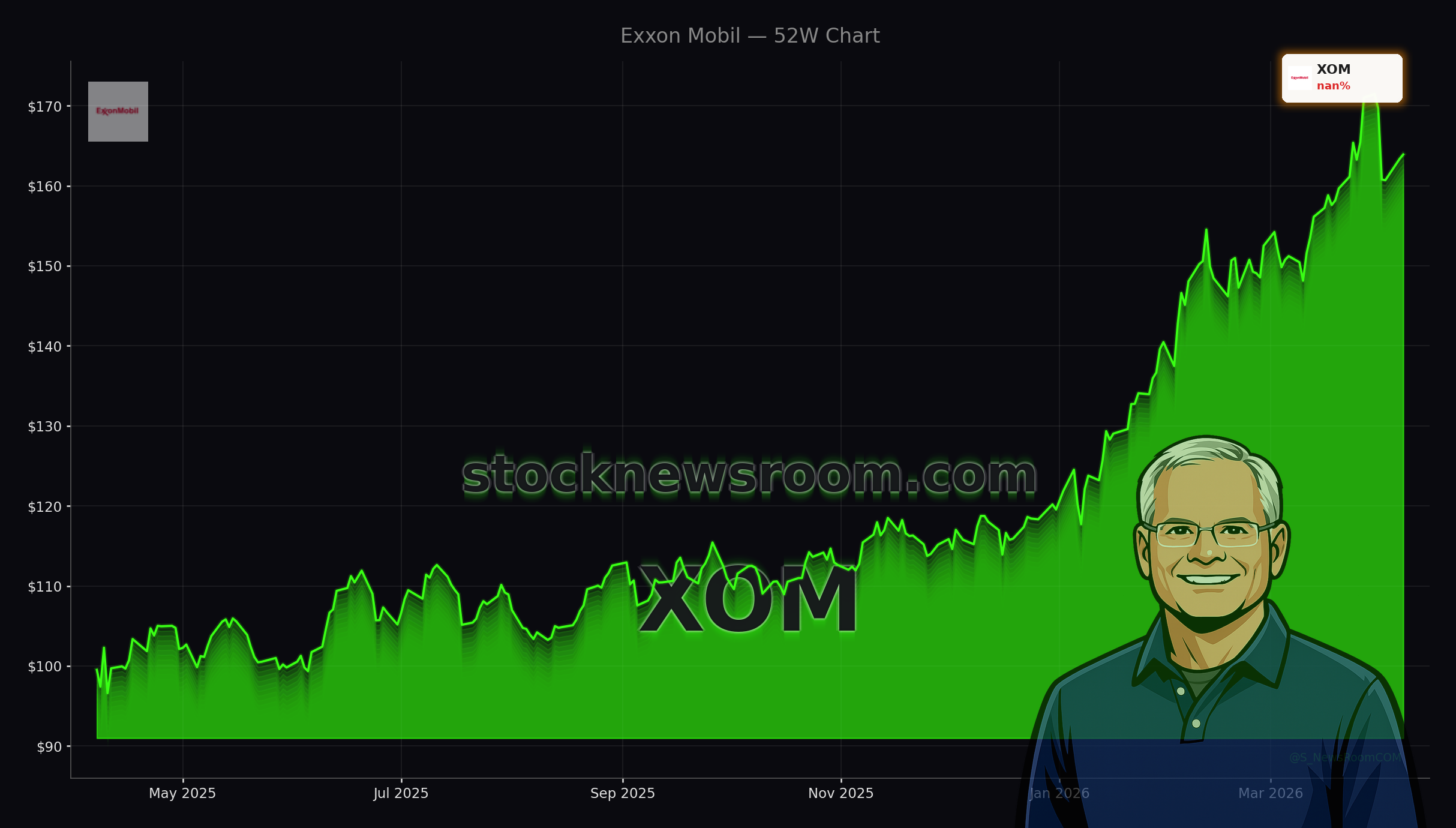
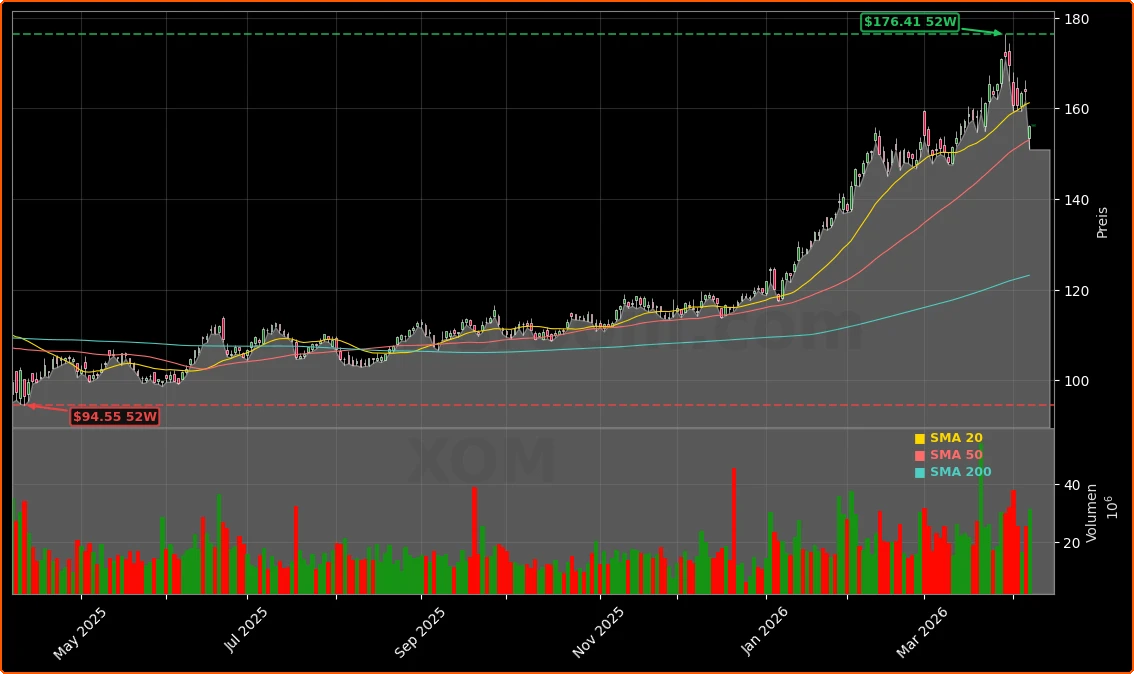
Exxon Mobil shares fell about 4.7% on Wednesday to roughly $154–$155 before recovering slightly in after‑hours trading near $156.39, underperforming the broader S&P 500 as crude prices retreated. The pullback followed headlines about a two‑week U.S.–Iran cease‑fire agreement and expectations that the Strait of Hormuz could gradually reopen, reducing immediate geopolitical risk that had propelled oil higher. For a stock that many traders had been treating as a pure Exxon Mobil Iran War proxy, that easing of tension triggered profit‑taking.
The move also came as Exxon acknowledged that global oil and gas production in Q1 will be about 6% lower than in Q4 2025 because of attacks on facilities in Qatar and the United Arab Emirates, where it holds ownership stakes. Those outages are pressuring volumes just as the market had been rewarding energy majors for war‑driven pricing power. That combination of softer production, complex accounting noise and lower spot crude explains why the stock lagged even though higher average prices should still be a net benefit for integrated players like Exxon and Chevron (CVX).
How exposed is Exxon Mobil to the Middle East?
Among western majors, Exxon has one of the largest Middle East footprints. The region represents roughly 20% of its upstream oil and gas production and about 5% of its refining and chemicals capacity. Two Qatari LNG liquefaction plants in which Exxon holds stakes account for about 3% of its 2025 global production and were recently damaged in Iranian attacks. Public reports suggest repairs could take a prolonged period, though the company has not provided a detailed recovery timeline.
At the same time, Exxon is trying to offset regional volatility by ramping up North American growth. It expects its Permian Basin output to reach about 1.8 million barrels of oil equivalent per day in 2026, and its Golden Pass LNG joint venture in Texas has just achieved first gas, with the first LNG cargo expected in Q2. Citi recently raised its Exxon Mobil price target from $150 to $175, citing this LNG leverage and a structural repricing of energy equities after the Iran war flare‑up, even as it maintained a Neutral rating on valuation grounds.
What does Wall Street think now?
Despite the recent slide, Exxon remains widely owned by institutions, with one Florida wealth manager recently lifting its stake by 19% in Q4 2025. Analysts are divided on whether the current quote around $156 fully reflects Exxon Mobil Iran War risk. Bernstein’s Bob Brackett keeps a Buy rating and a $195 price target, betting that timing losses will reverse and that higher for longer oil will support cash returns. By contrast, at least one smaller research shop has downgraded the stock from Hold to Sell, arguing that the war premium in the share price could unwind faster than investors expect if cease‑fire efforts hold.
For income‑oriented investors comparing supermajors, recent analysis still favors Exxon over pure‑play E&Ps like ConocoPhillips as a dividend vehicle due to its broader integrated model and long history of steady payouts. Exxon’s debt‑to‑equity ratio near 0.2x also leaves room for continued buybacks, giving management flexibility to turn wartime windfalls into stronger per‑share metrics once the accounting noise clears.
How should U.S. investors position around Exxon Mobil Iran War risk?
The Exxon Mobil Iran War narrative remains a double‑edged sword. On one side, disrupted Middle East volumes and damaged LNG infrastructure cap near‑term production, and accounting timing effects cloud headline earnings in Q1. On the other, the same conflict has lifted benchmark oil and gas prices enough to add an estimated $2.1 billion to $2.9 billion to Q1 profit, even before timing reversals. With global demand resilient and the company investing heavily in U.S. shale and LNG, many on Wall Street see the current setback as cyclical rather than structural.
Volatility across the energy complex underscores this tension. Peers such as Tesla and NVIDIA have been viewed as beneficiaries of a long‑term energy transition, yet traditional hydrocarbons are currently driving cash flow, and integrated majors like Exxon and Chevron still dominate S&P 500 energy weightings. For diversified U.S. portfolios, the key question is whether to treat the latest pullback as an entry point or a warning that the war‑risk premium is fading faster than fundamentals can catch up.
Related Coverage: For a deeper dive into how war headlines have already shaken the stock, see ExxonMobil Plunge -5.9%: War Risk Reset or LNG Upside?, which examines whether earlier selling was just a short‑term reset or the start of a longer de‑rating in LNG‑heavy majors. To understand how broader energy sentiment is shifting, read Chevron Oil Price Plunge -5.5% After Cease-Fire Shock, which analyzes whether Chevron’s move is a simple oil price reaction or a signal that energy bulls are reassessing risk.
These are sound trades and the profitability that will result from them will be material.— Neil Hansen, Exxon Mobil CFO
In the end, Exxon Mobil Iran War risk is weighing on reported Q1 numbers but simultaneously supporting price realizations and strategic LNG positioning. For U.S. investors, that means focusing less on noisy timing effects and more on balance sheet strength, capital discipline and long‑term cash returns. The next few quarters of earnings and guidance will show whether Exxon can turn today’s geopolitical shock into durable shareholder value.