
Is the sudden ExxonMobil Plunge a fading war-risk premium or the start of a deeper rethink on Big Oil’s LNG future?

Is the ExxonMobil Plunge just a war-premium reset?
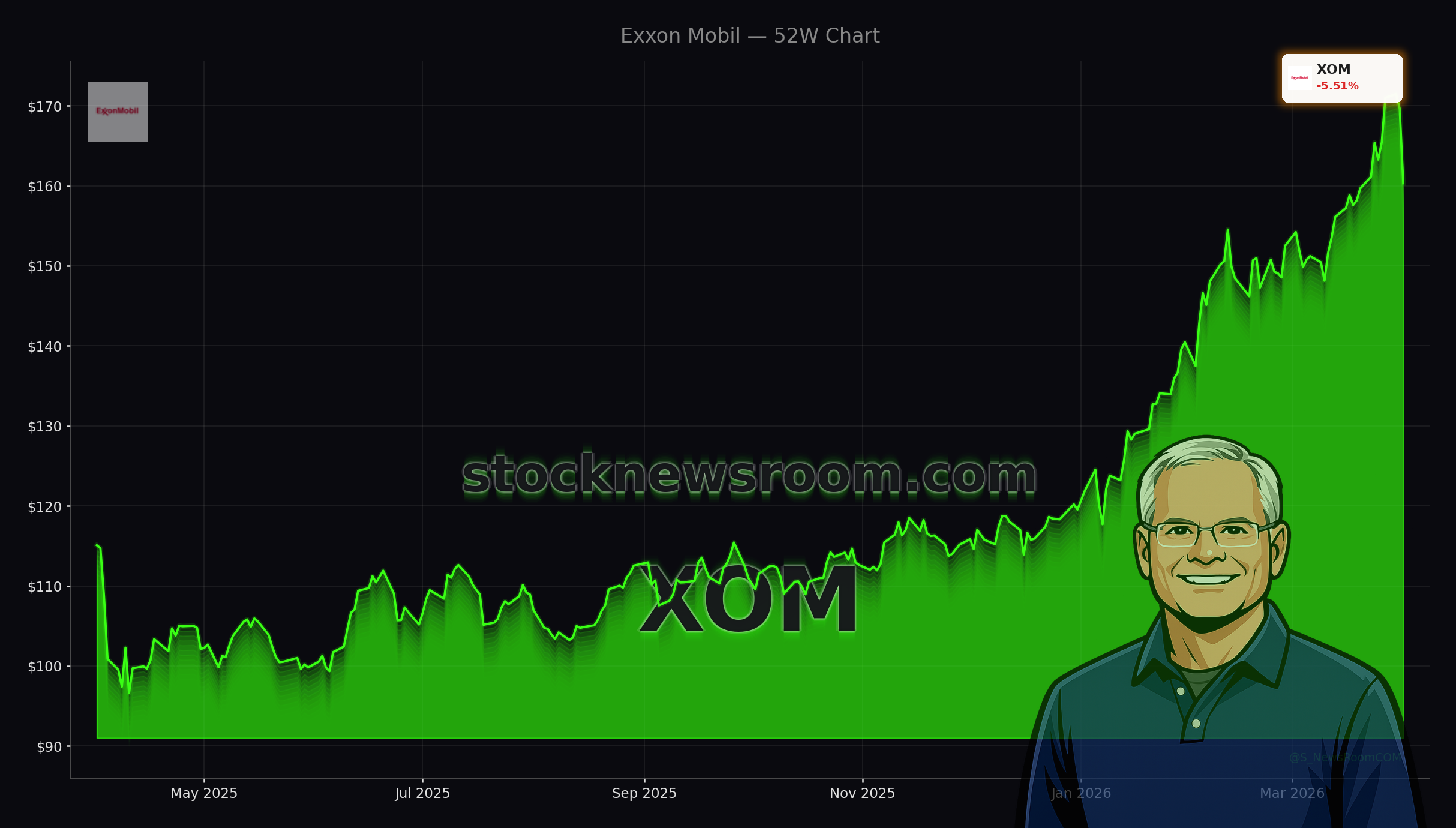
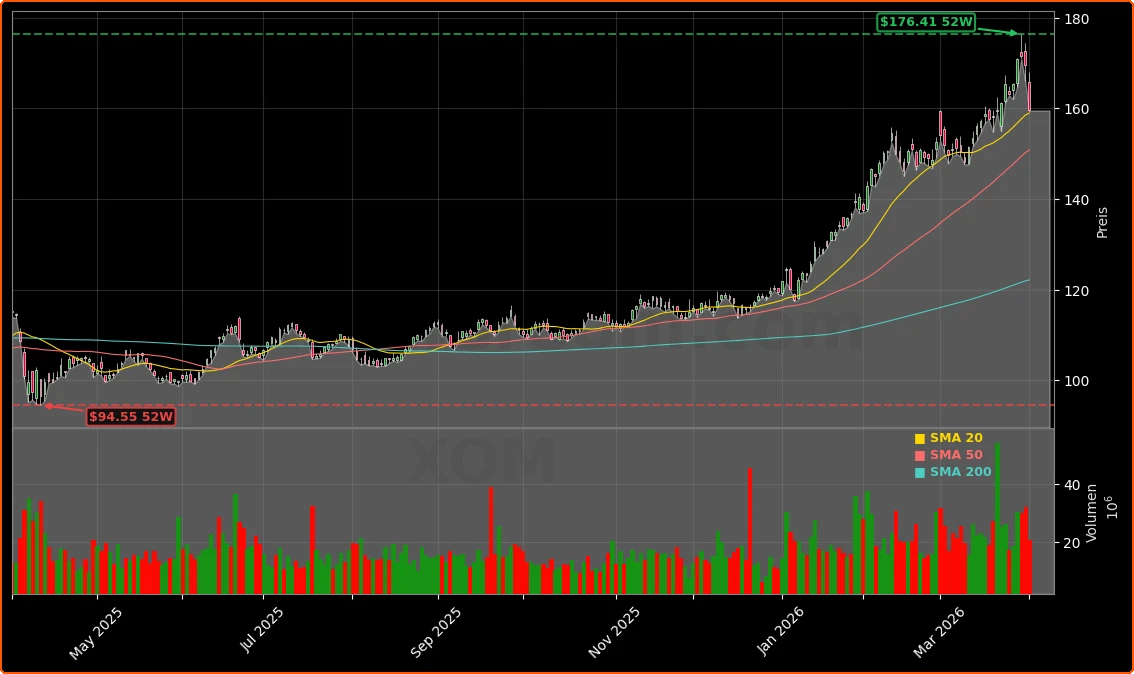
At around $159.64, Exxon Mobil is down roughly 5.91% versus Tuesday’s close of $168.00 and about 5.8% below its March 30 all-time closing high of $171.47. The stock is still up more than 30% year to date and over 36% versus a year ago, highlighting how sharp and sudden Wednesday’s ExxonMobil Plunge has been rather than signaling a broken long-term trend.
Energy names across the S&P 500 traded lower as crude benchmarks Brent and WTI pulled back on growing hopes that the war with Iran could de‑escalate in the coming weeks. That optimism has started to unwind the geopolitical risk premium that had pushed oil and gas prices – and integrated majors like Exxon Mobil and Chevron (CVX) – sharply higher through Q1 2026.
The selloff is also the worst two‑day stretch for Exxon Mobil in nearly a year, with the stock down almost 6% over that span. Yet even after the ExxonMobil Plunge, shares remain about 61% above their 52‑week low near $100, underscoring how elevated the starting point was after a powerful first-quarter rally.
How exposed is Exxon Mobil to Middle East risk?
Analysts estimate that roughly one‑fifth of Exxon Mobil’s oil and gas production is tied to the Middle East, including major natural gas and LNG stakes alongside QatarEnergy. Iran’s missile attacks on LNG infrastructure in Qatar earlier this year damaged two of 14 LNG trains where Exxon Mobil holds minority interests, trimming Qatar’s LNG capacity by an estimated 17% for three to five years.
Those disruptions are expected to shave about $5 billion a year from Exxon Mobil’s revenue run rate, a notable hit but not enough to derail its broader growth plans. Meanwhile, the shutdown of the Strait of Hormuz – through which about 20% of the world’s oil and LNG typically flows – has kept global gas prices elevated, partially offsetting the direct production losses.
Industry groups have stressed that large U.S. producers such as Exxon Mobil and Chevron are pushing hard for a reopening of the Strait before Washington fully disengages from the conflict, arguing that a long‑term closure would effectively hold a fifth of global oil supply “for ransom.” For now, markets appear to be pricing in a more benign path where shipping lanes gradually reopen and the war risk premium erodes – a key driver behind the ExxonMobil Plunge.
Does Golden Pass LNG change the story?
Ironically, the ExxonMobil Plunge comes just as one of the company’s most important growth projects begins to bear fruit. Exxon Mobil and QatarEnergy have completed the first LNG train at the Golden Pass project in Texas, a $10 billion facility that will ultimately have 18 million metric tons per annum (MTPA) of capacity once fully online next year. The first train alone adds 6 MTPA, with Exxon holding a 30% stake.
The timing is unusually favorable. With Iran disrupting LNG flows from the Gulf and damaging Qatari infrastructure, Golden Pass is positioned to help fill part of the global supply gap and strengthen U.S. LNG’s role in Europe and Asia. For Exxon Mobil, the project fits into a broader strategy of focusing capital on high‑return, low‑cost barrels and molecules that can generate attractive margins across cycles.
Management has guided to roughly $25 billion in incremental annual earnings and $35 billion in additional cash flow by 2030, assuming 2024‑like commodity prices and margins. That would support an estimated $145 billion in surplus cash flow through the end of the decade at around $65 oil – an outlook that has helped underpin investor confidence even during episodes like the current ExxonMobil Plunge.
What are Wall Street analysts saying now?
Despite the volatility, many research desks continue to highlight Exxon Mobil as a core blue‑chip energy holding. Zacks Investment Research notes that the company has built a strong record of positive earnings surprises and argues that its advantaged upstream assets – including the Permian Basin and key offshore projects – should drive double‑digit compound annual earnings growth into 2030.
On the sell‑side, major banks such as Goldman Sachs, Morgan Stanley, and RBC Capital Markets have generally maintained constructive views on the sector, even as they warn clients to expect more frequent pullbacks whenever headlines hint at de‑escalation in the Iran conflict. Consensus data compiled by MarketBeat still shows Exxon Mobil around a “Hold” rating overall, but with several “Buy” recommendations and average price targets clustered near or slightly above current levels, even after the ExxonMobil Plunge.
Institutional demand also appears resilient. Filings show that firms like Private Advisory Group LLC and Chatham Capital Group Inc. recently increased their Exxon Mobil positions, signaling that professional investors are willing to use weakness to accumulate shares. For income‑focused portfolios, the company’s roughly 2.4% dividend yield, backed by 43 consecutive annual dividend increases, remains a key attraction versus high‑growth names such as NVIDIA or Tesla.
How does Exxon Mobil compare to Chevron?
For U.S. investors weighing Exxon Mobil against peers, Chevron stands out as the closest comp. Both are integrated oil majors with strong balance sheets, sizeable share‑repurchase programs, and long dividend-growth track records. Both have surged in 2026 on the back of higher oil and gas prices, and both moved sharply lower on Wednesday as crude prices retreated.
Some portfolio managers prefer to pair a position in Exxon Mobil with tech bellwethers like Apple to balance cyclicality, while others are rotating more heavily into energy as a hedge against persistent commodity volatility. In that broader asset‑allocation context, the ExxonMobil Plunge looks less like a company‑specific crisis and more like a macro‑driven adjustment after an unusually strong quarter for the entire energy complex.
Related Coverage
Investors following Exxon Mobil’s move may also want to review developments at its closest peer. A recent analysis, “Chevron Energy Project -1.8%: AI Power and War Shock”, explores how Chevron is trying to turn a wartime oil windfall into a durable competitive advantage in powering artificial intelligence infrastructure, even as its shares slip. That piece puts Chevron’s strategy and recent price action in context with the same geopolitical and commodity forces driving today’s ExxonMobil Plunge.
The ExxonMobil Plunge underlines how sensitive even a mega‑cap like Exxon Mobil remains to shifts in Middle East headlines and oil prices, but it does little to change the company’s long‑term LNG expansion and cash‑generation outlook. For U.S. investors, the debate now is whether this pullback is an entry point into a diversified energy leader with a dependable dividend or the start of a broader rotation out of oil as war fears ease. The next few quarters of earnings, capital‑allocation updates, and progress at Golden Pass LNG will show whether Exxon Mobil can turn this bout of volatility into another leg higher for long‑term portfolios.