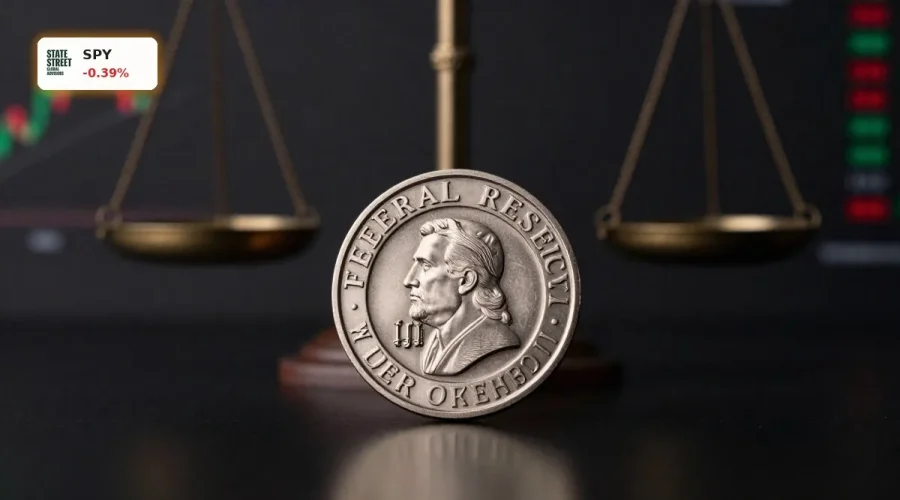
Is the upcoming Federal Reserve interest rate decision facing a monetary policy reversal due to inflation proving more persistent than expected?
Federal Reserve Interest Rate Decision: Fed’s Shift?
The minutes from the January meeting of the Federal Open Market Committee (FOMC) show a noticeable shift in tone: interest rate cuts are currently on hold. The Federal Reserve maintained the key interest rate at a 10 to 2 vote in the range of 3.5% to 3.75%, after having already cut rates three times by the end of 2025. Governors Christopher Waller and Stephen Miran voted for an additional cut of 25 basis points but remained in the minority.
Several participants explicitly wanted to note that future actions remain possible in both directions. The minutes emphasize that the risk of inflation remaining above the 2% target for an extended period is assessed as “significant.” Some members argued that additional easing would only be justified once it is clear that the disinflation process is back on a “firm track.” This places the next Federal Reserve interest rate decision more in focus than in previous quarters.
The market is pricing in a very high probability that rates will remain unchanged for the next meeting in March, according to futures exchanges. Concurrently, the SPDR S&P 500 ETF (SPY) recently fell to $683.62, a decrease of 0.39% from the previous day—an indication that the Fed’s hawkish message has dampened buying sentiment in the stock market.
Fed: Is Inflation the Deciding Factor?
The center of the debate in the committee is the inflation trend. The Consumer Price Index (CPI) rose by 0.2% in January and stands at 2.4%, just above the target, but from the perspective of many central bankers, disinflation is occurring “more slowly and unevenly than expected.” The PCE inflation measure is at 3%, with the core PCE reading expected later this week around 2.9%—a level deemed too high to quickly transition into a new rate-cutting cycle.
Several participants warned that further rate cuts could be misinterpreted as a lack of commitment to the 2% target. Other FOMC members, however, point to diminishing tariff effects, a cooling housing market, and productivity gains that could have disinflationary effects in the medium to long term. This divide explains why the minutes explicitly mention the option of new rate hikes, even though the majority currently advocates maintaining the current course.
For investors, this means that the next Federal Reserve interest rate decision will heavily depend on upcoming inflation and wage data. If oil prices and geopolitical risks continue to rise, the pressure on the central bank could even shift towards further tightening.
How Robust is the US Labor Market Really?
On the labor market side, the data presents a significantly more stable picture than last year. In January, 130,000 new jobs were created, and the unemployment rate fell to 4.3%. According to the minutes, the majority of Fed members believe that the weakness in the job market, which led to three rate cuts by the end of 2025, has largely been overcome.
The wording regarding “increased downside risks” for the labor market was removed from the official statement—an important signal that the employment side no longer provides an argument for rapid easing. Instead, the focus has clearly shifted to the inflation mandate. Several FOMC members suggested making it clearer in communications that if inflation were to pick up again, rate hikes could also be on the table.
This increases the environment of “two-way risk” for risky assets: both unexpectedly low and surprisingly high inflation data can abruptly change the path of future decisions by the Federal Reserve.
Political Pressure and New Fed Chair – What Does It Mean?
The upcoming Federal Reserve interest rate decision gains additional significance due to personnel debates: US President Donald Trump has nominated former Fed Governor Kevin Warsh as Jerome Powell’s successor. Warsh would take over a divided central bank, where a hawkish block does not rule out rate hikes, while other members expect two to three cuts possible starting in the summer.
Trump himself openly calls for lower rates to provide relief to homebuyers and businesses. The White House points to “cool and stable” inflation data as a success of its supply-side economic policy. This political pressure for the independence of the Federal Reserve poses potential conflicts—especially if the data suggests waiting or even tightening.
Markets are already reacting: the yield on the 10-year US Treasury was recently around 4.1%, and the dollar benefited from the hawkish signals. At the same time, many strategists still expect two rate cuts in the second half of 2026, provided core inflation sustainably moves toward 2%.
“Several participants warned that further easing of monetary policy in light of increased inflation values could be misinterpreted as a diminishing commitment to the 2% inflation target.”
— FOMC Minutes from January 2026
Bottom Line
Overall, the January minutes signal that the next Federal Reserve interest rate decision will be clearly shaped by inflation data and less by the labor market. For investors, the hawkish tone of the Federal Reserve means more volatility and a higher sensitivity to macro data, but no immediate break from the prospect of later rate cuts. Those building positions in stocks, bonds, or crypto should closely monitor the upcoming inflation reports and signals from the designated Fed Chair Kevin Warsh to benefit from the next monetary policy shift in a timely manner.
Related Sources
- Fed Minutes Signal Greater Reluctance on Rate Cuts (Bloomberg)
- Minutes of the Federal Open Market Committee January 27–28, 2026 (Federal Reserve)
- US Consumer Price Index – January 2026 (Bureau of Labor Statistics)