Can the new Ford MLB partnership turn a struggling EV story into a brand-fueled comeback for Ford stock?

How is Ford trading into Q1 2026?
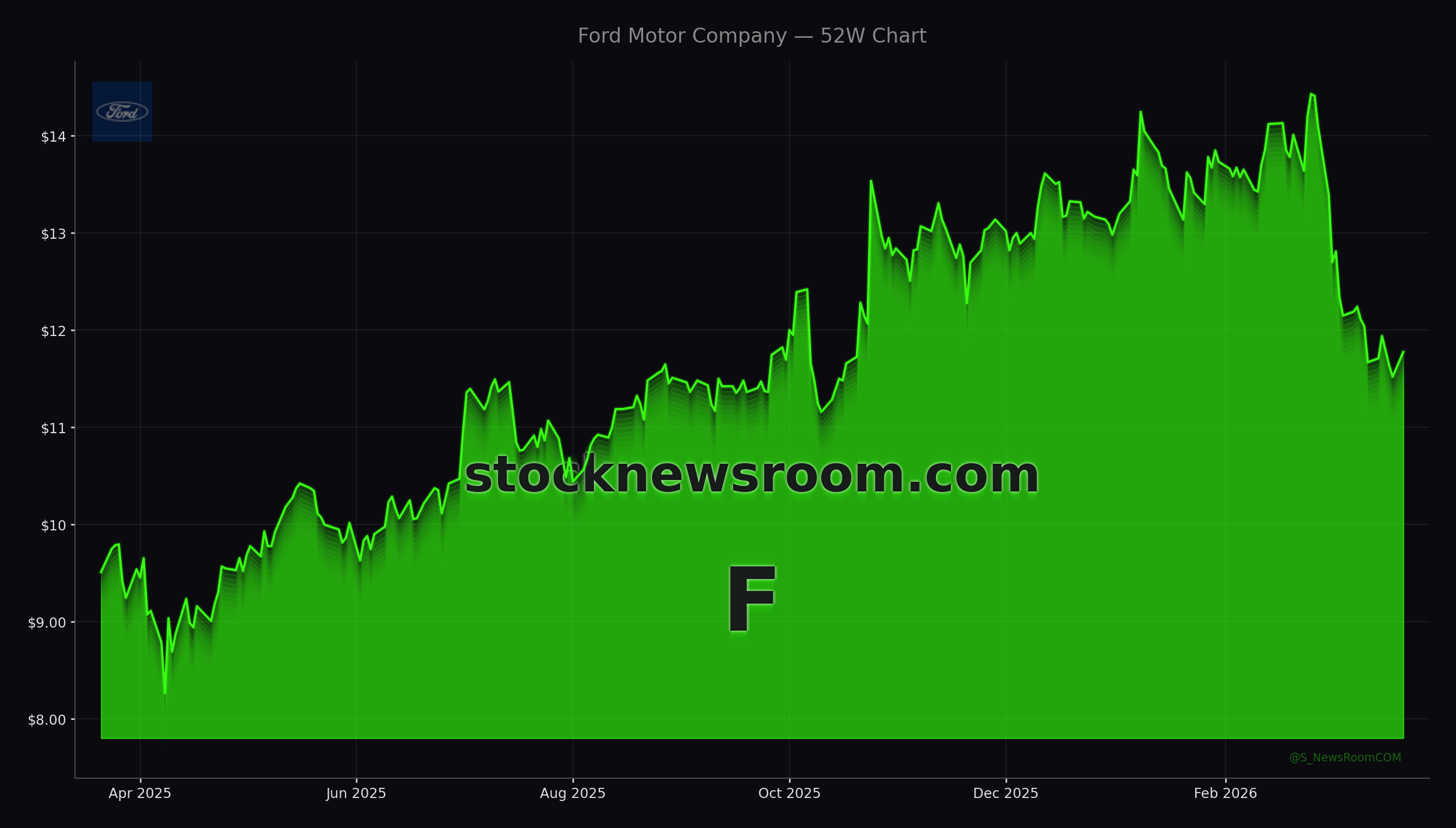
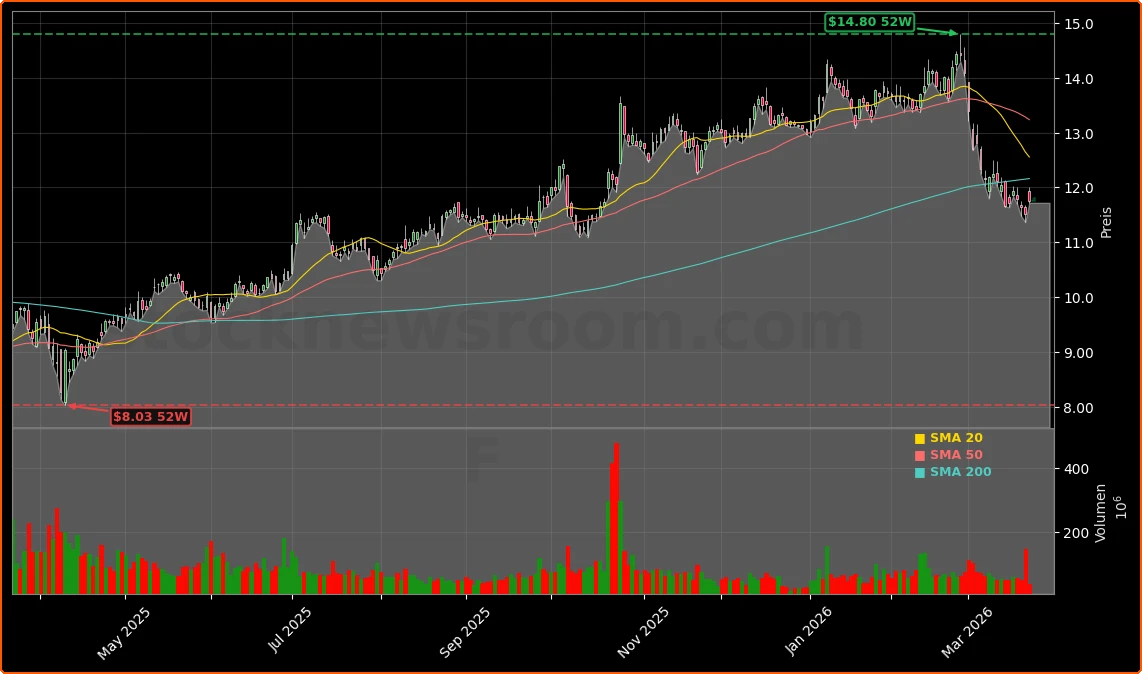
Ford Motor Company (F) ended Monday’s regular session at $11.76, up 2.08% from Friday’s close of $11.57, with a modest after‑hours uptick to $11.80. Despite the bounce, the stock remains roughly 12% below its 100‑day simple moving average and closer to its 52‑week low than its high, underscoring a difficult 12‑month stretch even as shares have gained about 12% year over year.
Technical indicators are mixed. The relative strength index (RSI) sits near 28, in oversold territory, while the MACD line remains below its signal, pointing to lingering bearish momentum. Key support is clustered around $11.00, with resistance near $13.00. At a forward P/E around 10.5, the market is pricing in modest earnings growth but not a rapid turnaround in Ford’s higher‑loss EV operations.
Analyst sentiment is balanced. RBC Capital Markets maintains a Sector Perform rating with a $12 price target, Barclays is at Equal Weight with a $13 target, and JPMorgan stands out more bullishly with an Overweight rating and a $15 target. The consensus rating remains “Hold,” with an average target of about $12.89, implying limited upside from current levels.
What does the Ford MLB partnership cover?
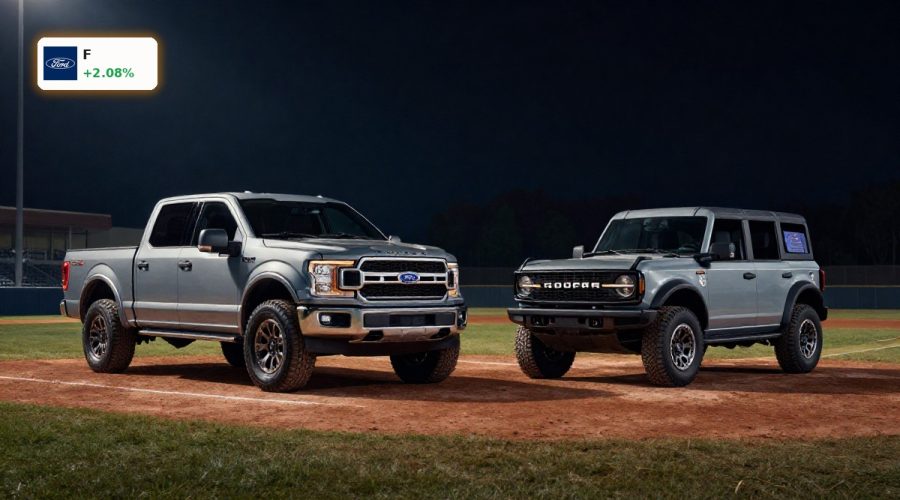
The newly announced Ford MLB partnership establishes Ford as the Official Automotive Partner of Major League Baseball under a multiyear, exclusive agreement. The deal gives Ford visibility across MLB’s highest‑profile events, including Opening Day, All‑Star Week, MLB at Field of Dreams and the postseason, culminating in the World Series presented by Capital One.
Crucially for long‑term brand equity, the partnership extends beyond the big‑league spotlight. Ford also secures rights across Minor League Baseball and Little League Baseball and Softball, including the Little League World Series. That structure lets the company and its dealer network activate at the grassroots level with youth clinics, equipment donations and community grants in key operating regions such as Kansas City, Buffalo and Detroit.
Marketing plans include presenting sponsorship of MLB’s July 4th initiative, fan experiences, and the “Drive Them Home” sweepstakes, where fans can win All‑Star Game tickets and the chance to drive home a 2026 F‑150 Lariat with PowerBoost Hybrid V6, an Expedition Platinum or a Bronco Badlands. The strategy is to tie Ford’s bestselling trucks and SUVs to family baseball rituals, reinforcing the company’s “built for America” positioning against rivals like Tesla and NVIDIA‑driven software‑first players that have less heritage branding to lean on.
Why this sports bet matters for Ford+ and EV risks
The Ford MLB partnership lands at a pivotal moment for the Ford+ plan, which splits the business into Ford Blue (ICE and hybrids), Ford Pro (commercial) and Model e (EVs and software). While Ford Pro and Ford Blue remain profitable, the Model e segment has generated more than $14.5 billion in losses over the last three years, and management recently booked a $19.5 billion charge tied to EV assets.
Ford has committed around $5 billion to a new universal EV platform aimed at launching affordable EVs from 2027, starting with a midsize pickup targeting a roughly $30,000 price point. Management’s goal is to deliver a lower five‑year total cost of ownership than a three‑year‑old used Tesla Model Y, but they do not expect the EV segment to reach profitability until 2029. That long runway heightens execution risk at a time when EV competitors are also aggressively cutting costs and pivoting to new architectures.
Brand‑driven initiatives like the Ford MLB partnership are designed to buttress Ford Blue and Ford Pro, where margin contribution is stronger and cash flows help fund EV investments. By embedding its trucks and SUVs into MLB content, ballpark experiences and youth baseball programs, Ford is effectively using sports to deepen loyalty and defend share in profitable segments while it works through EV restructuring. The move also echoes strategies from tech‑adjacent giants like Apple, which have long used lifestyle branding to support ecosystem economics.
How does Ford’s outlook compare with US auto rivals?
Ford’s push to blend nostalgic Americana with a tech‑forward image through the Ford MLB partnership contrasts with peers taking different strategic angles. General Motors is emphasizing software monetization and capital returns, while Tesla pursues a more disruptive path built around autonomous driving and potential robotaxi networks rather than traditional brand marketing.
For now, investors will get their next hard data point on Ford’s trajectory on April 29, 2026, when the company reports Q1 2026 results at 4:05 p.m. ET, followed by a 5:00 p.m. ET conference call with CEO Jim Farley and CFO Sherry House. Wall Street currently expects earnings per share of about $0.19, up from $0.14 a year ago, on revenue of roughly $39.3 billion, compared with $37.4 billion previously.
Management is likely to face questions about the pace of EV losses, capital allocation between Ford Pro, Ford Blue and Model e, and how much incremental return they expect from large‑scale marketing plays like the Ford MLB partnership. With consumer discretionary stocks under pressure in recent months and the auto cycle late in its expansion, investors will be watching for any updated guidance on margins, especially in North America and commercial fleets.
Related Coverage
Investors focused on the broader EV and mobility landscape may also want to track developments at Ford’s chief rival Tesla. A recent analysis, “Tesla Terafab +3.3% Surge: Musk’s High‑Stakes AI Chip Bet”, explores how Elon Musk aims to turn in‑house chip and robotics investments into a strategic advantage that could reshape margins and competitiveness across the auto industry. Comparing Ford’s brand‑centric Ford MLB partnership with Tesla’s chip and AI bets highlights the starkly different playbooks major automakers are using to win the next decade.
This partnership is about honoring tradition while putting real capability behind the moments that matter for fans, players, and for the communities that keep the game, and the country, moving forward.— Lisa Materazzo, Ford Global Chief Marketing Officer
Altogether, the Ford MLB partnership gives Ford a high‑visibility platform just as Q1 2026 earnings approach, reinforcing its core truck and SUV franchise while it absorbs heavy EV investment. For US investors, the stock remains a value‑oriented, income‑friendly way to gain exposure to autos, with near‑term sentiment likely dictated by April’s earnings and any updates to the Ford+ roadmap. The next few quarters will show whether this blend of Americana marketing and disciplined capital deployment can turn current brand momentum into durable shareholder returns.