Can Ford Strategy turn painful EV write-downs into a fresh pivot powered by F-Series profits and a bold move into energy?

How is Ford Motor Company moving the stock today?
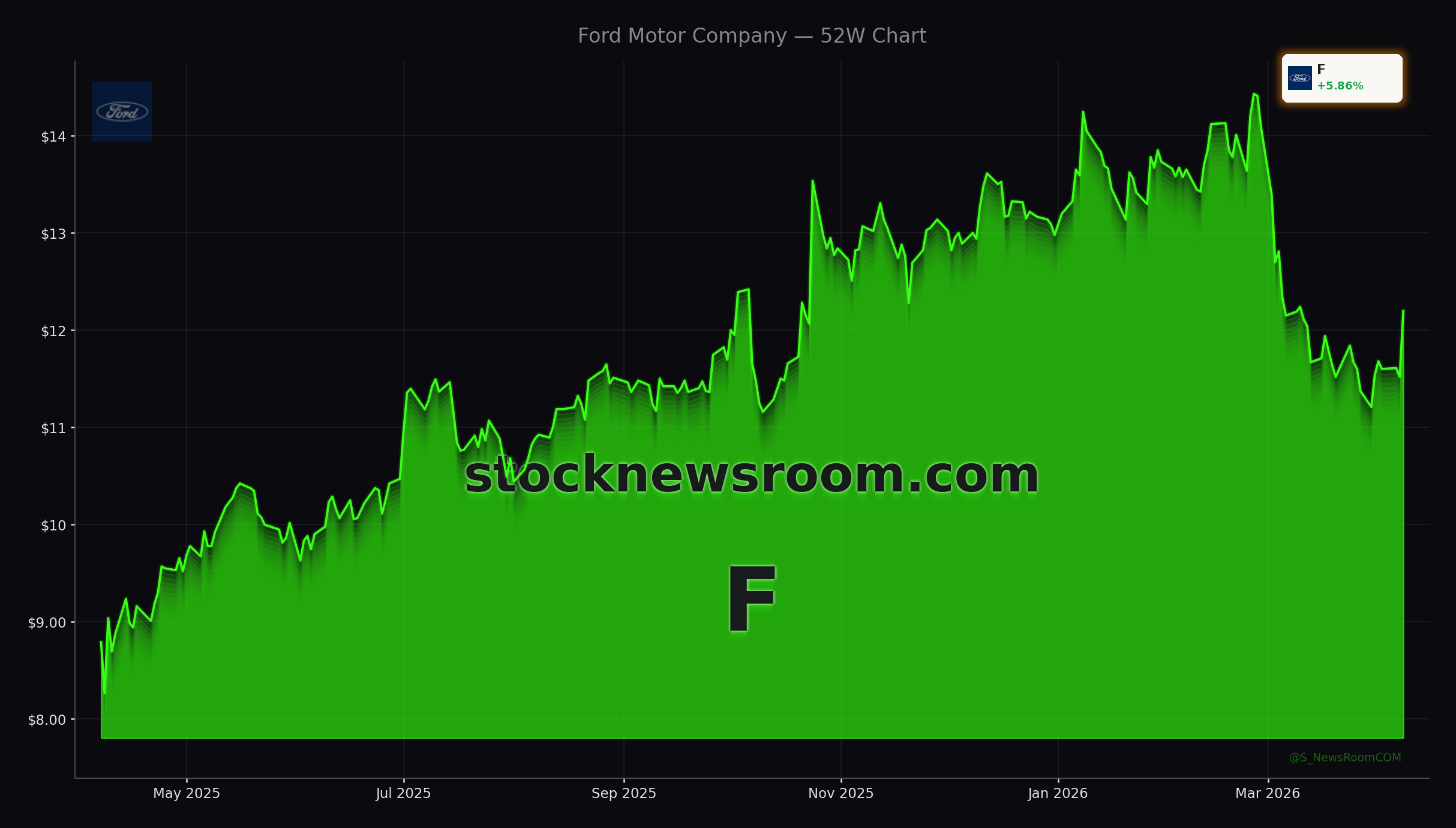
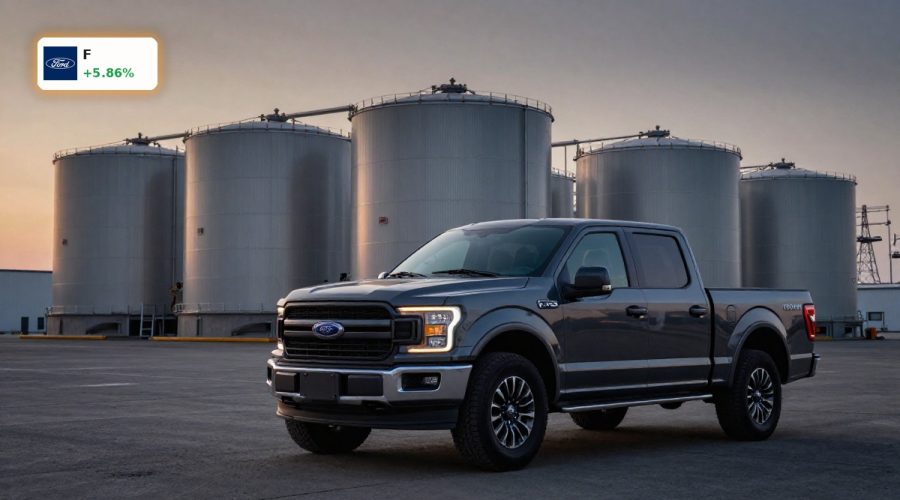
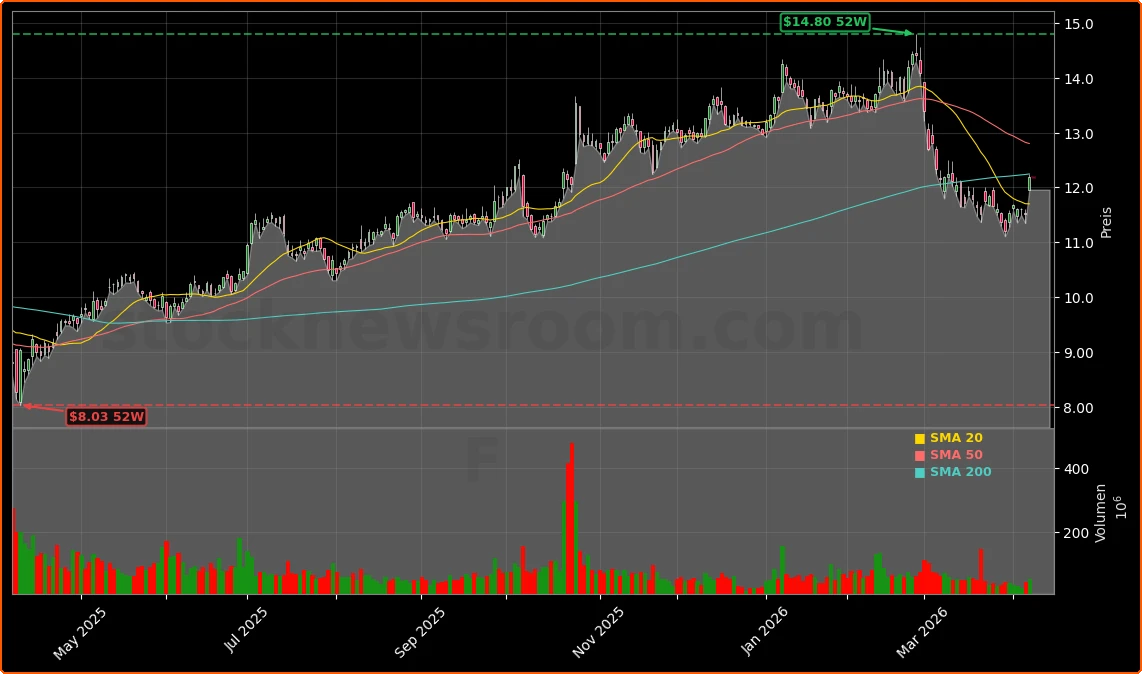
Ford Motor Company (F) rallied roughly 5.9% on Wednesday, climbing from a prior close of $11.76 to $12.20 by the regular-session close, before slipping marginally in after-hours trading. The move tracks a similar 5%–6% jump in Toyota shares, underscoring that global vehicle demand is holding up despite higher rates, tariff tensions and lingering supply bottlenecks. Even after today’s bounce, Ford remains down more than 10% in 2026, leaving the stock well below typical large-cap auto valuations on the S&P 500 and still under the average analyst price target around the mid-teens.
The immediate catalyst is confirmation that F-Series and Super Duty demand remains robust, easing fears that higher prices and economic uncertainty would trigger a major pullback in Ford’s most profitable lineup. At the same time, investors are reassessing the broader Ford Strategy after the company booked one of the largest EV write-downs in industry history and unveiled a new energy-focused business aimed at capturing AI and data center power demand.
Can Ford Strategy still lean on the F-Series profit engine?
Ford’s dependence on its flagship truck franchise remains both a strength and a risk. The F-Series, including the F-150 and Super Duty models, has been America’s best-selling truck for 49 straight years and the best-selling vehicle overall for 44 years, with more than 800,000 units sold last year. In 2025, the F-Series accounted for roughly 37% of Ford’s U.S. sales, meaning any sustained disruption hits the income statement hard.
That vulnerability is on display as aluminum tariffs and a fire at key supplier Novelis squeeze supply of Canadian aluminum used heavily in F-150 body panels. Ford has asked the White House for relief, warning that tariff and disruption-related costs could approach $3 billion and hinder production of high-volume models like the F-150. U.S. officials have so far refused to roll back the tariffs, leaving Ford to juggle inventory, pricing and alternative sourcing while it protects market share from General Motors’ Chevrolet Silverado and Stellantis’ RAM.
Despite these headwinds, Ford closed 2025 with $187.27 billion in revenue and the best Super Duty volume since 2004. Management is guiding for 2026 adjusted EBIT of $8 billion to $10 billion, with CEO Jim Farley targeting an 8% adjusted EBIT margin by 2029. For now, the Ford Strategy still assumes that truck and commercial-vehicle profits will fund the company’s next phase.
Did EV write-downs break or reset Ford Strategy?
The most jarring piece of the Ford Strategy came with a $10.70 billion impairment tied to Model e asset write-downs and EV program cancellations, contributing to a Q4 2025 GAAP net loss of $11.10 billion. Special charges totaled $15.50 billion, including a $3.20 billion hit from unwinding the BlueOval SK joint venture. Model e posted a full-year EBIT loss of $4.81 billion in 2025, and Ford now expects another $4 billion to $4.5 billion EBIT loss from the EV segment in 2026.
Farley has framed the move as essential surgery rather than retreat, arguing that Ford misjudged the pace and profitability of early mass-market EV adoption. The updated Ford Strategy shifts the focus away from capital-intensive, stand-alone EV programs toward scalable platforms that arrive closer to 2027 and can share components across segments. This contrasts with Tesla’s pure-play EV approach and differs from General Motors, which is doubling down on autonomous driving through Cruise rather than tilting into energy infrastructure.
On Wall Street, sentiment is mixed but stabilizing. Consensus skews toward “Hold” ratings, with a handful of Buys and one Sell, and an average price target in the low-to-mid teens that implies upside from current levels. Several buy-side desks now view the 7x forward P/E and rich dividend yield above 5% as compensating for cyclical and execution risk, provided the new Ford Strategy can contain EV losses over the next two to three years.
Is Ford Energy the real long-term pivot?
The boldest component of the Ford Strategy is Ford Energy, a business built around battery energy storage systems (BESS) rather than passenger EVs. Ford plans to repurpose its Glendale, Kentucky battery manufacturing footprint to produce advanced LFP prismatic cells, 5 MWh+ storage systems, BESS modules and 20-foot DC container units, targeting 20 GWh of annual capacity from 2027 onward. Management expects to deploy roughly $1.5 billion of capital in 2026 alone to support the build-out.
Farley has been explicit that this is not a contract-manufacturing play. Ford wants end-to-end energy solutions — from design and deployment to long-term service — for utilities, large industrial customers and fast-growing data center operators that power AI workloads from companies like NVIDIA and cloud giants such as Apple. The company’s licensing deal for cost-effective LFP chemistry with CATL could provide a pricing edge versus competitors relying on imported or higher-cost chemistries.
Investors are drawing parallels to Caterpillar’s power generation segment, which has delivered accelerating double-digit revenue growth by supplying backup and prime power systems into the same AI and data center wave. If Ford Energy executes, the Ford Strategy could gradually re-rate the stock away from pure auto cyclicality and closer to industrial-infrastructure peers.
How does Ford Pro support the transition?
Ford Pro, the commercial-vehicle and fleet business, remains the financial anchor while the rest of the Ford Strategy evolves. The unit is guiding for $6.5 billion to $7.5 billion in EBIT in 2026, underpinned by more than 42% market share in U.S. Class 1–7 commercial vehicles and 30% growth in paid software subscriptions last year. Those high-margin, recurring software and services revenues add a stability layer that many traditional automakers lack.
Competitively, Ford Pro positions the company differently than EV-focused players such as NIO and Tesla, and more like a blended industrial-fleet operator competing with Apple-style ecosystem thinking in software and services. For U.S. investors, this diversification means Ford’s earnings trajectory may track a different pattern than pure consumer auto names on the NYSE and NASDAQ.
Related Coverage
Safety and regulatory risks remain a key overlay for any Ford Strategy. A deeper dive into these issues is available in Ford BlueCruise Investigation +2.9%: Safety Shock for EV Plans, which examines how ongoing probes into advanced driver-assistance systems could affect Ford’s reputation and cost base. For a broader look at how EV peers are faring, NIO Earnings +98% Delivery Boom: Rally or Value Trap? reviews whether rapid delivery growth at Chinese EV maker NIO signals a sustainable turn or just another brief rally in a volatile segment.
We made difficult but critical strategic decisions that set us up for a stronger future.— Jim Farley, CEO of Ford Motor Company
In sum, the Ford Strategy now rests on three pillars: defending F-Series and Ford Pro profits, absorbing near-term EV losses after massive write-downs, and building Ford Energy into a meaningful player in grid and data center storage. For U.S. investors, that mix offers income, cyclicality and long-duration growth optionality in a single name. The next few quarters — especially contract wins and execution milestones in Kentucky — will show whether Ford truly transitions from traditional automaker to an infrastructure-backed, AI-adjacent industrial story worth a higher multiple.