Can FuelCell Energy’s bold AI data-center pivot turn improving losses into a real turnaround story for investors?
How did FuelCell Energy Earnings stack up?
For its fiscal Q1 2026 ended January 31, FuelCell Energy reported total revenue of $30.5 million, up 61% year over year but well below Wall Street expectations near $42 million. The top line was driven primarily by $12.0 million of product revenue from four fuel-cell module deliveries, alongside $11.0 million in generation revenue and $3.2 million from service agreements. Advanced technology contracts, including work with ExxonMobil Technology and Engineering Company and Esso Netherlands B.V., contributed $4.3 million, down from $5.7 million a year earlier.
On the bottom line, the company posted a GAAP net loss attributable to common shareholders of $23.7 million, or -$0.49 per share, a major improvement from last year’s -$1.42 per share. On an adjusted basis, FuelCell Energy Earnings came in at -$0.52 per share, beating consensus estimates for a loss of about -$0.68. Adjusted EBITDA improved to -$17.0 million from -$21.1 million, a sign that cost-cutting and operating discipline are starting to show up in the numbers.
Operating expenses fell sharply to $20.4 million from $27.6 million, helped by a $4.1 million reduction in research and development and a $1.5 million drop in administrative and selling costs, plus the absence of restructuring charges. However, the company still recorded a gross loss of $5.9 million, slightly worse than the prior year’s $5.2 million, as manufacturing variances and weaker advanced-technology margins more than offset better results in service and generation.
Is the AI data-center pivot a game changer?
Beyond the headline FuelCell Energy Earnings numbers, management put heavy emphasis on a strategic shift toward powering AI and cloud data centers, a market increasingly constrained by grid capacity. Over 80% of the company’s more than 1.5 gigawatts sales proposal pipeline now targets data-center customers, with typical project sizes between 50 and 300 megawatts and a strong tilt toward the U.S. market.
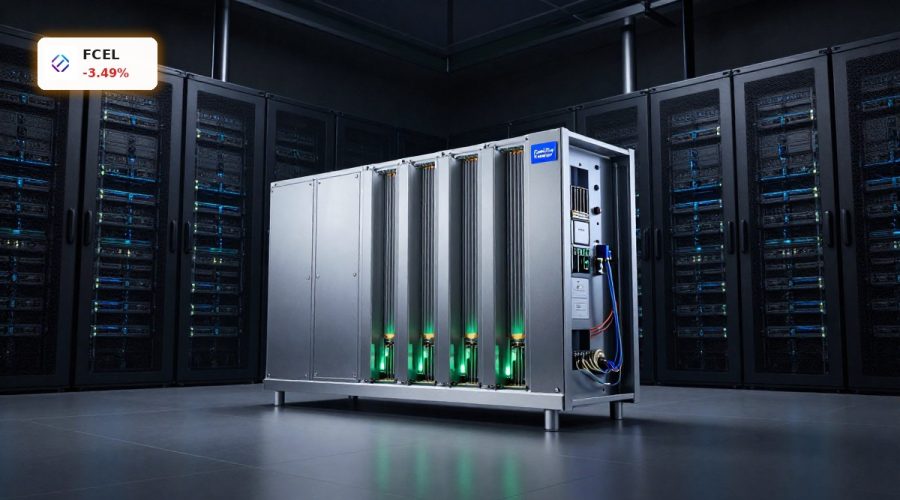
FuelCell is pitching its carbonate fuel-cell systems as behind-the-meter, baseload power plants that can run on natural gas, biogas, or hydrogen, providing steady electricity with lower emissions and independence from stressed utility grids. The company highlights the native DC output of its new 1.25 megawatt modular block, which can reduce AC-to-DC conversion losses for next-generation, high-density server racks. Management also points to integrated absorption chilling as a structural edge, claiming improved data-center Power Usage Effectiveness (PUE) and up to $127 million in incremental value over 20 years for a 100 megawatt facility.
To accelerate adoption, FuelCell has teamed up with Sustainable Development Capital Limited (SDCL) to identify up to 450 megawatts of opportunities globally, pairing FuelCell’s technology and long-term service contracts with SDCL’s project capital and infrastructure asset-management expertise. This puts the company in the same broad conversation as data-center-adjacent players like NVIDIA and Apple on the demand side, and power-solution competitors such as Bloom Energy and Enphase Energy on the supply side, though FuelCell’s market cap and scale are far smaller.
What do the balance sheet and backlog say?
Despite the ongoing losses, FuelCell ended the quarter with a solid liquidity position of $379.6 million in cash, restricted cash, and cash equivalents. The company raised $54.9 million during the quarter by issuing shares at an average price of $8.82, and another $2.5 million after quarter-end via 3.0 million shares at $7.67. It also secured $25 million in debt financing from the U.S. Export-Import Bank to support international utility-scale projects.
Backlog stood at $1.17 billion, down about 10.8% from the prior period, as recognized revenue outpaced new awards. Management stresses that backlog consists of fully contracted and committed orders, while the much larger pipeline of data-center proposals will only enter backlog once contracts are signed. The company continues to operate 58.8 megawatts of fuel-cell capacity in South Korea under long-term agreements and is expanding its Torrington, Connecticut manufacturing facility from 100 to 350 megawatts of annualized capacity, with planned 2026 capex of $20 million to $30 million.
Carbon capture remains a second, distinct growth pillar. Two carbonate fuel-cell modules are scheduled to ship in April to Rotterdam for an Esso Netherlands B.V. project that will showcase direct carbon capture from external point sources alongside power, hydrogen, and heat generation. That positions FuelCell in an emerging niche where industrial emitters, oil majors, and heavy industry search for practical decarbonization tools.
How is Wall Street viewing FuelCell Energy now?
Despite the upside surprise in FuelCell Energy Earnings per share, the stock remains a speculative name on the NASDAQ, and analysts still see a long road to profitability. Many expect FuelCell won’t turn a profit until around 2030, and the current Altman Z-Score indicates elevated bankruptcy risk typical of early-stage clean-tech firms. Research shops such as Zacks Investment Research continue to frame FCEL as a high-risk, high-volatility stock with a “Hold”-type stance, while several Wall Street analysts cited by Benzinga recently trimmed or cautiously maintained price targets ahead of the report rather than upgrading outright.
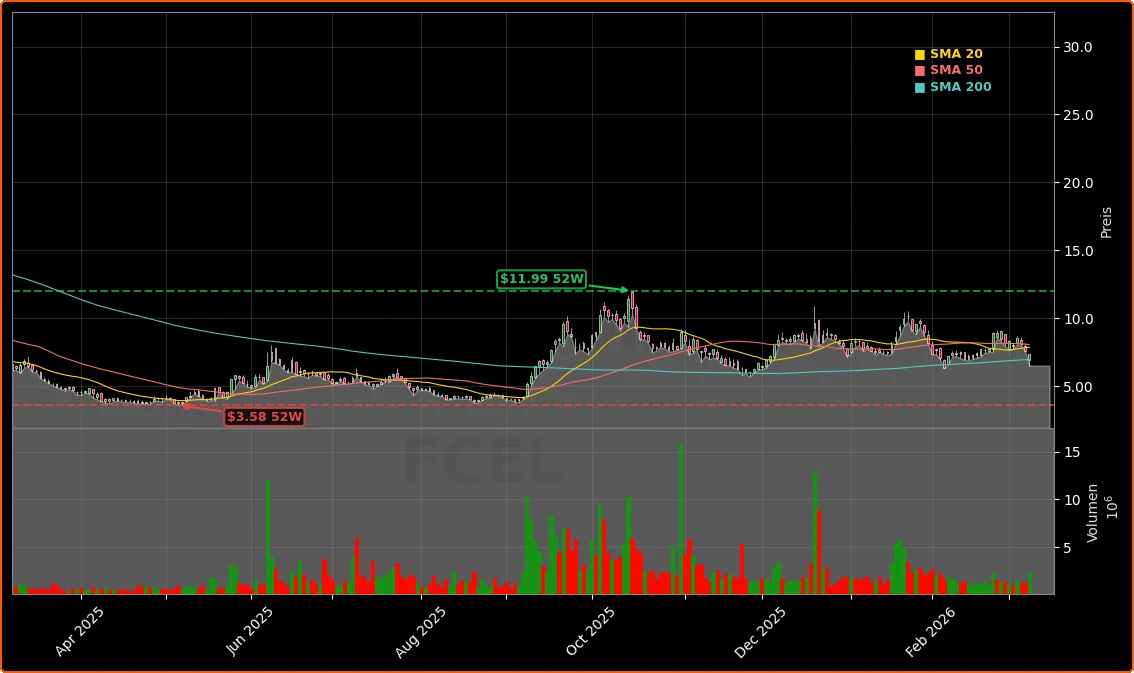
At $7.33, FCEL trades below its previous close of $7.80 as investors digest the revenue miss and shrinking backlog alongside the promising AI data-center narrative. For U.S. portfolios already exposed to data-center beneficiaries like Tesla or Apple, FuelCell offers an upstream, infrastructure-style bet on the same AI megatrend—but with far higher execution risk and dilution potential.
We delivered strong revenue growth, sharpened operating discipline, and strengthened our liquidity position — all while positioning FuelCell Energy to capture the defining opportunity of the AI era.
— Jason Few, President and CEO of FuelCell Energy
Conclusion
Looking ahead, the next few quarters will test whether the robust pipeline of AI data-center proposals can convert into contracted backlog without further eroding margins or balance-sheet strength. For now, FuelCell Energy Earnings highlight a company tightening its operations, leaning hard into one of the most power-hungry trends in tech, and asking Wall Street for patience as it tries to scale from niche fuel-cell supplier to critical data-center power partner.
Further Reading
- FuelCell Energy (FCEL) Q1 2026 Earnings Call Transcript (Seeking Alpha)
- Why FuelCell Energy Stock Just Dropped (The Motley Fool)
- FuelCell Energy (FCEL) Reports Q1 Loss, Misses Revenue Estimates (Zacks Investment Research)
- FuelCell Energy, Inc. (FCEL) Quote & Profile (Yahoo Finance)