
Is General Electric Aerospace’s latest drop a real warning sign or just another sentiment-driven shakeout in a hot stock?

Is General Electric Aerospace selloff about sentiment?
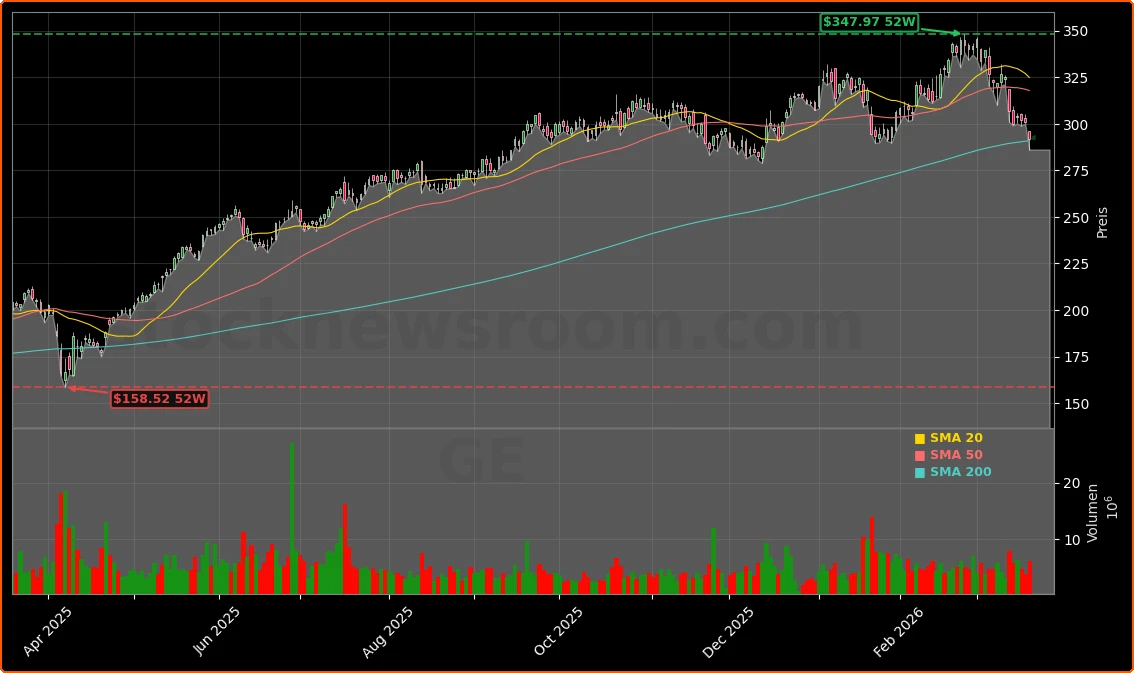
General Electric Company has been a standout in the S&P 500 over the past 12 months, with the stock still up roughly 50% year over year even after this month’s pullback. The latest drop comes on the heels of a powerful fourth‑quarter report, where revenue climbed about 18.9% and EPS surged 32%, underscoring strong commercial aviation demand and a robust defense backlog. Yet the stock sold off more than 3% from the Jan. 22 open to close as investors used the good news to lock in gains after a roughly 57% run in the prior year.
Trading on March 19 again highlighted the disconnect between fundamentals and sentiment. Intraday, the stock slid more than 4%, with technical signals flashing short‑term bearish and momentum indicators sinking into oversold territory. Short‑term traders are increasingly focused on the fact that the shares trade below key short‑ and medium‑term moving averages, raising the risk of further selling if institutional investors rebalance away from high‑beta industrial winners.
How do oil prices hit GE customers?
The latest leg down in General Electric Aerospace is closely tied to the sharp rise in oil prices in early 2026. Airline customers face higher jet fuel bills, which could squeeze margins and potentially lead to deferred engine overhauls or slower orders for new aircraft. That scenario would flow directly into GE’s commercial engine and services revenue, where utilization and shop visits are critical profit drivers.
For now, there is no clear evidence of a hard stop in demand, but the risk is enough to shift the narrative from unbridled growth to a more cyclical debate. Large carriers have historically responded to fuel spikes by aggressively cutting costs, renegotiating maintenance schedules and deferring some capex. If this playbook returns in 2026, General Electric Aerospace may see growth moderate from its recent double‑digit pace, even if long‑term air travel and fleet renewal trends remain supportive.
What new policy and supply risks matter for GE?
Beyond fuel, investors are also reacting to fresh U.S. policy moves aimed at reducing dependence on Chinese rare‑earth suppliers. New rules requiring critical materials to be sourced from non‑Chinese providers starting in 2027 could push up input costs for GE’s jet engines and related components. While the company has several years to adjust its supply chain, the prospect of structurally higher material costs raises questions about future margin expansion targets.
Short‑term, traders see this as another headwind layered onto a stock that had already priced in a clean transformation into a focused aerospace champion. Longer term, however, diversifying away from single‑country dependencies may actually strengthen General Electric Aerospace’s resilience, even if it requires upfront investment in qualifying new suppliers and potentially absorbing near‑term cost inflation.
How do defense and ETFs support the story?
One counterweight to these worries is the powerful defense and space backdrop. Rising U.S. and international defense budgets are fueling steady demand for advanced avionics, engines and military systems, where GE competes alongside L3Harris, RTX and Lockheed Martin. Recent commentary on L3Harris highlighted how expanding missile and space programs, along with global defense demand, are supporting multi‑year growth across the aerospace and defense complex, with GE cited among highly rated peers benefiting from the same trend.
Institutional flows also remain a key factor. The iShares U.S. Aerospace & Defense ETF (ITA) holds General Electric Aerospace as one of its top positions, alongside RTX and Boeing, with the top three names representing about 44% of the fund. GE’s roughly 50% gain over the past year has made it an outsized performance driver in this benchmark ETF, which means any profit‑taking or risk‑off move in the sector can amplify selling pressure in the stock even if company‑specific fundamentals stay strong.
How does GE stack up versus other U.S. industrials?
In the broader industrials universe, peers such as Caterpillar and Honeywell have been able to lean on automation, energy infrastructure and, increasingly, AI‑linked projects to offset cyclical concerns. While GE no longer has its legacy power and healthcare units — GE HealthCare now trades separately — its concentrated bet on aerospace gives it a cleaner, but also more volatile, exposure to global travel and defense cycles. By comparison, diversified mega‑caps like Berkshire Hathaway provide a more balanced mix of financials, energy and industrial exposure, but lack the direct upside to aircraft engine replacement cycles.
For tech‑heavy portfolios loaded with NVIDIA, Apple or Tesla, General Electric Aerospace can still act as a differentiated play on global mobility and government defense spending. However, after such a strong run, the stock’s behavior this quarter suggests it is transitioning from an under‑owned recovery name to a crowded consensus long, where positioning and macro headlines can dominate day‑to‑day price action.
Related coverage
Investors watching industrial cyclicals and AI‑linked infrastructure should also look at how heavy‑equipment giant Caterpillar is being re‑rated by the market. Our in‑depth piece, “Caterpillar AI Infrastructure Boom: Record Backlog and Growth Shock”, explores whether the company is quietly morphing into an AI infrastructure powerhouse while still being valued like a traditional cyclical. For GE shareholders, that analysis offers a useful comparison of how Wall Street is treating different industrial growth stories tied to long‑duration capital spending.
General Electric Aerospace now sits at an interesting crossroads: earnings momentum, defense exposure and ETF support argue for staying power, while oil prices, policy‑driven cost risks and stretched positioning argue for caution. For U.S. investors, the stock remains a high‑quality core aerospace holding, but likely with a bumpier ride than over the past year. The next few quarters of airline behavior, supply‑chain updates and macro data will show whether General Electric Aerospace can convert recent turbulence into another leg of sustainable growth.