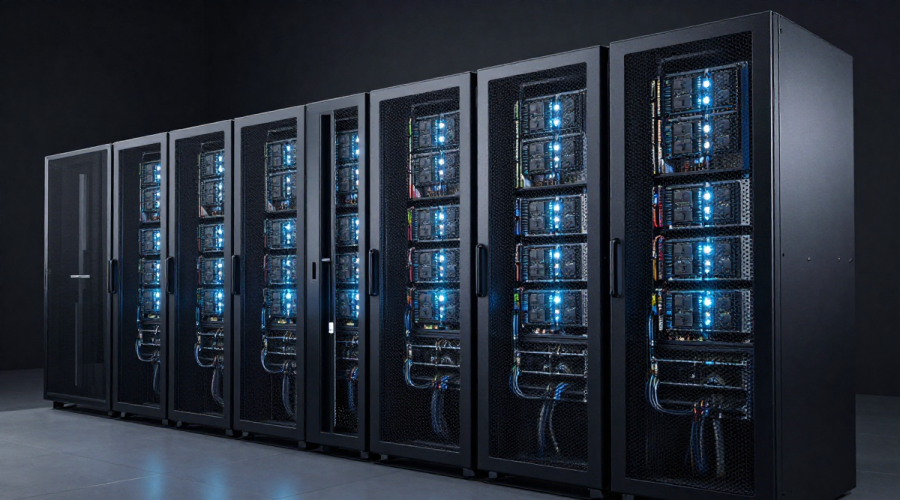
Is the Global AI Infrastructure boom a sustainable super‑cycle or the prelude to a painful correction for tech investors?
How big is the Global AI Infrastructure wave?
After three years of outsized gains, the Nasdaq‑100 has stalled in 2026 as investors question how far the current Global AI Infrastructure capex cycle can run. Yet underneath the index-level hesitation, spending is accelerating. Microsoft, Amazon, Google and Meta are expected to deploy roughly $650 billion collectively to build out AI data centers, networks and software over the next years. OpenAI has outlined an even more aggressive long‑term ambition, with plans implying up to $1.4 trillion in potential investment, underscoring how central AI capacity has become to Big Tech strategy.
Consultancies such as McKinsey see AI infrastructure demand extending at least through 2030, with PricewaterhouseCoopers estimating a $15.7 trillion global addressable market for AI by that date. That backdrop explains why Nvidia, Broadcom and Marvell remain at the center of the trade: hyperscalers increasingly view the risk of underspending on AI as greater than the risk of building too much capacity too soon.
Nvidia, TSMC and Marvell: who captures the silicon upside?
On the chip side, the boom is already visible in reported numbers. Taiwan Semiconductor Manufacturing Company lifted revenue by about 30% in the first two months of 2026, driven largely by orders for AI accelerators and advanced logic used in training and inference clusters. Marvell Technology recently guided for $2.4 billion in current-quarter sales, above Wall Street expectations, on surging demand for custom data center silicon. Its upbeat outlook sent the stock sharply higher after hours.
Memory has become another critical bottleneck for Global AI Infrastructure. Micron has sold out its High Bandwidth Memory (HBM) supply for 2026 and projects the HBM market could reach $100 billion by 2028, growing at roughly 40% annually. Citigroup has highlighted HBM as a structural profit driver for leading memory suppliers. In parallel, Samsung Electronics and SK Hynix shares have rebounded after a valuation reset, supported by optimism that AI-related DRAM and NAND demand will stay robust even if PC and smartphone markets remain cyclical.
Equity performance is reflecting this divergence. The Philadelphia Semiconductor Index (SOX) recently bounced more than 4% in a single session as investors rotated back into AI-levered names, while the S&P North American Technology Software Index has slipped into bear-market territory amid fears that generative AI could cannibalize traditional software licenses.
Why data center builders like Oracle and Quanta matter
Beyond chipmakers, the build‑out of Global AI Infrastructure is driving a parallel boom in data center construction, power systems and grid services. TSMC’s growth is one sign; another is Quanta Services, which reported a record $44 billion backlog tied to power grid modernization and AI‑driven data center projects. For infrastructure contractors, AI clusters are increasingly intertwined with utility-scale energy storage and high‑voltage transmission upgrades.
Oracle sits at a crucial junction. The company’s Oracle Cloud Infrastructure (OCI) business is viewed as a proxy for AI‑driven cloud demand, with investors closely watching whether quarterly growth can remain in the high double digits. Strong OCI bookings would reinforce the thesis that second‑tier cloud platforms can secure meaningful share of AI workloads alongside Amazon Web Services, Microsoft Azure and Google Cloud.
In Asia-Pacific, hyperscale specialist AirTrunk secured a ¥191.6 billion (about $1.24 billion) green loan to expand its TOK1 campus near Tokyo beyond 300 megawatts of capacity, part of a Japan portfolio now exceeding $8 billion in total investment. Once its four Japanese sites are fully built, AirTrunk expects roughly 530 MW of combined capacity, making it one of the country’s largest AI and cloud data center operators.
Anthropic vs. Pentagon: a new risk for AI leaders?
The breakneck pace of Global AI Infrastructure spending is colliding with politics and ethics, with Anthropic emerging as a test case. The AI lab has filed suit against the U.S. Department of Defense after being labeled a supply‑chain risk, a designation that effectively blocks it from government contracts unless it relaxes certain safety guardrails on its models. Anthropic argues that it does not want its technology repurposed for mass surveillance or autonomous weapons – a stance that may play well with some enterprise customers but complicates its capital needs and any eventual IPO.
The dispute comes even as Anthropic’s own growth metrics underscore the sector’s revenue potential. The company is reportedly on track toward an annualized revenue run‑rate approaching $20 billion, easing some concerns that AI model companies cannot monetize fast enough to justify infrastructure-heavy business models. Microsoft has deepened its partnership with Anthropic, integrating Claude-based agents into its 365 Copilot suite, where daily active users have reportedly increased tenfold year over year. That agent-centric approach underpins Wall Street’s view that leading AI platforms could become quasi-utility layers of the digital economy.
Will productivity gains offset disruption?
Macroeconomically, AI advocates frame the Global AI Infrastructure surge as a once‑in‑a‑generation productivity shock. Estimates for Europe alone point to roughly EUR 1.2 trillion in incremental productivity gains over time. At a global level, the International Monetary Fund expects AI to affect about 40% of jobs worldwide, and up to 60% in advanced economies, with roughly 7% of roles at risk of displacement but many more likely to be augmented.
China is leaning into this narrative, positioning AI as a “sunrise industry” capable of offsetting an aging population and slower baseline growth. Policymakers there are prioritizing rapid adoption – from industrial robotics to AI agents like Tencent’s WorkBuddy – over pre‑emptive restrictions on automation, while universities rework curricula to emphasize skills that are harder to replace, such as cross‑disciplinary problem‑solving and creativity.
For U.S. investors, the key portfolio debate is whether current AI capex resembles the early, messy years of the internet build‑out in the mid‑1990s or something more speculative. Strategists at major banks draw parallels with 1996‑97 rather than 1929, arguing that while some capital will inevitably be misallocated, the long‑term earnings power of AI‑exposed hardware, cloud and cybersecurity leaders remains compelling.
The highest risk in AI right now is the gap between unprecedented infrastructure spending and the question of whether revenues will ultimately catch up.
— Senior equity strategist at a major Wall Street bank
Conclusion
With a multi‑year earnings growth premium still forecast for the technology sector within the S&P 500, the durability of the Global AI Infrastructure cycle will likely determine whether recent volatility proves to be a pause – or a peak – in the AI trade. For long‑term investors willing to stomach swings, the next phases of spending from hyperscalers, governments and industrial adopters could define the dominant winners of the coming decade.
Further Reading
- AI could add $15.7 trillion to the global economy by 2030 (PwC)
- TSMC reports 30% revenue jump on AI chip demand (Reuters)
- AirTrunk secures $1.24 billion green loan for Japan data center expansion (Bloomberg)
- Globaler KI-Investitionszyklus bei Yahoo Finance (Yahoo Finance)