Is gold’s stunning surge above the latest Gold Price Record a durable new regime or a trap before the next correction?
Why is gold holding above $5,000?
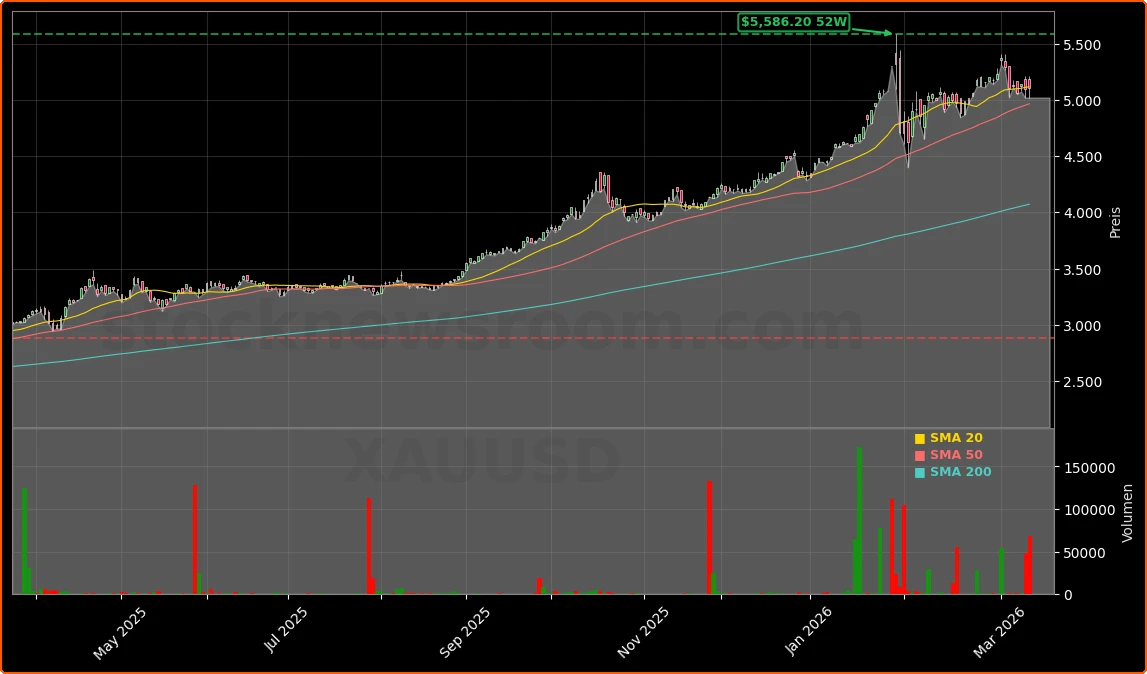
Gold’s climb to a fresh Gold Price Record in late January, when it first vaulted above $5,000 per ounce, was fueled by a rare mix of macro and geopolitical drivers. Escalating tensions in the Middle East, including U.S.-Israeli strikes on Iranian targets that threatened oil flows through the Strait of Hormuz, pushed global investors toward traditional safe havens. At the same time, expectations for slower Federal Reserve rate cuts and sticky inflation kept real yields subdued, supporting the case for holding non‑yielding assets like gold.
Today’s price near $5,112.80 represents a modest pullback of about 0.9% from the previous close at $5,098.00, but the broader uptrend remains intact. Gold broke $4,000 for the first time in October 2025 and then rallied past $5,000 on January 26, 2026, marking its largest annual advance since the late 1970s. Despite recent volatility, XAUUSD is still trading close to its all‑time high zone just below $5,400 reached last week, confirming the recent Gold Price Record as more than a brief spike.
How are J.P. Morgan and Wells Fargo positioned?
Wall Street banks are responding to the Gold Price Record with increasingly aggressive forecasts. J.P. Morgan now expects gold to reach roughly $6,300 by year‑end 2026, arguing that the metal offers a powerful portfolio hedge in an environment of geopolitical stress and elevated global debt. The bank also highlights a structural shift: foreign central banks are steadily accumulating bullion and could purchase another 800 metric tons this year alone, providing a persistent demand floor.
Wells Fargo has raised its price target into a similar $6,100 to $6,300 range for 2026, signaling that large U.S. institutions see further upside even after the dramatic move from $2,000 to above $5,000 in just over three years. Goldman Sachs has gone on record as a conviction buyer, lifting its gold forecast to $5,400 with clear upside risk if private‑sector diversification into hard assets accelerates. For U.S. investors who typically focus on equities like NVIDIA, Tesla and Apple, the message from these banks is unambiguous: gold is no longer a fringe hedge, but a mainstream asset class that can materially influence portfolio performance.
Could higher rates trigger a sharp correction?
The bullish narrative is not without caveats. Gold’s last major stumble, in 2022, came when the Federal Reserve launched an aggressive rate‑hiking cycle. Back then, XAUUSD dropped from around $2,000 to near $1,600 by autumn, a drawdown of almost 30%, as rapidly rising yields boosted the opportunity cost of holding gold. Some strategists warn that a similar pattern could unfold if sticky inflation forces the Fed to keep rates higher for longer or even resume hikes.
Another risk factor is the role of gold and silver as liquidity sources during equity market stress. When stocks sell off sharply, investors often lock in gains on winning positions in precious metals to raise cash. With gold and silver both up dramatically over the past year, that dynamic could amplify downside moves. Several analysts therefore see scope for an initial 10–15% correction from current levels, particularly if volatility spikes across the S&P 500 and NASDAQ.
What does the Gold Price Record mean for U.S. portfolios?
For American retail and institutional investors, the Gold Price Record forces a re‑think of asset allocation. Traditional 60/40 stock‑bond portfolios struggled through the last inflation shock, while gold quietly reasserted its role as a diversifier. Many portfolio strategists now recommend a 2%–10% allocation to gold and related assets, depending on risk tolerance and time horizon.
There are multiple ways to gain exposure. Physical gold—bars, coins or high‑purity jewelry—offers direct ownership but involves storage and insurance costs. Gold ETFs such as SPDR Gold Shares (GLD) hold physical bullion in vaults and track the spot price minus management fees, making them a popular option on U.S. exchanges. Futures contracts allow leveraged exposure but come with margin calls, expiration dates and roll costs. Gold mining stocks and diversified miners add operational leverage to the metal’s price but also bring company‑specific risks like cost overruns, political exposure and balance‑sheet stress.
Recent moves in gold‑linked equities underscore that leverage. Research from Zacks Investment Research shows that Gold.com Inc. (GOLD) has rallied strongly year‑to‑date, benefiting from higher realized prices and robust demand for precious metals. Other coverage from 24/7 Wall Street highlights a basket of leading gold miners and ETFs as potential beneficiaries of the new pricing regime. However, as recent volatility in major miners demonstrates, these equities can sell off sharply even when bullion holds up, especially if investors rotate back into growth sectors or mega‑cap tech names such as NVIDIA and Apple.
The break above $5,000 is less a blow‑off top and more a repricing of what strategic insurance is worth in a world of persistent geopolitical risk.
— Senior commodities strategist at a major Wall Street bank
Conclusion
For now, the Gold Price Record above $5,000 signals that the metal has firmly re‑entered the core conversation on Wall Street. The combination of central bank buying, geopolitical uncertainty and constrained supply is pushing banks like J.P. Morgan, Wells Fargo and Goldman Sachs to pencil in targets well north of today’s levels. For investors, that means gold and gold‑related assets deserve a deliberate spot on the watchlist, with position sizes calibrated to both the upside potential and the very real risk of a sharp, rate‑driven correction.
Further Reading
- Gold (XAUUSD) on Yahoo Finance (Yahoo Finance)
- With Iran Sending Gold Over $5,000, the Best Gold Stocks and ETFs to Buy Now (24/7 Wall Street)
- Bull of the Day: Gold.com Inc. (GOLD) (Zacks Investment Research)