Can the current gold record rally above $5,000 continue despite tariffs, exploding debt, and Fed signals?
Gold Record Rally: How Strong is the Current Increase?
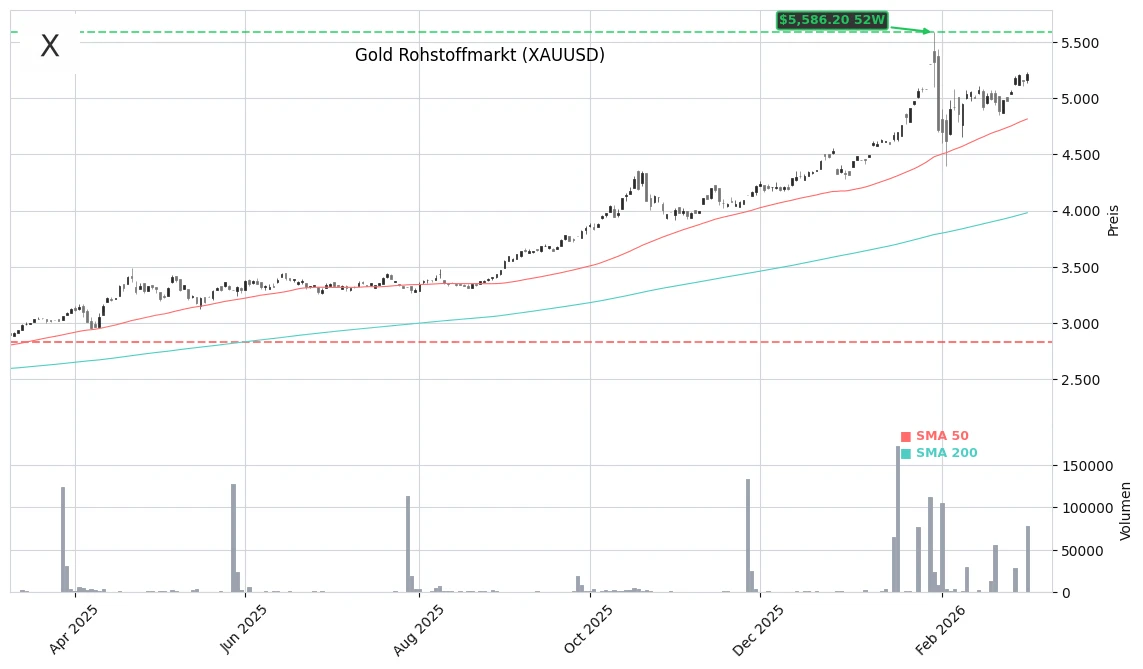
On the spot market, Gold (XAUUSD) rose by about 0.76% to $5,215.70 per ounce during Wednesday’s session, after already reaching levels around $5,190 in the morning. This allows the precious metal to recover part of the losses it incurred during a historic two-day sell-off at the turn of the month, when the price fell from a peak near $5,600 to around $4,400. In recent days, the price has stabilized clearly above $5,000, confirming the overarching upward trend that marked a significant gold record rally with an increase of about 64% in 2025 and an additional approximately 18% since the beginning of 2026.
Technically, the bulls remain in control: The price is comfortably above the moving averages of the last ten ($5,036) and twenty trading days ($5,021). Intraday, buyers found support on Tuesday at $5,140 to $5,150, which corresponds roughly to the 61.8% Fibonacci retracement of the recent upward movement. A daily close above $5,170 would technically clear the way towards the short-term resistance area around $5,250.
What Role do Tariffs and the Iran Conflict Play?
On the fundamental side, the gold record rally is currently fueled by several simultaneously active crisis points. In the U.S., a broad-based import tariff of 10% has come into effect after a previously introduced reciprocal tariff regime was halted by the Supreme Court. President Donald Trump has already threatened to raise it to 15%, but concrete decisions are still pending. The uncertainty surrounding future trade policy and potential additional tariffs on strategic goods such as batteries or industrial chemicals is fueling recession and inflation fears—typical drivers for movements towards gold.
At the same time, the conflict between the U.S. and Iran remains a central factor influencing the gold commodity market. A U.S. military buildup ahead of the next round of nuclear talks heightens concerns about escalation in the Middle East. Market participants are pricing this risk in the form of higher security premiums, benefiting not only gold but also other precious metals: Silver briefly climbed above $91 per ounce, platinum surged by 8% to $2,285, while palladium also gained.
Debt, Debasement Trade, and the Fed – What Drives XAUUSD?
A structural driver of the gold record rally is the so-called debasement trade. Given a U.S. budget deficit of around $1.8T in fiscal year 2025 and a national debt of about $38T, investors fear a gradual devaluation of the U.S. dollar. Commodity strategists point out that potential refunds of already paid tariffs could further burden the deficit, thereby putting pressure on the dollar and U.S. Treasury bonds. In this environment, investors are increasingly reallocating capital from bonds and currencies into tangible assets like gold.
Prominent investors like Ray Dalio and Paul Tudor Jones recommend holding gold with an allocation of up to 15% in portfolios to hedge against the combination of high national debt, increasing money supply, and political uncertainty. Institutional investors remain engaged through futures exchanges and ETFs like SPDR Gold Shares, even if there are short-term outflows—about 4.5 tons in a single trading day—that can be viewed as profit-taking in the context of the ongoing gold record rally.
Do Stable Interest Rates Hinder Further Increases?
Headwinds are coming from the U.S. Federal Reserve. Boston Fed President Susan Collins recently emphasized that interest rates are likely to remain unchanged for the time being due to robust labor market data. The futures market is pricing in over a 90% probability that the key interest rate will remain in the range of 3.50% to 3.75% in March. Since gold does not yield any ongoing returns, stable or even rising interest rates tend to diminish its attractiveness compared to bonds.
J.P. Morgan remains clearly optimistic and has recently raised its forecast for 2026 to a range of $6,000 to $6,300 per ounce. Other major firms like Goldman Sachs, Citigroup, and RBC Capital Markets also emphasize the importance of gold as a hedge in the current environment of high debt, geopolitical tensions, and moderate dollar weakness. For investors, this means: As long as the $5,000 mark is technically defended, the upward trend remains intact, even if interim setbacks within the overarching gold record rally must be accounted for at any time.
We remain firmly optimistic for gold in 2026 and have recently raised our outlook to a range of $6,000 to $6,300 per ounce.
— J.P. Morgan Research
Bottom Line
The current gold record rally is fueled by a rare interplay of tariffs, debt fears, and geopolitical uncertainty, keeping the gold price stable above $5,000. For investors, gold remains a central tool for hedging against currency and market risks in the already nervous environment of capital markets. Those looking to enter should view pullbacks towards support zones as opportunities within the ongoing upward trend of the gold commodity market, rather than calling an end to the record rally.
Related Sources
- J.P. Morgan Raises Gold Outlook for 2026 to $6,000 to $6,300 (J.P. Morgan)
- Gold Price Development and Dollar Weakness in Focus (Bloomberg)
- U.S. Fiscal Deficit and National Debt Reach New Records (U.S. Treasury)
- Gold Commodity Market at Yahoo Finance (Yahoo Finance)